
Data is everywhere—but turning that data into reliable, usable insights requires more than collecting it. Modern businesses need professionals who can build pipelines, manage cloud storage, transform raw information, and ensure data reaches the right people at the right time.
That is where AWS data engineering comes in.
As organizations increasingly move their data infrastructure to the cloud, understanding AWS data engineering can help aspiring and experienced professionals build practical skills for designing scalable data solutions. But what exactly does a modern data engineer need to know, and which AWS tools belong in their toolkit?
Let’s explore.
What Is AWS Data Engineering?
AWS data engineering is the practice of collecting, transforming, storing, managing, securing, and delivering data using Amazon Web Services.
An AWS data engineer typically works with data pipelines, storage systems, databases, data lakes, analytics platforms, and cloud-based processing services.
The goal is simple: make data reliable, accessible, secure, and ready for analysis or business applications.
A typical data engineering workflow may look like this:
Data Sources → Data Ingestion → Storage → Transformation → Processing → Analytics → Insights
AWS provides services that can support different stages of this workflow, allowing organizations to build cloud-based data platforms that can scale as their data requirements grow.
Why Is AWS Data Engineering Important?
Modern organizations generate data from applications, websites, customer interactions, IoT devices, transactions, and business systems. Managing this information efficiently requires more than traditional databases.
Cloud-based data engineering provides several advantages:
- Scalability: Infrastructure can expand as data volumes increase.
- Flexibility: Teams can select services based on specific workloads.
- Automation: Many data workflows can be automated and orchestrated.
- Security: Access controls and encryption can help protect sensitive information.
- Cost efficiency: Cloud resources can be optimized based on usage.
- Faster analytics: Well-designed pipelines make data available for analysis more efficiently.
For professionals, learning these concepts can also create a stronger foundation for careers involving cloud computing, analytics, and data platforms.
The Essential AWS Data Engineer Toolkit
An AWS data engineer does not simply need to memorize AWS services. The real skill lies in understanding when, why, and how to use different services together.
Here are some important components of a modern AWS data engineering toolkit.
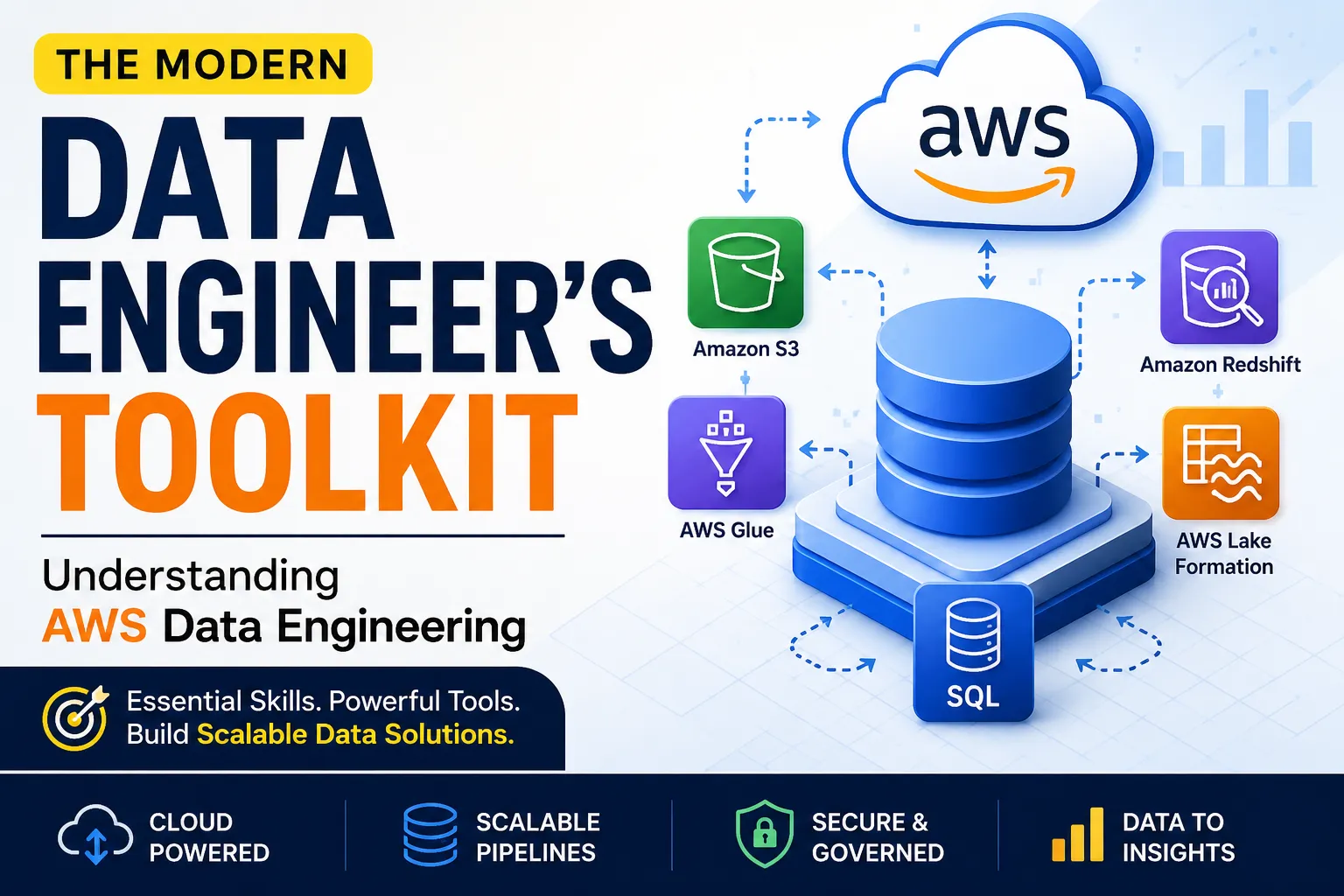
1. Amazon S3 for Data Storage
Amazon S3 is an important building block for many AWS data architectures.
Data engineers can use it to store large volumes of data in different formats, making it useful for data lakes and downstream analytics workloads.
A strong understanding of S3 should include concepts such as:
- Buckets and objects
- Storage classes
- Lifecycle management
- Versioning
- Replication
- Encryption
- Access policies
Understanding cloud storage fundamentals is therefore an important part of data engineering fundamentals.
2. AWS Glue for Data Integration and ETL
Data rarely arrives in a clean, analysis-ready format.
AWS Glue supports extract, transform, and load (ETL) workflows and can work with data stored in Amazon S3. AWS documentation also highlights its integration with the AWS Glue Data Catalog and other AWS analytics services.
For a data engineer, understanding ETL means knowing how to:
- Extract data from different sources.
- Transform it into a usable format.
- Validate and organize the data.
- Load it into an appropriate destination.
These processes form the backbone of many modern data pipelines.
3. AWS Glue Data Catalog for Metadata
Storing data is only part of the challenge. Teams also need to understand what the data represents, where it came from, and how it should be accessed.
The AWS Glue Data Catalog provides a centralized metadata repository that helps organizations discover and manage data across different systems.
For data engineers, metadata management becomes particularly important as data environments become larger and more complex.
4. Amazon Redshift for Data Warehousing
Data warehouses are designed to support analytical workloads and business intelligence.
Amazon Redshift provides SQL-based analytics capabilities for large datasets and can also query data stored in Amazon S3 through integrations such as Redshift Spectrum.
Learning data warehousing concepts helps engineers understand how structured data can be organized for reporting, analytics, and decision-making.
5. AWS Lake Formation for Data Governance
Building a data lake is not enough. Organizations also need to control who can access different datasets.
AWS Lake Formation helps organizations centrally govern and secure data lakes and provides fine-grained access controls for data stored in Amazon S3 and metadata managed through the AWS Glue Data Catalog.
This makes data governance an important part of the modern data engineer's responsibilities.
6. SQL for Data Engineering
Cloud services may provide the infrastructure, but SQL remains one of the most important technical skills for data professionals.
A modern data engineer should understand:
- SELECT statements
- Filtering and sorting
- Aggregations
- GROUP BY
- JOIN operations
- Subqueries
- Common table expressions
- Data validation
- Query optimization
Strong SQL knowledge makes it easier to work with databases, warehouses, analytics platforms, and data pipelines.
7. Data Pipelines and Orchestration
A data pipeline connects different stages of a data workflow.
For example:
Customer Application → Raw Data → S3 → Transformation → Data Warehouse → BI Dashboard
The data engineer's job is to ensure that information moves through this workflow reliably.
This includes understanding scheduling, dependencies, monitoring, error handling, retries, and automation.
Pipeline orchestration is therefore one of the most valuable skills to develop when preparing for an aws data engineer role.
What Skills Should an AWS Data Engineer Learn?
A strong AWS data engineering skill set combines cloud knowledge with traditional data engineering principles.
Key areas include:
- Data fundamentals: Data types, databases, data models, data quality, metadata, and data lifecycle.
- SQL: Querying, joins, aggregations, filtering, and optimization.
- Cloud storage: Amazon S3, storage classes, lifecycle policies, versioning, and security.
- ETL: Extracting, transforming, validating, and loading data.
- Data lakes and warehouses: Understanding how different architectures support different workloads.
- Security: IAM, encryption, access policies, and governance.
- Monitoring: Understanding how to identify failures, performance issues, and pipeline problems.
- Automation: Building repeatable and scalable workflows.
A structured data engineering course can help learners develop these concepts systematically instead of trying to learn individual cloud services in isolation.
How Do Data Engineering Fundamentals Help Your Career?
The most effective way to learn cloud data engineering is to first understand the underlying principles.
For example, knowing Amazon S3 is useful. But understanding why a data lake uses object storage, how data should be organized, how access should be controlled, and how downstream systems consume that data is far more valuable.
That is why data engineering fundamentals should come before attempting to master every AWS service.
A strong foundation can help you:
- Understand real-world data architectures.
- Build better data pipelines.
- Choose appropriate storage solutions.
- Work effectively with SQL and databases.
- Understand data quality and governance.
- Prepare for cloud data engineering roles.
- Progress toward advanced AWS data engineering skills.
How Can Beginners Start Learning AWS Data Engineering?
Beginners should avoid trying to learn dozens of AWS services simultaneously.
Instead, follow a progressive learning path:
Step 1: Learn Data Fundamentals
Start with data types, databases, data modeling, ETL, data quality, and data lifecycle concepts.
Step 2: Build SQL Skills
Practice queries, joins, aggregations, filtering, and working with multiple tables.
Step 3: Understand Cloud Storage
Learn how Amazon S3 works and explore concepts such as versioning, replication, lifecycle management, and encryption.
Step 4: Learn Data Pipelines
Understand how data moves from sources to storage, transformation systems, and analytics platforms.
Step 5: Explore AWS Data Services
Gradually learn services such as AWS Glue, Amazon Redshift, Amazon Athena, and AWS Lake Formation.
Step 6: Practice Real-World Scenarios
Theory becomes significantly more valuable when you can apply it to realistic data workflows.
Where Can You Learn AWS Data Engineering Foundations?
If you're looking for a structured starting point, the Data Engineering Foundations on AWS course from LearnKartS is designed to introduce learners to core AWS data engineering concepts.
Explore Data Engineering Foundations on AWS on Coursera
The course covers areas including data types, data modeling, SQL, ETL pipelines, AWS storage services, data quality, and data management. It is designed to help beginners and professionals build a foundation before progressing into more advanced cloud data engineering topics.
What Career Opportunities Can AWS Data Engineering Skills Support?
Developing AWS data engineering skills can support several technology career paths.
Depending on your experience and broader skill set, you may explore roles such as:
- Data Engineer
- Cloud Data Engineer
- Data Platform Engineer
- ETL Developer
- Cloud Engineer
- Data Analyst with strong engineering skills
- Analytics Engineer
The exact responsibilities vary by organization, but many of these roles require professionals who can work with data pipelines, cloud infrastructure, databases, and analytics systems.
The Future of the Data Engineer's Toolkit
The modern data engineer is no longer limited to traditional databases and ETL scripts.
Today's toolkit increasingly combines:
Cloud + SQL + Data Pipelines + Automation + Security + Governance + Analytics + AI
As organizations generate more data and adopt cloud-native architectures, professionals who understand how these components work together can become valuable contributors to data-driven teams.
The key is not to chase every new technology.
Instead, build strong fundamentals, understand the purpose of each tool, and learn how different services fit together into a complete data architecture.
Final Thoughts
AWS data engineering is about much more than learning a list of cloud services. It is about understanding how data moves, where it is stored, how it is transformed, how it is secured, and how organizations can turn it into something useful.
If you're starting your journey, focus first on data engineering fundamentals, strengthen your SQL and cloud knowledge, and then gradually expand into AWS-specific services and architectures.
Ready to build your AWS data engineering foundation? Explore the course, strengthen your cloud data skills, and take the next step toward becoming a modern data professional.


















Sign in to leave a comment.