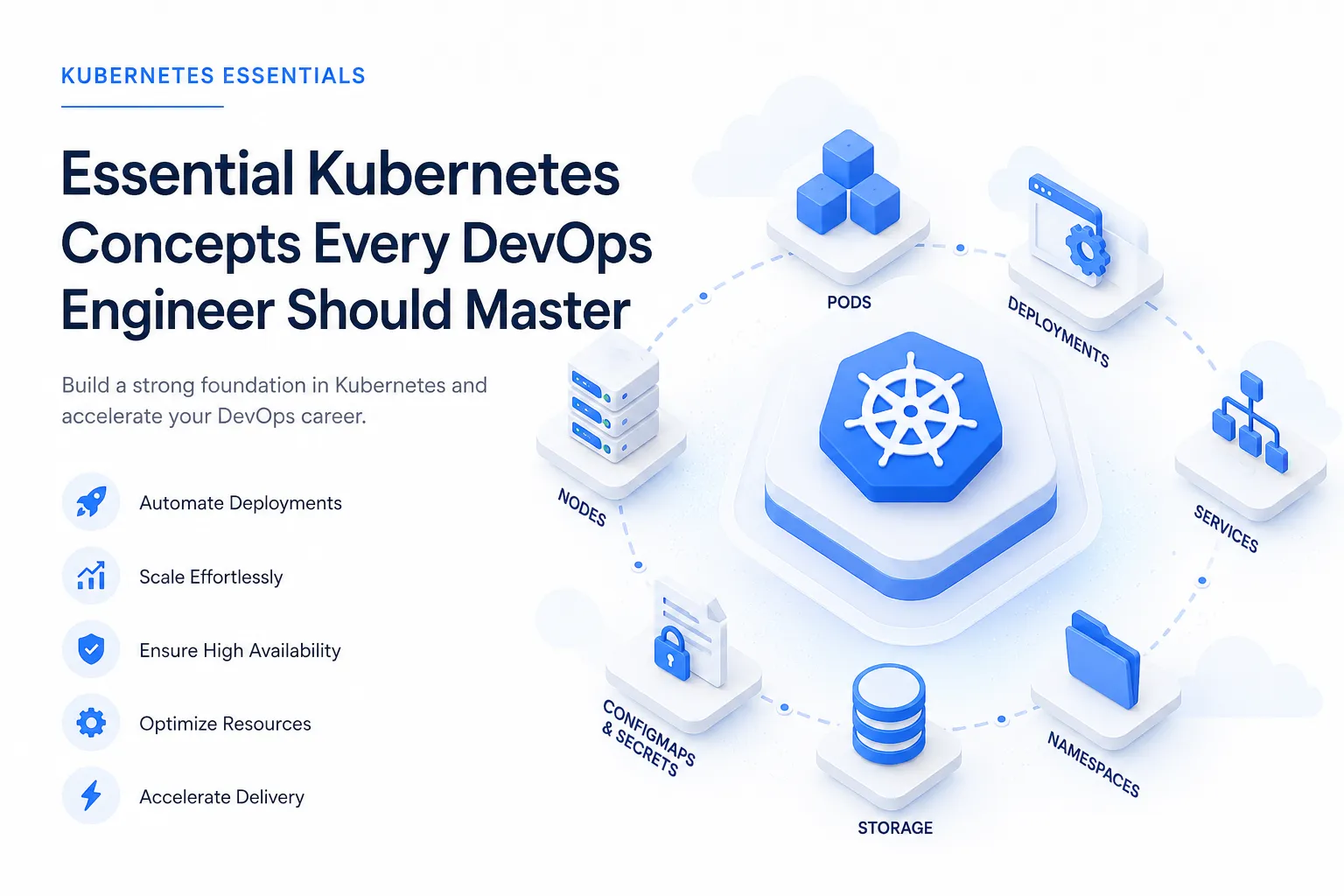

Kubernetes has become one of the defining technologies of modern software development. As organizations embrace cloud-native architectures, containerized applications, and continuous delivery, Kubernetes has evolved from a specialized tool into a core skill for DevOps professionals.
But here's the reality: many engineers rush into learning commands, YAML files, or advanced tools without first understanding how Kubernetes actually works. While this approach may help you complete a tutorial, it rarely prepares you to manage real-world production environments.
If you want to build a successful DevOps career, mastering the fundamentals is the smartest place to start. A strong understanding of Kubernetes Fundamentals enables you to troubleshoot issues with confidence, design reliable deployments, and adapt to new tools as the Kubernetes ecosystem continues to evolve.
Why Kubernetes Matters in Modern DevOps
Today's applications are expected to be available around the clock, scale instantly during peak traffic, and recover quickly from failures. Achieving this manually is both time-consuming and error-prone.
Kubernetes addresses these challenges by automating many of the operational tasks involved in running containerized applications. It helps teams deploy software consistently, manage infrastructure efficiently, and keep services running even when individual components fail.
This is why Kubernetes has become a standard technology across startups, enterprises, and cloud providers. For DevOps engineers, learning Kubernetes isn't just about adding another skill to a resume—it's about understanding the platform that powers modern application delivery.
Start with the Architecture, Not the Commands
A common mistake beginners make is focusing on commands before understanding the architecture.
Imagine learning to drive by memorizing dashboard buttons without understanding how the car works. The same principle applies to Kubernetes. When you understand the purpose of each component, troubleshooting becomes easier, deployments become more predictable, and new concepts are easier to grasp.
Clusters: The Foundation of Kubernetes
Everything in Kubernetes revolves around a cluster.
A cluster combines the resources needed to run applications efficiently. At its center is the control plane, which makes decisions about scheduling workloads, monitoring system health, and ensuring applications continue running as expected. Worker nodes provide the computing resources where applications actually execute.
Understanding this relationship helps explain many of Kubernetes' automated capabilities, from scheduling workloads to recovering from failures.
Pods: The Smallest Unit of Deployment
One of the first concepts every DevOps engineer should understand is the Pod.
Unlike traditional environments where applications run directly on servers, Kubernetes packages containers inside Pods. These Pods become the basic units that Kubernetes creates, manages, replaces, and scales.
Although Pods are designed to be temporary, Kubernetes continuously monitors them and automatically replaces unhealthy instances when necessary. This behavior forms the basis of Kubernetes' resilience.
Deployments: Making Application Updates Reliable
Deploying new application versions is rarely as simple as replacing old code with new code.
Production systems require updates that minimize downtime and allow quick recovery if something goes wrong. Kubernetes Deployments handle this process automatically by managing application replicas and rolling updates.
Instead of interrupting users during software releases, deployments can be introduced gradually, significantly reducing operational risk.
For organizations practicing continuous integration and continuous delivery (CI/CD), this capability is invaluable.
Services: Keeping Applications Connected
Modern applications often consist of multiple microservices communicating with one another.
Because Pods are constantly created and replaced, their network addresses are not permanent. Kubernetes solves this challenge through Services, which provide stable communication between different parts of an application.
This abstraction allows developers to focus on building software without worrying about constantly changing infrastructure details.
Namespaces: Organizing Growing Environments
As Kubernetes environments expand, organization becomes increasingly important.
Namespaces allow teams to separate resources for development, testing, and production while using the same cluster. They also make it easier for multiple teams to work independently without interfering with each other's workloads.
For large organizations, proper use of namespaces improves governance, simplifies resource management, and supports secure collaboration.
Configuration and Secrets: Separating Code from Configuration
Applications depend on configuration values such as database connections, environment settings, and API credentials.
Rather than embedding these values directly into application code, Kubernetes provides dedicated mechanisms for managing them separately. Sensitive information is protected, configuration changes become easier to manage, and deployments become more flexible across different environments.
This separation is considered a best practice in cloud-native application development.
Persistent Storage: Supporting Stateful Applications
Not every application is stateless.
Databases, messaging systems, and business-critical applications need data that survives container restarts. Kubernetes provides persistent storage capabilities that allow applications to retain important information even when workloads are moved or recreated.
Understanding storage concepts is essential before managing production workloads where data availability directly affects business operations.
Scaling and Self-Healing: The Features That Set Kubernetes Apart
Two of Kubernetes' greatest strengths are its ability to scale automatically and recover from failures without manual intervention.
When application demand increases, Kubernetes can add additional instances to handle the workload. When traffic decreases, it can reduce resources to improve efficiency.
At the same time, Kubernetes continuously monitors application health. If a workload fails or becomes unresponsive, it automatically replaces or restarts it, helping maintain service availability.
These capabilities reduce operational overhead while improving reliability—two key goals of every DevOps team.
Think Beyond the Technology
Learning Kubernetes is not just about understanding containers or deployment strategies. It's about developing the mindset required to build resilient, scalable, and automated systems.
The most effective DevOps engineers don't simply know how Kubernetes works—they understand why its design principles solve real operational problems. That deeper understanding allows them to make better architectural decisions, troubleshoot complex issues, and collaborate more effectively with development and operations teams.
As the cloud-native ecosystem continues to evolve, these foundational concepts remain relevant regardless of the tools built on top of Kubernetes.
Build a Strong Foundation Before Chasing Certifications
Many professionals begin learning Kubernetes with the goal of earning a kubernetes certification. While certifications can demonstrate knowledge and improve career prospects, they are most valuable when backed by genuine practical understanding.
A structured Kubernetes Fundamentals Course that combines conceptual learning with hands-on exercises can help bridge the gap between theory and real-world application. Instead of focusing solely on passing an exam, it prepares you to work confidently with Kubernetes in production environments.
Final Thoughts
Kubernetes has become the backbone of modern DevOps, enabling organizations to deploy applications faster, scale efficiently, and build resilient cloud-native systems.
Mastering the fundamentals is the key to unlocking everything that comes next. Once you understand how clusters, Pods, Deployments, Services, storage, and automation work together, advanced topics become much easier to learn and apply.
Whether you're just beginning your journey or strengthening your existing skills, investing time in Kubernetes Fundamentals will provide long-term value. The stronger your foundation, the easier it becomes to adapt to new technologies, solve real-world infrastructure challenges, and grow as a DevOps professional.






























Sign in to leave a comment.