
Every engineering leader has heard the same pitch by now. Add an AI coding assistant, watch your team ship faster. Some of that is true. Autocomplete-style tools genuinely save time on small, repetitive coding tasks.
But enterprise software engineering is rarely about small tasks. It is about legacy systems nobody fully understands anymore, integrations across a dozen internal tools, and release cycles that cannot afford to break production. That is a different problem than writing a function faster, and it needs a different kind of AI support.
This piece looks at where AI is genuinely changing enterprise software engineering in 2026, where the hype outpaces the results, and what to actually look for when you are choosing tools or a delivery partner.
From Code Assistants to Full Lifecycle Support
The first wave of AI development tools focused almost entirely on the coding step. Autocomplete, function suggestions, quick refactors. Useful, but narrow. A developer still had to write the tests by hand, review the pull request manually, and handle deployment the same way they always had.
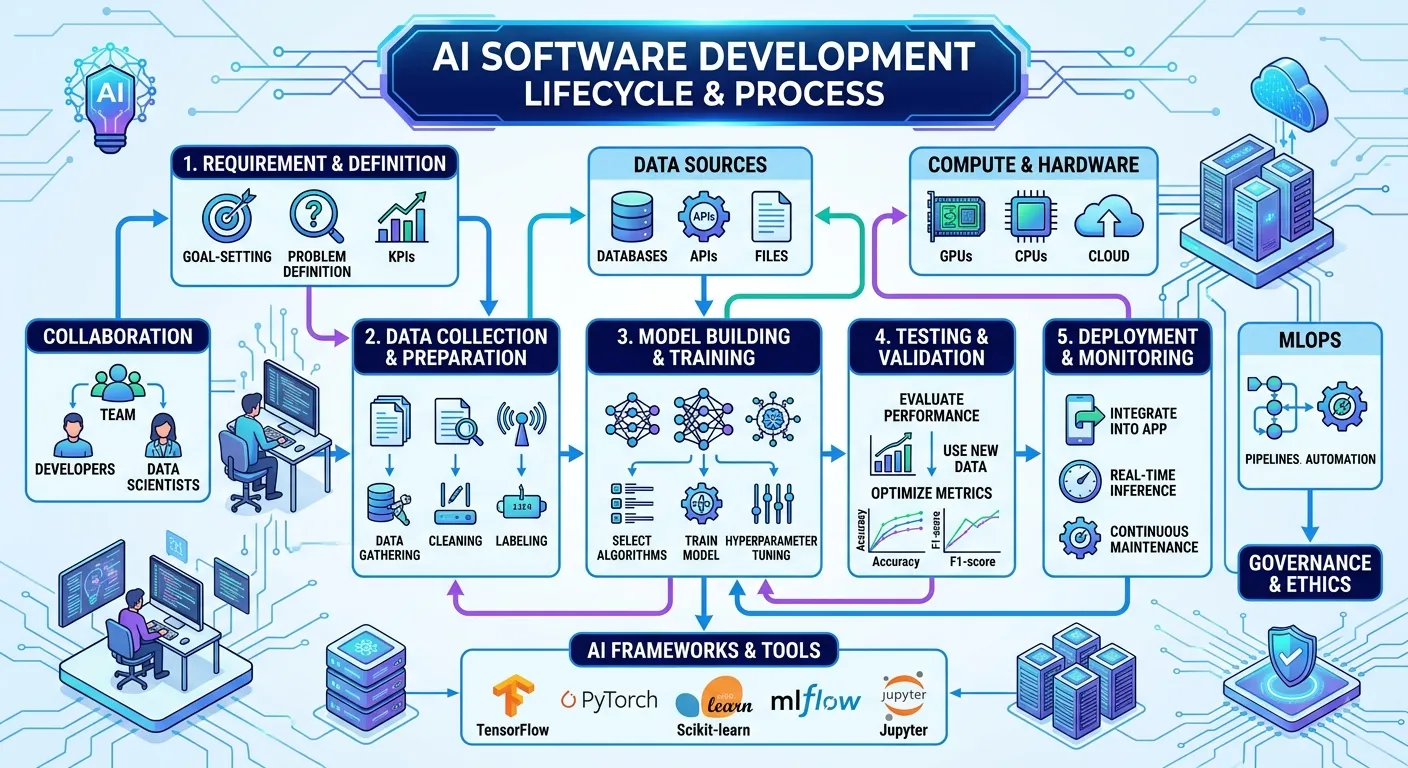
What is changing now is the scope. AI is moving across the full software development lifecycle, not just the coding step. That includes generating test cases and synthetic test data, flagging likely defect areas before code ships, automating code review against your own style guide rather than a generic one, and supporting infrastructure and deployment tasks through AI-assisted CI/CD checks.
This matters because the biggest time sinks in enterprise engineering rarely sit in the coding step itself. They sit in testing, review cycles, and the slow, careful work of modernizing old systems. A tool that only speeds up typing does not touch most of that time.
Where AI Actually Helps With Legacy Modernization
Legacy modernization is where a lot of enterprise engineering budget quietly disappears. Old codebases with little documentation, business logic buried in code nobody wants to touch, and a modernization project that keeps slipping because nobody can confidently say what will break.
AI is proving genuinely useful here, though not in the way most vendors advertise it. It rarely rewrites an entire legacy system on its own. What it does well is speed up the discovery phase, analyzing undocumented code to surface what it actually does, flagging patterns that are safe to refactor automatically, and generating a first-pass migration plan that a senior engineer can then sanity-check instead of building from scratch.
That shift, from doing the modernization work to accelerating the groundwork before it, is the realistic version of what AI-powered legacy modernization looks like today. Enterprises that expect AI to fully automate a re-platforming project usually end up disappointed. Enterprises that use it to compress the discovery and planning phase tend to see real time savings.
Choosing the Right Mix of Tools
There is no shortage of AI coding tools right now, and most engineering teams end up running two or three at once for different jobs. A general-purpose coding assistant for everyday development, a privacy-focused tool for regulated codebases that cannot leave a controlled environment, and something more specialized for legacy analysis or test generation.
A few things are worth checking before adding another tool to the stack:
Where your code actually goes. Some AI coding tools process code through third-party infrastructure by default. If you work in a regulated industry, ask directly whether the tool supports private or on-premise deployment, and whether your code is ever used to train a shared model.
Whether it understands your codebase, not just syntax. Tools that only suggest generic code based on public training data tend to produce suggestions that look right but do not match your architecture. Tools that index your actual codebase and documentation produce far more usable output.
How it fits your review process. AI-generated code still needs human review before it ships, especially in regulated environments. The tools worth adopting make that review faster, not something you skip. For a broader comparison of what is currently available, this rundown of AI development tools is worth a look before you shortlist anything.
Platform Engineering vs Point Solutions
The other decision enterprises face is whether to adopt a handful of point tools or invest in a more unified, AI-powered engineering approach that spans the whole delivery lifecycle.
Point tools are easy to try and low commitment. You install a plugin, see if it helps, and move on if it does not. That works fine for individual productivity gains. It works less well when the goal is consistency across a large engineering organization, since every team ends up with a different mix of tools and no shared governance over how AI-generated code gets reviewed or how prompts are managed.
A more integrated approach, sometimes described as AI-powered digital engineering, treats AI acceleration as something built into the delivery pipeline itself rather than a set of individual plugins. This tends to matter more for large organizations that need consistent standards across dozens of teams and multiple codebases, where point tools alone start to create more fragmentation than they solve.
For teams building or scaling a specific product rather than modernizing legacy infrastructure, the equivalent question is whether product engineering work benefits from the same kind of AI-assisted, end-to-end product engineering approach, where design, build, testing, and iteration are supported by AI at every stage rather than only at the coding step.
What Actually Moves the Needle in 2026
Strip away the marketing language, and a few patterns hold up consistently across enterprises that are getting real value from AI in software engineering:
- AI accelerates testing and review more reliably than it accelerates net-new architecture decisions
- Legacy modernization benefits most from AI in the discovery and planning phase, not full automation
- Tools that understand your actual codebase outperform generic, public-model suggestions
- Governance and human review remain non-negotiable, especially in regulated industries
- Consistency across teams matters more at scale than any single tool's individual feature set
None of this means AI-powered software engineering is overhyped. It means the value shows up in different places than most vendor pitches suggest, and the enterprises getting the most out of it are the ones evaluating tools against their actual bottlenecks instead of a generic feature checklist.
FAQs
What is AI-powered software engineering? AI-powered software engineering applies AI across the full development lifecycle, including code generation, automated testing, code review, defect prediction, and legacy modernization, rather than only speeding up the act of writing code.
Can AI fully automate legacy system modernization? Not reliably yet. AI is genuinely useful for analyzing undocumented legacy code and speeding up migration planning, but a senior engineer still needs to validate the plan before execution, especially for business-critical systems.
Is it safe to use AI coding tools with sensitive enterprise code? It depends on the tool. Some process code through third-party infrastructure by default. Enterprises handling sensitive or regulated code should confirm whether a tool supports private or on-premise deployment before adopting it.
Should we use multiple AI coding tools or one unified platform? Point tools work well for individual productivity gains but can create inconsistency across large engineering teams. A more unified, platform-based approach tends to matter more once you need consistent governance and standards across many teams and codebases.
How much faster can enterprise teams actually deliver with AI-powered engineering? Results vary by organization and use case, but enterprises that combine AI-assisted coding with automated testing and streamlined review processes commonly report meaningfully faster delivery cycles compared to fully manual development, particularly on projects involving repetitive testing or legacy analysis work.
This article was written for WriteUpCafe. Anchor text used for the three outbound links to wizr.ai is generic and topic-based rather than branded, as requested. Please confirm WriteUpCafe's current outbound and sponsored-link disclosure policy before publishing, since guest content with commercial backlinks may need a disclosure tag depending on their guidelines at the time of submission.























Sign in to leave a comment.