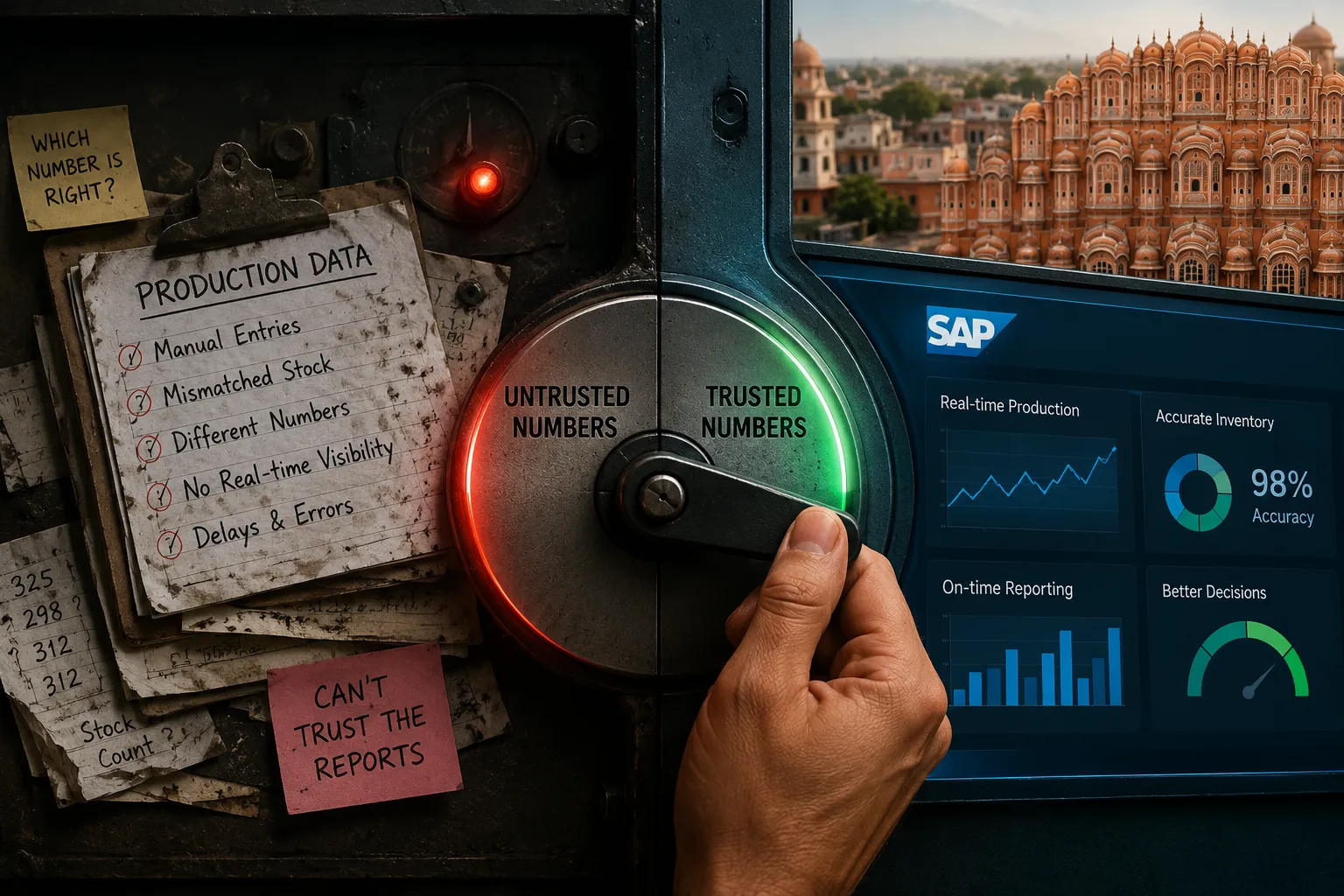

A Jaipur based manufacturing firm sat through a two hour SAP demo, nodded along at the dashboards, and then the managing director asked one question that stopped the room: what happens six months after go-live, once the consultants pack up and leave. Nobody on the vendor side had a ready answer. That gap is common in SAP in Jaipur conversations, where the sales pitch covers features and pricing in detail but says almost nothing about what daily operation actually looks like once the system is live.
The honest answer is that an ERP rollout succeeds or fails on decisions made before the contract is signed, not after. This piece walks through what that managing director's question actually exposed, and what any business owner evaluating SAP should be asking instead.
The Question That Changed the Conversation
The MD wasn't asking about cost or timelines. He wanted to know who would fix a stuck sales order at 9 pm during month end closing, three months after implementation. That question forced the vendor to talk about support structure instead of software features, and the answer they gave was thinner than the demo had suggested.
Why SAP in Jaipur Businesses Reach This Point?
Most Jaipur manufacturers and traders start their ERP search focused entirely on functionality: what the software can do, which modules exist, how the reports look. The support and handover conversation usually gets pushed to a later meeting that never quite happens with the same urgency. By the time a business realizes it needs that answer, the implementation is already underway and leverage has shifted to the vendor.
Getting the Basics Right: What SAP B1 Actually Covers
SAP B1 is built for small and mid sized companies that need one system handling finance, inventory, sales, and purchasing instead of three or four disconnected tools. It was never designed to replace enterprise scale SAP products, and that's exactly why it fits a growing Jaipur business better than something oversized for its needs.
Core Modules Included
- Financial accounting
Handles ledgers, banking, and statutory reporting in one place instead of separate spreadsheets. - Inventory and warehouse management
Tracks stock movement across locations with real time visibility into what's actually on hand. - Sales and purchasing
Connects quotations, orders, and vendor purchases so nothing gets entered twice.
Beyond the Software: Why Implementation Approach Matters
A license alone doesn't run a business. How the system gets configured, who trains the staff, and how data gets migrated from the old setup determine whether the software actually gets used or quietly gets abandoned within a year. This is where most first time buyers underestimate the effort required on their own side.
Making Sense of SAP Business One ERP
SAP Business One ERP solves a specific problem: disconnected data across departments. When finance, sales, and warehouse teams work off separate systems, month end reconciliation turns into a manual exercise nobody enjoys. A single ERP backbone removes that friction by giving every department the same numbers in real time.
- Single source of data
Eliminates the version conflicts that happen when each department keeps its own records. - Faster decision making
Owners see current stock and cash position without waiting for someone to compile a report.
Questions Worth Asking Before You Sign
Before any commitment, ask what happens during the first month of live usage, who owns data migration errors, and what response time is guaranteed for critical issues. Vendors who hesitate on these questions are telling you something about what comes after the sale closes.
What Drives SAP Business One Price Up or Down
SAP Business One Price depends less on the software license itself and more on the scope of customization and the number of users accessing the system.
- Number of user licenses
More concurrent users accessing the system directly increases the subscription or license cost. - Customization depth
Standard workflows cost far less than heavily modified processes built around unusual business rules. - Data migration complexity
Clean, organized existing data migrates faster and cheaper than years of inconsistent spreadsheets.
What This Looks Like Once the System Is Live?
Once the system is running, the real cost conversation shifts from setup fees to how quickly issues get resolved. A business that negotiated hard on price but ignored support terms often ends up paying more in lost productivity than it saved on the invoice.
Finding the Best SAP Partner in India
Choosing the Best SAP Partner in India for the rollout matters more than the software brand itself, since two businesses running identical SAP B1 licenses can have completely different experiences depending on who implemented and supports the system.
- Industry specific experience
A partner who has implemented similar manufacturing or trading businesses understands your workflows faster. - Local support presence
A team physically reachable in your city responds faster than a purely remote support desk. - Transparent post go-live terms
Clear documentation on response times and escalation avoids disputes once the system is running.
SAP Business One in India: What Comes Next for SAP in Jaipur Companies
SAP Business One in India has grown steadily among mid sized manufacturers and distributors who outgrew basic accounting software but don't need a large enterprise platform. For SAP in Jaipur specifically, that growth is visible in how many local firms are now asking implementation questions upfront instead of discovering gaps after the fact, which is exactly the shift that managing director's question represented.
The Real Takeaway for Jaipur Businesses
The strategic value of getting this right isn't the software itself, it's the operational clarity that follows: fewer manual reconciliations, faster decisions, and a support relationship that holds up under pressure rather than only during the sales cycle. Businesses that ask the hard questions early end up with systems that actually get used, not shelved software nobody trusts.
That one question from a Jaipur managing director should be the standard, not the exception. Any business evaluating an ERP rollout deserves a straight answer about what happens after the contract is signed, and the vendors willing to give that answer upfront are usually the ones worth working with.


























Sign in to leave a comment.