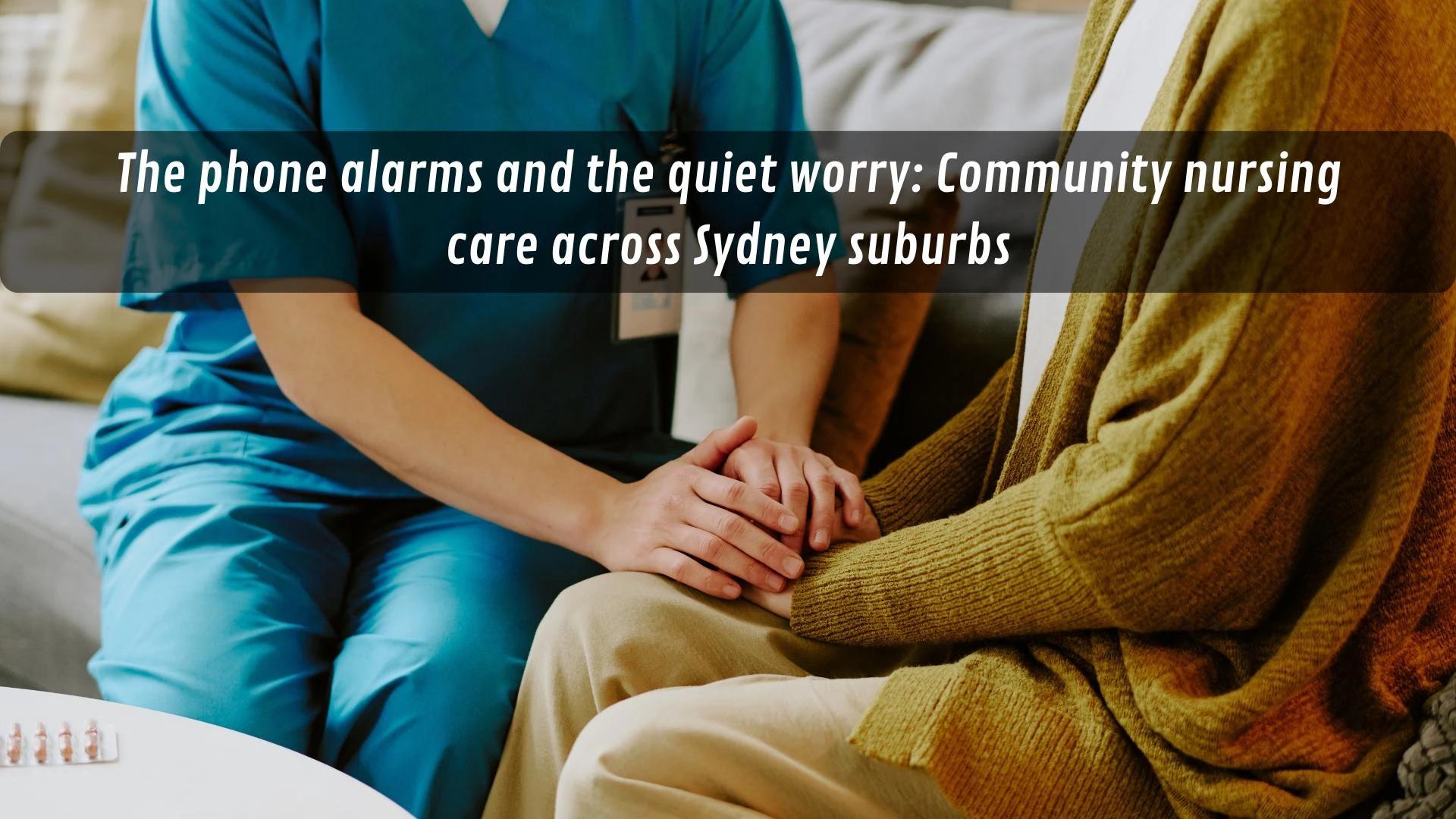

If you’ve ever brought someone home after a hospital stay—or watched a loved one’s health become more complicated over time—you’ll know the feeling.
It’s the way the house looks the same, but your body doesn’t.
You’re alert in a new way. You notice the distance between the bed and the bathroom. You notice how they hold the handrail. You notice how long it takes them to catch their breath after a short walk. You notice how quickly your own mind starts doing math: Next medication at 2. Dressing at 4. Fluids. Food. Rest. Watch the wound. Don’t miss anything.
And then the phone alarm goes off again.
Across Sydney suburbs, community nursing care often begins right here—not in the dramatic moments, but in the ordinary hours that suddenly feel high-stakes. It’s the type of support that steps into a real household and helps it carry clinical needs without the household falling apart.
The part of home care that doesn’t show up on a checklist
There are tasks, sure. And tasks matter.
But the heavier part is the constant interpretation.
At home, you’re always asking yourself:
- Is this pain expected, or is it a warning sign?
- Is the wound healing, or just… not getting worse?
- Is that tiredness a normal dip, or the start of something?
- Should I call someone now, or wait and see?
Carers don’t always describe it as anxiety because it feels too practical for that. It feels like responsibility. Like being “on” all the time. Like you’ve become the person who must notice what a trained clinician would notice—without having the training.
That’s the gap community nursing is meant to fill: not just doing clinical work, but helping people stop guessing.
What it’s actually like when a nurse visits
People often imagine home nursing as clinical and brisk, like a mobile hospital.
Sometimes it’s brisk. But the best version of it is surprisingly human.
A nurse arrives, and the first thing that happens is often not a procedure—it’s a recalibration of the room. Someone asks how the week has been. Someone listens to the answer. Someone looks properly, not quickly.
Then the clinical work begins: wound care, medication support, catheter care, diabetes management (including insulin where appropriate), monitoring and documenting changes, and other skilled supports depending on a person’s needs.
But threaded through the visit is something else: translation.
“Here’s what we’re looking at.”
“Here’s what’s normal at this stage.”
“Here are the signs we don’t ignore.”
“Here’s how to make this routine workable in your home.”
If you want a simple overview of the kinds of support community nursing can include, you can see them described on this community nursing care page (Abundance Healthcare Group).
Why the suburb you live in changes how care lands
Sydney is not one city in practice. It’s a thousand different days.
Some people are in apartments where space is tight, and privacy is thin. Some are in houses with steps everywhere. Some are in busy family homes where care has to fit around school runs and shift work. Some are living alone, where each visit is not just support but reassurance that someone else has eyes on the situation.
Suburb realities affect care in three big ways.
1) Timing becomes part of safety
When care involves dressings, medications, or monitoring, timing isn’t just a convenience. Predictability helps. It keeps routines stable. It reduces missed steps.
Unpredictable windows, on the other hand, can make households feel like they can’t plan anything—not even rest.
2) Continuity isn’t a luxury
A familiar nurse doesn’t just feel nicer. They become clinically useful.
They learn what someone looks like on a “good day,” which makes it easier to spot the small changes that might matter. In home care, those small changes are often the first clues that something needs attention.
3) Coordination either works—or it lands on the family
Home-based nursing often sits alongside other supports: support workers, allied health, GP visits, specialist appointments, equipment providers, and family rosters.
When communication is clear, the household isn’t forced to become a switchboard. When it isn’t, carers end up retelling the same story again and again, hoping no detail gets lost between people.
The difference between “support at home” and “nursing”
Families are often surprised by how much they need this distinction.
Support workers can be crucial for daily living—personal care, meals, mobility support, and routines. Nursing is different because it involves clinical judgement and responsibility.
Nursing is the part that helps answer:
- Is this wound progressing properly?
- Are these symptoms within expectations?
- What early signs might point to infection, dehydration, skin breakdown, or medication side effects?
- What do we do if something changes tonight?
That judgement is why nursing support can feel like a weight lifted. Not because the situation becomes easy, but because it becomes less uncertain.
Where NDIS fits, when it fits
For NDIS participants, community nursing may be part of supports when disability-related health needs require skilled clinical care—particularly where tasks carry higher risk and need professional oversight.
In households navigating NDIS supports, clarity can reduce stress dramatically. Useful things to understand include:
- What tasks require nursing qualifications and why
- How changes are documented and shared
- How nursing aligns with support workers and other providers
- What the escalation plan is, and if it needs to be changed quickly
When those pieces are clear, care feels less fragile—less like it depends on one person remembering everything.
The questions that help families breathe again
When people are tired, they often ask big questions they can’t answer: “Will this get better?” “Are we doing enough?”
Community nursing helps by answering the questions that make tomorrow doable:
- What are we aiming for this week?
- What should we track?
- What’s the most important thing to get right daily?
- What are the red flags?
- Who do we call, and when?
Those answers don’t remove the emotional weight, but they reduce the spiral. They replace vague fear with specific action.
Knowing when to escalate without second-guessing yourself
Home care can make people hesitant to escalate. Nobody wants to overreact. Nobody wants another trip back to the hospital.
But some symptoms aren’t “wait and see” symptoms.
Severe breathing difficulty, chest pain, stroke symptoms, uncontrolled bleeding, sudden collapse, or rapidly worsening confusion warrant emergency services.
Other issues—like increasing redness/warmth/swelling or discharge from a wound, fever, catheter blockage, persistent vomiting, dehydration signs, or unstable blood sugar patterns—should prompt timely clinical advice. Early action is often what prevents bigger complications.
Key Takeaways
- Home-based care often feels hardest because of constant uncertainty and decision-making, not just the tasks.
- Community nursing brings qualified clinical care into the home, including skilled support and monitoring as needed.
- In Sydney, suburban logistics affect timing, continuity, and coordination—and these shape how manageable care feels.
- Good nursing support clarifies what’s normal, what to watch for, and what to do if things change.
- The goal is steadiness: safer routines at home that support dignity for the person receiving care and breathing room for carers.




























Sign in to leave a comment.