
The work of a Data Science Manager is both interesting and critical in today's data-driven world. The importance of having knowledgeable executives in data science has increased dramatically as companies increasingly rely on data to make better decisions.
This will help you in understanding the roles, responsibilities, and essential tasks of a data science manager as well as how you might advance into this position. We will walk you through everything in an easy-to-understand manner, regardless of whether you're a data scientist hoping to advance to a managerial position or you're just interested in what this position involves.
What Is a Data Science Manager?
In order to use data to address business challenges, a data science manager oversees a group of data scientists, analysts, and engineers.
They don't just develop code or create models; they bridge the gap between business objectives and data-driven solutions. Their responsibilities include leadership, strategy, communication, technical understanding, and project delivery.
Consider them to be team leaders as well as data interpreters; they understand both business and data.
The Difference Between a Data Scientist and a Data Science Manager
The two jobs are frequently confused. Although they both deal with data, their roles are very different.
- A Data Scientist analyzes data, builds models, and generates insights.
- A Data Science Manager is in charge of the complete process, including work planning, people management, output quality assurance, alignment with business goals, and presentation of outcomes to stakeholders.
To put it briefly, a manager does not handle all of the coding or modeling themselves; instead of they concentrate more on leadership and delivery.
Core Responsibilities of a Data Science Manager
The following are the main responsibilities that characterize a data science manager's position:
1. Leading the Data Science Team
The core of the work is leading a data science team. This includes:
- Hiring new data scientists and training them.
- Coaching and mentoring team members to help them develop their skills.
- Maintaining the group inspired and focused on the objectives of the business.
- Creating a positive, productive team environment.
2. Project Planning and Execution
Planning is necessary for any data science effort. A manager of data science:
- Collaborates with stakeholders to comprehend company requirements.
- Breaks issues into tasks that can be handled.
- Assigns the appropriate individuals to the appropriate tasks.
- Makes sure that work is completed on schedule and within budget.
3. Aligning Data Projects with Business Goals
Linking data science efforts to business requirements is one of the most important responsibilities. This includes:
- Determining how company operations can be enhanced by data.
- Converting business issues into inquiries for data science.
- Communicating technical findings to stakeholders who are not technical in a way that is understandable
4. Ensuring Quality and Compliance
Accuracy, ethics, and compliance are essential for data science job. A manager of data science makes sure:
- In terms of modeling, documentation, and coding, the team adheres to best practices.
- Models are tested, verified, and tracked.
- The group complies with data privacy regulations such as the CCPA and GDPR.
- Work is completed in a transparent and reproducible manner.
5. Technology and Tools Management
Even if they might not write code daily, managers need to know:
- Which technologies and tools are used by the team?
- How to assess new platforms and technologies.
- How to ensure that tools work with the tech stack of the business.
6. Communication and Stakeholder Management
The key is communication. A manager of data science:
- Presents outcomes to clients and leadership.
- Explains project risks, constraints, and anticipated results.
- Manages the expectations of stakeholders.
- Increases the level of trust between the business and data teams.
7. Budget and Resource Planning
Depending on the company, managers might also:
- Manage the employment, infrastructure, and tool budgets.
- Make resource plans to satisfy project demands in the future.
- Create business cases for data projects or new hires.
Skills Every Data Science Manager Needs
It takes a mix of technical, business, and leadership skills to be successful in this position. Let's study these:
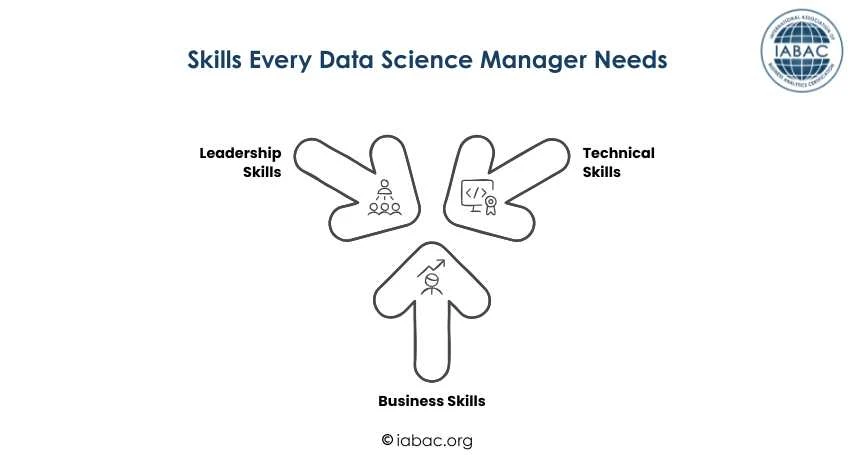
Technical Skills
- Knowledge in statistics, data analysis, and machine learning.
- Familiarity with cloud platforms or technologies such as Python, SQL, R, and Spark.
- Familiarity with modeling, data pipelines, and model evaluation.
- Ability to provide technical advice and evaluate code.
Business Skills
- A solid understanding of strategy and business metrics.
- Experience in converting data into useful business insights.
- Skill to collaborate across functional boundaries and manage stakeholders.
Leadership Skills
- Coaching and team building.
- Resolution of conflicts and making decisions.
- Good communication.
- The capacity to control resources, time, and scope.
How to Become a Data Science Manager
Here are some actions you may take if you're currently employed in data science and want to advance to a leadership position:
1. Strengthen Your Communication Skills
Present your work to audiences who are not technical. Write executive summaries more often. Learn to simplify complicated concepts.
2. Take Ownership of Projects
Don't only code. Begin discussing with stakeholders, addressing obstacles, and creating timetables. Show your ability to lead and deliver.
3. Learn People Management
Mentor younger team members if you can. Develop your dispute resolution, motivation, and feedback-giving skills.
4. Get Certified
You can differentiate yourself with certifications such as the Data Science Certified Manager from IABAC. The following are the main topics of this certification:
- Data science project management.
- leadership in settings that depend heavily on statistics.
- Governance and ethics.
- Transforming data solutions into business demands.
- It is worldwide recognized and might help you gain credibility when applying for managerial positions.
It is recognized worldwide and might help you gain credibility when applying for managerial positions.
A Data Science Manager role requires a unique combination of leadership, technology, business knowledge, and communication skills. It's not enough to know how to construct models; you also need to know how to build teams that use data to make an effect.
If you're passionate about both data and people, this could be the perfect path for you.
Taking a certification like the IABAC Data Science Certifications is a great step toward formalizing your skills and showing that you’re ready to lead.
































Sign in to leave a comment.