
Organizations today rely heavily on digital platforms to connect employees, customers, partners, vendors, and stakeholders. Whether it's a customer self-service portal, an employee intranet, a partner collaboration platform, or a SaaS-based business application, web portals have become central to modern business operations.
As companies invest in enterprise web portal development, much of the attention is often directed toward user-facing features and customer experiences. However, behind every successful portal lies a critical component that determines how effectively the platform can be managed, monitored, and scaled: the admin dashboard.
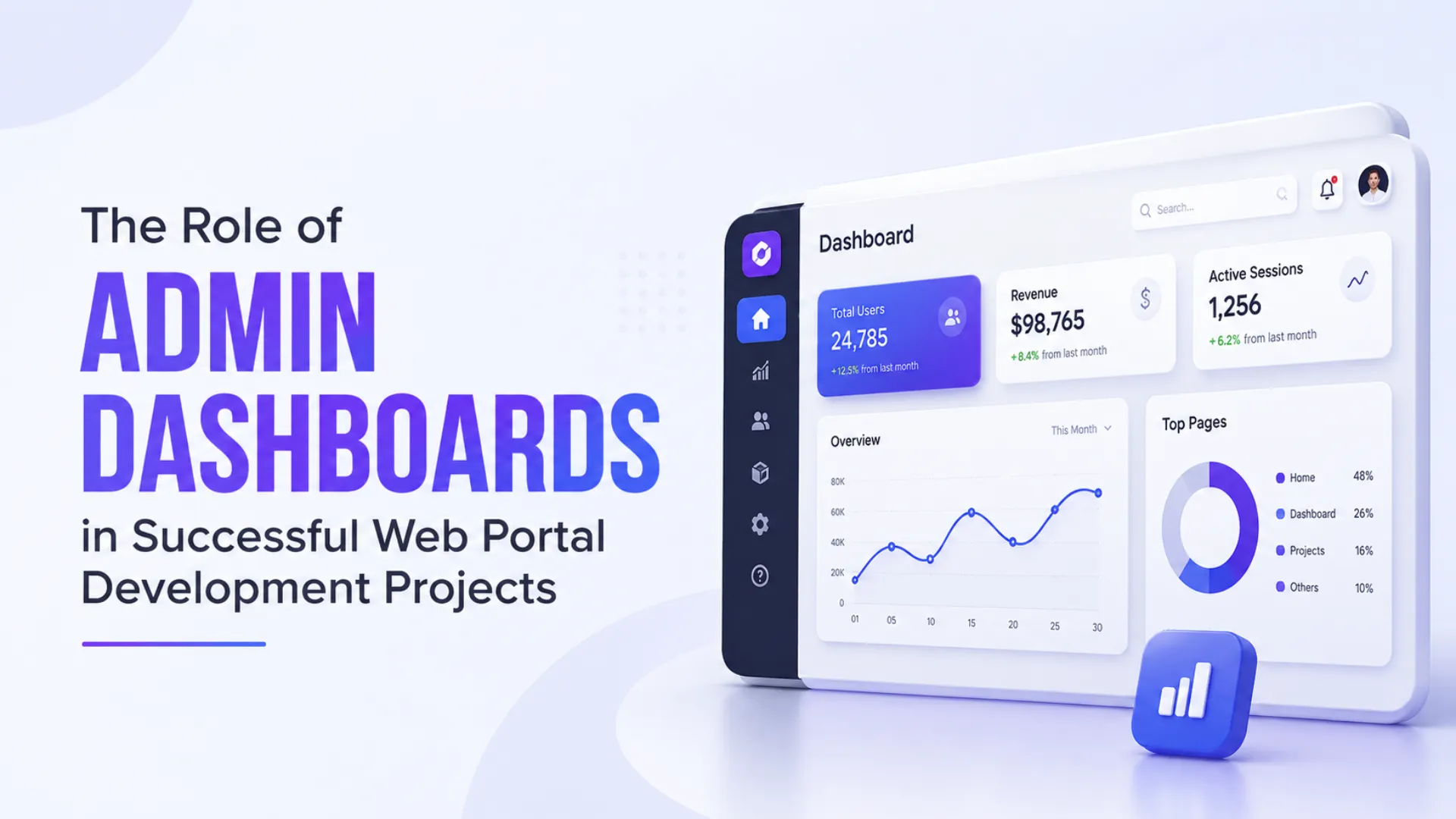
An admin dashboard serves as the operational command center of a portal ecosystem. It enables administrators to manage users, monitor activity, analyze performance, automate workflows, and maintain security from a centralized interface.
Businesses seeking professional web portal development services increasingly recognize that a well-designed dashboard is not merely an administrative tool. It is a strategic asset that directly impacts operational efficiency, business intelligence, and long-term scalability.
What Is an Admin Dashboard?
An admin dashboard is a centralized management interface that allows authorized personnel to oversee and control various aspects of a web portal.
Rather than navigating multiple systems, administrators can access essential business functions through a single portal management system. This typically includes user management, content administration, workflow oversight, analytics reporting, and security controls.
In modern custom web portal solutions, dashboards provide a real-time view of organizational activities and system performance. Administrators can quickly identify issues, track user engagement, monitor key business metrics, and make informed decisions without relying on multiple disconnected applications.
Think of it as the control tower of a digital ecosystem. While end users interact with portal features, administrators depend on dashboards to keep the entire environment operating smoothly.
Why Admin Dashboards Are Essential in Web Portal Development Projects
Centralized Control
One of the primary advantages of admin dashboard development is centralized management.
Without a unified interface, organizations often struggle with fragmented systems, duplicated processes, and inconsistent oversight. Dashboards eliminate these challenges by bringing critical management functions into a single environment.
For example, a customer portal development project may require administrators to manage thousands of customer accounts, subscription plans, support requests, and content updates. A centralized dashboard significantly simplifies these tasks.
Real-Time Visibility
Business leaders increasingly depend on real-time information to make informed decisions.
Modern analytics dashboards provide instant access to user activity, system performance, sales metrics, support tickets, and operational data. This visibility helps organizations identify trends before they become problems.
For instance, an e-commerce portal can immediately detect unusual spikes in traffic or customer complaints and respond proactively.
Improved Decision-Making
Data-driven organizations consistently outperform competitors because they make decisions based on measurable insights rather than assumptions.
A reporting dashboard enables executives and managers to track performance indicators, evaluate operational efficiency, and uncover opportunities for improvement.
The result is faster, more informed decision-making across departments.
Enhanced Productivity
Manual administrative tasks consume valuable resources.
By automating repetitive processes through enterprise workflow automation, dashboards reduce administrative burdens and free employees to focus on higher-value activities.
Tasks such as user onboarding, approval workflows, document routing, and notification management can often be automated directly through the dashboard interface.
Better Customer Experience
Customer satisfaction is heavily influenced by operational responsiveness.
When support teams, administrators, and managers have immediate access to customer data and portal performance metrics, they can resolve issues faster and provide more personalized experiences.
This is particularly important in customer experience management initiatives where service quality directly impacts retention and revenue.
Business Scalability
As organizations grow, complexity increases.
A scalable dashboard architecture ensures that businesses can manage expanding user bases, additional services, and new workflows without creating administrative bottlenecks.
This scalability is a fundamental requirement for SaaS portal development and enterprise software solutions.
Key Features of Modern Admin Dashboards
Successful dashboards combine usability with powerful functionality.
User and Role Management
A robust user management system enables administrators to create, modify, and deactivate accounts while maintaining organizational structure.
Role assignments help ensure that users only access information relevant to their responsibilities.
Access Control
Role-based access control remains one of the most important security mechanisms in enterprise applications.
Administrators can define permissions based on departments, job functions, or organizational hierarchy, reducing security risks and ensuring compliance.
Analytics and Reporting
Data visualization capabilities help transform complex information into actionable insights.
Interactive charts, KPI monitoring, performance reports, and business intelligence dashboards enable organizations to track progress and identify opportunities.
Workflow Management
Workflow management tools automate routine business processes, improve consistency, and reduce delays.
Whether approving invoices, processing customer requests, or managing employee onboarding, workflow automation improves operational efficiency.
Notifications and Alerts
Real-time alerts keep administrators informed about critical events such as security incidents, workflow bottlenecks, or performance anomalies.
Timely notifications enable rapid intervention when necessary.
Content Management
Many portals require frequent content updates.
Integrated content management capabilities allow administrators to publish, edit, organize, and archive information without relying on technical teams.
Security Monitoring
Cybersecurity remains a top concern for organizations.
Admin dashboards often include activity logs, audit trails, login monitoring, and threat detection tools that support proactive security management.
Integration Capabilities
Modern portals rarely operate in isolation.
API integration services allow dashboards to connect with CRM platforms, ERP systems, HR software, marketing tools, and third-party applications, creating a unified digital ecosystem.
How Admin Dashboards Support Business Growth
The value of dashboards extends beyond administrative convenience.
Organizations leveraging advanced dashboard capabilities often achieve measurable improvements in productivity and operational performance.
By centralizing data and processes, businesses can streamline operations and eliminate inefficiencies. Teams collaborate more effectively because they work from a shared source of truth.
Executives gain visibility into organizational performance, enabling them to track KPIs and align activities with strategic objectives.
Consider an employee portal development project within a large enterprise. A comprehensive dashboard can automate leave approvals, training management, internal communications, and performance tracking. The result is reduced administrative overhead and improved employee engagement.
Similarly, a cloud-based customer portal can provide leadership with real-time insights into customer behavior, subscription trends, and service utilization, supporting growth-focused decision-making.
The Role of Modern Frontend Technologies
The effectiveness of an admin dashboard depends significantly on the technologies used to build it.
React-Powered Dashboard Experiences
Organizations investing in react js development services often benefit from highly interactive user experiences.
React development enables component-based architectures that improve responsiveness, maintainability, and scalability. Dashboards built with React can efficiently handle real-time updates, complex visualizations, and dynamic user interactions.
This makes React particularly valuable for scalable web applications that require high performance.
Enterprise Applications Built with Angular
Many enterprises continue to leverage angularjs development services and modern Angular development frameworks for sophisticated business applications.
Angular provides a structured architecture that supports large-scale enterprise application development. Its built-in features help development teams maintain consistency across complex dashboard environments.
For organizations managing extensive workflows and large user populations, Angular remains a compelling choice.
Improved Adoption Through Better User Experience
Regardless of the framework selected, modern frontend development frameworks contribute significantly to dashboard usability.
Intuitive interfaces improve user adoption, reduce training requirements, and increase overall productivity.
Admin Dashboards and Legacy System Modernization
Digital transformation initiatives frequently involve replacing outdated systems with modern platforms.
In many cases, legacy applications contain valuable business logic but suffer from poor usability, limited reporting capabilities, and fragmented management processes.
This is where legacy application modernization services deliver significant value.
Organizations can modernize existing systems by introducing centralized dashboards that provide enhanced visibility and operational control while preserving critical business functions.
For example, a manufacturing company migrating from an aging on-premise portal to a cloud-based platform may implement a modern dashboard that consolidates inventory management, production tracking, and performance reporting.
Similarly, financial institutions undergoing application modernization often use dashboards to unify customer data, compliance monitoring, and operational analytics.
These modernization efforts not only improve efficiency but also support broader digital transformation objectives.
Choosing the Right Web Portal Development Partner
The success of a portal project often depends on selecting the right development partner.
When evaluating a web portal development company, businesses should look beyond technical capabilities alone.
Technical Expertise
A qualified partner should demonstrate expertise in enterprise web portal development, frontend technologies, backend architecture, cloud platforms, and API integrations.
Industry Experience
Experience within specific industries often translates into faster implementation and better alignment with business requirements.
Security Practices
Strong security frameworks, compliance knowledge, and secure development methodologies are essential.
Scalability Planning
Future growth should be considered from the beginning. The right partner designs systems capable of supporting increased users, transactions, and functionality.
Long-Term Support
Successful portals evolve continuously. Ongoing maintenance, optimization, and enhancement services are critical for long-term success.
Organizations that prioritize these factors are more likely to achieve sustainable results from their portal investments.
Conclusion
Admin dashboards have evolved from simple management interfaces into strategic business tools that drive operational excellence.
They provide centralized control, improve visibility, support better decision-making, strengthen security, and enable organizations to scale efficiently. Whether supporting customer portal development, employee portal development, SaaS portal development, or broader enterprise software solutions, dashboards play a pivotal role in long-term platform success.
As businesses continue their digital transformation journeys, investing in robust admin dashboard development should be considered a core requirement rather than an optional enhancement.
The most successful web portals are not defined solely by what users see. They are powered by intelligent administrative systems that enable organizations to manage complexity, gain actionable insights, and create sustainable business growth. For companies investing in web portal development services, the admin dashboard is often the difference between a portal that simply functions and one that delivers lasting business value.



























Sign in to leave a comment.