
Cancer is a heterogeneous term that encompasses many diseases which share a fundamental feature, i.e the abnormal growth of cells and their ability to metastasize.The war against cancer is centuries old, however the battle against this nemesis of mankind has rapidly shifted gears in past 2-3 decades. This has been made possible with our understanding of human genome, cell cycle, mutations, and a rapid advancement in treatment technologies making the treatment individual & target specific.
As per the National Cancer Registry of India, the incidence of new cancer cases was between 90-100 per 1 lac individuals for 2020, an estimate which is projected to increase and 1 in 9 indians may be afflicted by this disease by 2025. However the diagnoses of cancer is not to be considered a death sentence and patients can even be cured if diagnosed and treated early.
The doctors who treat cancers are called oncologists and there are three specialties involved in treatment planning. These are the surgical, radiation and medical oncologists. These 3 specialists can be compared to be like the armed forces. The surgeon is like the army, radiation oncologist is like the air force and the medical oncologist is like the navy.All 3 have equal contribution in the cure for cancer.
Radiation oncology is the science of treatment of cancer with high energy rays including Photons, electrons or particles like protons through sophisticated equipment called the linear accelerators.However, this modality of treatment is known by misnomers like giving light or heat or laser. The treatment is locally directed, bloodless and painless. Radiation oncology forms an integral part of cancer care and treatment goal can be cure or relief of symptoms based upon the stage of the cancer.
Radiation is an important component of curative treatment either alone or in combination with surgery, chemotherapy, and immunotherapy. The indications for treatment depends upon the site and the stage of malignancy.Here are some examples of how treatment protocols are designed:
- Curative/Radical setting- Radio therapy is given directly with or without chemotherapy to cure the disease. These include Cancers of Nasopharynx, Larynx, Upper esophagus, advanced stage of Lung ca, cervix, vagina, etc.
- Adjuvant setting- After curative surgery has happened radiation is prescribed in cases with high risk features to reduce the chances of recurrence with or without chemotherapy. For example, cancers of brain, mouth, breast, uterus, soft tissue sarcoma, esophagus, rectum, etc.
- Neoadjuvant setting- Aim is to downstage a tumor and make it more amenable to surgical resection. Examples include Ca Rectum, Esophagus.
- Palliative setting- The goal here is symptom relief with short course of radiation. Some examples include: Metastases to brain, Bone (pain), Spinal cord compression causing paralysis, Bleeding from tumors like rectum, cervix, etc.
Radiation therapy delivery and mechanism of action: IN the last 2 decades there has been immense advancements in the delivery of radiotherapy. The treatment planning and delivery has become more conformal to the tumor with the reduction of side effect profile. After the discussion with your doctor, the steps for treatment planning include: Simulation CT & MRI scans with immobilization of the patient which may include making a mask or a vacloc cushion. Post that the doctor & his team perform target volume delineation & planning of treatment delivery which is a completely computerized process.The cancer is visualized on the scans and are marked out for treatment while simultaneously the nearby healthy organs are marked for minimizing dose spill to them to reduce side effects. The treatment delivery is done on machines called linear accelerators and are usually known by their brand name like Trubeam, Versa HD, Halcyon, Cyberknife, Gammaknife, etc.
Radiation therapy works by damaging the DNA of cells and destroys their ability to reproduce. Both normal and cancer cells can be affected by radiation, but cancer cells have generally impaired ability to repair this damage, leading to cell death.
Radiotherapy delivery is scheduled according to the treatment protocol being followed.Usually patient has to come for treatment 5 days a week from Monday to Friday for a duration of 1-6 weeks.The treatment duration varies depending upon the site, goal of treatment, & dose delivered. Daily treatment may take 10-15 minutes and is completely OPD based. A patient might also be scheduled for concurrent chemotherapy which is usually given once a week.
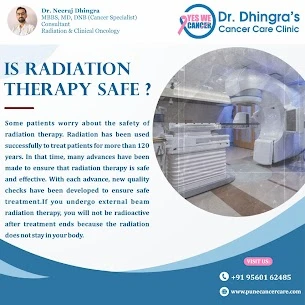
Radiotherapy is treatment with high energy X rays where the beams are delivered from outside the body, targeted at the site of cancer. As with performing any scan like CT or PET scan the patient doesn’t feel the treatment while it happens. It is a completely painless, non invasive and bloodless procedure. After the treatment for the day is done patient can go home.There is usually no immediate observation required after the treatment.
However the effects of the treatment are cumulative and certain side effects can be experienced as the treatment progresses. These are mostly site specific and localized to the site of treatment.For example patients undergoing radiation for oral cancers can have skin pigmentation, mouth ulcers, thick saliva, dryness of mouth and difficulty in swallowing. These side effects are transient and manageable with medications. After the treatement is over they subside over 2-4 weeks. Extra care during treatment is required as these side effects may be very troublesome for some patients. This includes care instructions as given by treating doctor, diet management and exercise as feasible for patient.
Technological advancements in treatment: As with all treatments the advancements in technology has made treatment more targeted & conformal to the tumor. The adoption of techniques like IMRT, IGRT and VMAT and enhanced role of Artificial intelligence has made it possible to safely target the tumor with reduction of side effects. The focus is also on reducing the treatment duration so that patient visits to the hospital can be minimized.The best examples are of breast [ 5 weeks protocol reduced to 1-3 weeks] and prostate [ 7 weeks protocol reduced to 1-4 weeks].
Also the integration of highly conformal treatment called stereotactic Radiosurgery in routine practice has made it possible to reduce the treatment times to as short as 1-5 days. These are known by the names SRS/ SRT/ SBRT and are now routinely utilised in treatment of various cancers including brain, HEad and neck, breast, lung, pancreas, prostate and specially in recurrent localized tumors.The goal of treatment is delivery of high doses of radiation to tumor with curative intent while finishing it quickly like a surgical procedure. The lack of a surgical incision, avoidance of hospital stay and excellent disease free and control rates are now making stereotaxy a mainstream treatment especially in recurrent and limited metastatic disease settings.
Radiotherapy can be delivered only at a hospital where the linear accelerators have been installed. Due to the high costs of these machines there are only 8-9 hospitals in pune where this treatment can be availed.The radiation oncology department at Ruby Hall Clinic, Pune houses 3 world class equipments for the cancer treatment which includes a Trubeam STx 2.0, Halcyon Elite and CyberKnife. We routinely treat all sites of cancers and boast of a strong stereotaxy program which has been strengthened by the arrival of AI platform with the installation of CyberKnife. The costs involved in the treatment is highly variable and is dependent upon the technique availed.
I would like to summarise by stating that cancer treatment is evolving to become more target oriented and consequently the quality of life is also improving. Discuss all treatment options with your oncologist and make an informed decision. Yes there are side effects but don’t be afraid of them. The ultimate goal is making the person cancer free and we together can win this battle.
Take away : Dr Neeraj Dhingra [MBBS, MD, DNB, DHM] is Best Oncologist in Pune practising as Senior Consultant- Cyberknife Radiosurgery and Radiation Oncology at prominent Hospitals across Pune. He is available at Ruby Hall Clinic in Pune. He is extensively trained is proficient in treating cancer patients with complex radiotherapy techniques including IMRT, IGRT, VMAT, SRS/SBRT by modern day Linear accelerators including Cyberknife. He has many publications in renowned national and international journals. He is also a member of the Association of Radiation Oncologists of India and other reputed national and international professional organizations. His areas of interest are Malignancies of the Brain, Head and neck, Thorax and Genitourinary tract with a special focus on stereotactic treatments including SRT and SBRT.
Dr Neeraj Dhingra [MBBS, MD, DNB, DHM] Best Cancer Specialist in PCMC Pune available at prominent Hospitals across PCMC. He is available at Aditya Birla Memorial hospital, Lokmanya hospital, D Y Patil , Lifepoint multispeciality hospital and on panel of other hospitals too. Dr.Neeraj is also available at Dr. Dhingra Cancer Clinic in Rahatani,off Pimple Saudagar,Pune.
Contact us : https://punecancercare.com/about-us/



























Sign in to leave a comment.