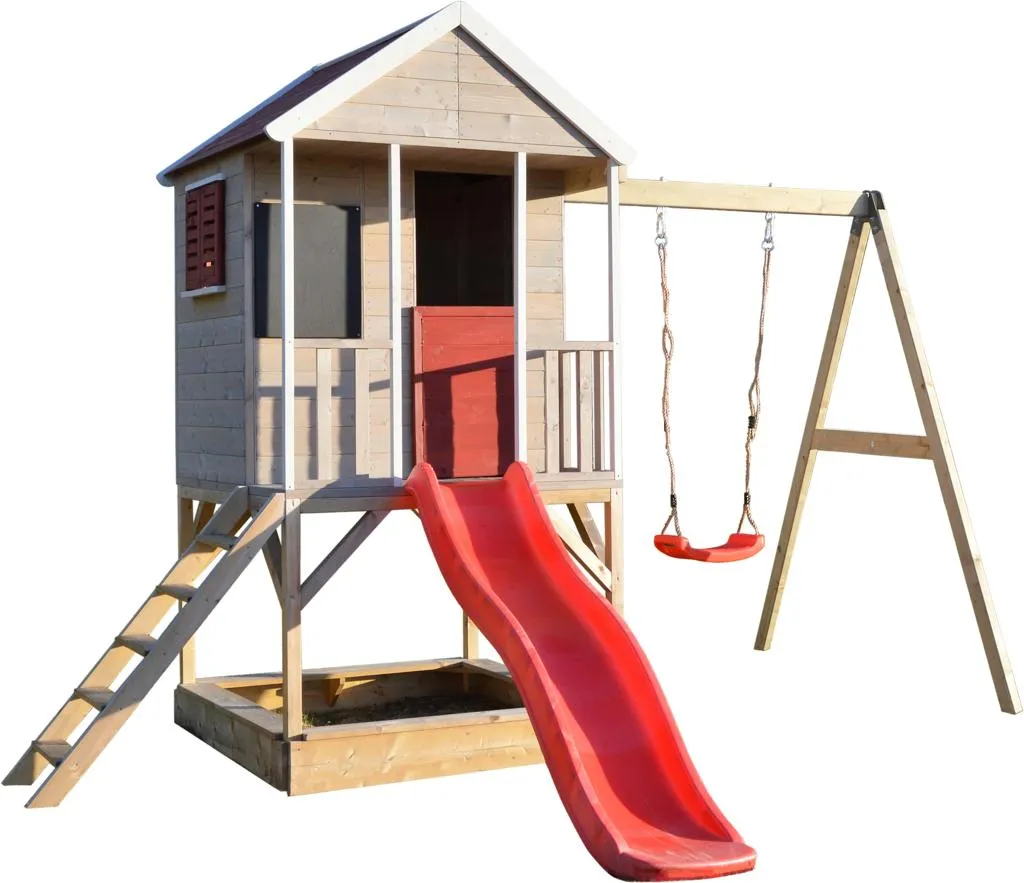

I still remember the exact creak of the swing set my parents put up when I was six — the left chain squeaked a half-second before the right one, every single time. I haven't thought about that sound in years, and yet here it is, fully intact in my head, the way certain childhood things just are. That's the part nobody mentions when you're standing in your own backyard trying to decide between models: you're not really buying a swing set. You're building the backdrop for whatever your kids end up remembering thirty years from now.
Which makes it strange how often the decision gets rushed. People spend more time picking a couch.
Buy for the Kid They're Becoming
My youngest is at the stage where the highlight of her day is climbing two steps and sliding down, over and over, with the kind of focus most adults can't manage for anything. My older one was exactly there two summers ago, and now he wants monkey bars and a way to prove he's not scared of heights anymore. Kids don't stay in one phase long enough for a swing set to be just right for very long — unless you've planned for the next phase before they've even asked for it.
A few things that actually matter here:
- If there's more than one kid, or even a steady stream of neighborhood friends, a single-purpose set gets outgrown fast.
- It's much easier to leave room for a climbing wall or a second swing now than to bolt one on later and have it look like an afterthought.
- "They'll use this forever" is optimistic. "They'll use this for most of growing up" is realistic, and it's still a lot.
This is where custom design stops being a marketing phrase and starts being genuinely useful — you're not picking from three fixed configurations, you're building around your actual kids.
Your Yard Isn't the One in the Photos
Every brochure shows a swing set sitting in the middle of an enormous, perfectly flat lawn with nothing else around it. Almost nobody's yard looks like that. Mine has a slope, a fence eight feet too close, and a tree that drops something sticky every June.
Walk your real yard before you fall for a model. Figure out the actual footprint, including the open space — sometimes called the fall zone — that needs to stay clear so a kid swinging too hard doesn't end up against the fence or the patio. If the space is tight, that's not the end of it. Compact layouts exist precisely for this: a playhouse tucked into a corner instead of sprawled across the whole yard, a row of swings doing double duty as monkey bars. The goal isn't squeezing in the biggest set possible. It's having something that fits and still leaves you somewhere to put a picnic blanket.
The Difference You Only Notice Years Later
Two swing sets can look almost identical in a catalog and turn out completely different once they've sat through a few real winters. This is the part that's easy to skip past while shopping, and the part you'll regret skipping if you do.
Worth slowing down for:
- Whether it's actually handcrafted from solid lumber, or assembled from the cheaper composite stuff that swells and warps after enough rain.
- Whether it meets ASTM International standards, which is more or less the playground version of a safety rating you'd actually trust.
- Whether there's a real warranty — years, not months — behind the build.
None of this shows up on day one. It shows up in year four, in whether the beam still feels solid under a kid's full weight or whether the bolts have started working loose.
The Ground Underneath Matters Too
Most of the attention goes to the structure, and almost none of it goes to what's underneath. That's backwards. Safety surfacing — wood fiber, rubber mulch, poured rubber, whatever you land on — is what actually absorbs a fall in a way bare grass or packed dirt can't. It's the least exciting line item on the whole project and probably the one doing the most quiet work.
Building It Yourself, or Letting Someone Who's Done It Hundreds of Times Handle It
There's a real satisfaction in building the thing your kids will grow up on with your own hands, and I don't want to talk anyone out of that if it's what they want. Just go in clear-eyed about what it involves — leveling ground that's never as flat as it looks from the kitchen window, anchoring posts deep enough that nothing shifts, torquing what feels like a hundred bolts so none of them loosen by the time school starts again.
Professional installation trades that weekend for a different kind of certainty: someone who's done this hundreds of times got it right the first time. Our range of swing sets comes from a team that's installed over 25,000 of these, which means whatever odd quirk your yard has — a slope, a tree root, a fence in the wrong place — they've almost certainly worked around it before.
What You're Actually Buying
A swing set isn't really a piece of equipment. It's a few years of your kids choosing the backyard over a screen, of other people's kids showing up at your door asking if your kids can play, of a sound — a creak, a laugh, a "watch this, Mom" — that's going to outlast the paint and the warranty and probably end up living in someone's memory the way that squeaky chain still lives in mine.
If you're still going back and forth, skip the guessing and talk to an actual person about your actual yard. SwingIt Playscapes will walk through it with you and help you find and install the right swingset for the space and the kids you've actually got — not whatever happened to look best on a homepage.



























Sign in to leave a comment.