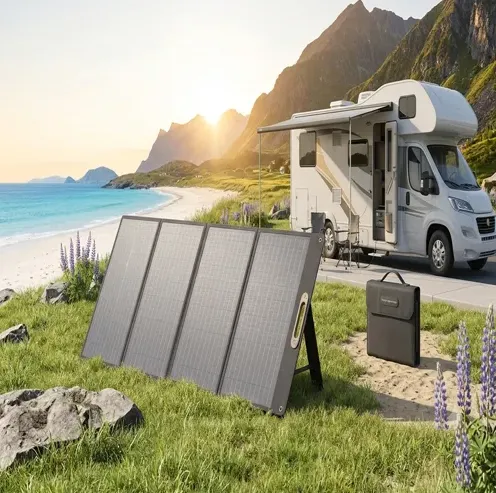

As the world grows increasingly mobile and energy conscious, the demand for portable, efficient, and eco-friendly power solutions has never been higher. From outdoor enthusiasts trekking remote trails to digital nomads working in unpredictable places, the need to generate electricity on the go has driven a new wave of product innovation. Among these solutions, foldable solar panels have emerged as a true game-changer—delivering clean energy in a compact, lightweight, and ultra-convenient format.
1. What Are Foldable Solar Panels?
Foldable solar panels are a category of portable photovoltaic modules engineered for easy transport, deployment, and storage. Unlike rigid panels designed for permanent rooftop or ground installations, foldable models feature sections connected by hinges or flexible materials, enabling them to collapse into a compact package for travel. When unfolded, these panels expose a large surface area to the sun, converting light into electricity for charging batteries, running appliances, or directly powering devices.
2. How Do Foldable Solar Panels Work?
Foldable solar panels operate on the same photovoltaic principle as traditional solar panels. Sunlight (composed of photons) strikes the panel’s semiconductor cells, where energy excites electrons and generates an electric current. This current is typically DC (direct current), which is either used directly to charge compatible gear (USB devices or 12V batteries) or passed through an inverter or charge controller for broader compatibility.
The unique feature of foldable solar panels is their physical configuration. By folding and unfolding, the user can easily carry them in a backpack or vehicle and deploy them only when and where power is needed.
3. Benefits of Foldable Solar Panels
- Portability: Compact folding design allows for easy transport and storage, making them ideal for camping, hiking, travel, and emergencies.
- Ease of Use: Quick setup, with plug-and-play connectors for most devices. No tools required.
- Versatility: Can charge phones, tablets, laptops, portable power stations, cameras, GPS units, and even some small appliances.
- Eco-Friendly: Generate clean, renewable power without fuel, noise, or emissions.
- Cost Efficiency: Reduce dependence on disposable batteries or expensive generator fuel.
- Emergency Preparedness: Essential for blackout situations, disaster relief, or off-the-grid living.
4. Types of Foldable Solar Panels: Monocrystalline vs. Polycrystalline vs. Thin-Film
Understanding cell types helps narrow your choice:
Monocrystalline Foldable Solar Panels:
- Highest efficiency (18–23%)
- Sleek black appearance
- Best for limited space or maximum power in a compact foldable format
- Generally more durable and longer lasting
Polycrystalline Foldable Solar Panels:
- Medium efficiency (15–18%)
- Slightly lower cost
- Blue tinted, less uniform look
- Suitable where space and weight are less critical
Thin-Film (CIGS or Amorphous) Foldable Solar Panels:
- Most flexible, can be rolled or folded tightly
- Lower efficiency (10–12%) but cheapest in dollar/watt
- Best for covering large, awkward or curved surfaces
Shenzhen Sungreat Energy Technology Co., Ltd. offers foldable solar panels in all main types, and our advisors can help match you to the right fit.
5. Common Applications of Foldable Solar Panels
- Outdoor Adventure: Backpacking, camping, trekking, cycling, or boating.
- RV & Vanlife: Remote travel with power for lighting, refrigeration, and communications.
- Emergency Use: Disaster kits, first responders, hospitals, search-and-rescue.
- Military & Expedition: Tactical, field work, or backup power in remote zones.
- Travel & Commuting: Charging devices in airports, trains, or while road-tripping.
- Off-Grid Living: Cabins, tiny homes, or outdoor work sites.
6. Key Features to Consider When Buying Foldable Solar Panels
a) Power Output
Measured in watts—higher wattage means more devices charged or faster charging. Typical foldable panels range from 10W up to 300W or more.
b) Weight and Folded Size
Lower weight and smaller footprint are essential for backpacking, while travel and vanlife might prioritize output over size.
c) Connector Types
Look for integrated USB (for phones), DC/MC4 (for power stations or 12V gear), and adapters for diverse devices.
d) Durability
Check for tough fabrics, reinforced corners, waterproof coatings, and anti-shock laminate.
e) Integrated Charging Controller or Display
Some panels include built-in smart controllers, digital displays, or LED status indicators.
f) Setup and Mounting Options
Kickstands, grommets, loops, or magnets make setup easy and keep the panels optimally oriented to the sun.
7. Understanding Power Ratings and Real-World Output
A foldable solar panel’s labeled wattage is based on optimal laboratory “Standard Test Conditions” (STC)—1,000W/m² solar irradiance at 25°C. In real operation, output fluctuates due to:
- Sun angle and weather
- Temperature
- Shading or dust
- Cable loss
- Device draw
Shenzhen Sungreat Energy Technology Co., Ltd. provides honest performance data and expert advice to help you select the right panel for your needs—not just what’s printed on the box.
8. Portability, Weight, and Design Considerations
True portable power begins with thoughtful design. Consider:
- Number of folds or panels: More panels often means greater wattage.
- Materials: Durable fabrics (like 600D polyester), water-resistant zippers, corrosion-resistant connectors.
- Carrying handles or cases: For easy transport.
- Thickness and overall bulk when packed.
9. Durability, Weather Resistance, and Safety
Foldable solar panels often face harsher conditions than fixed models. Look for:
- IPX4 or better weatherproof ratings.
- UV-resistant coatings, double-stitching, and secure folds.
- Overcurrent, overcharge, and short-circuit protection (especially with integrated charge controllers).
Regular maintenance—cleaning surfaces and inspecting connections—will maximize panel life and safety.
10. How to Match Foldable Solar Panels to Your Devices
- Calculate Device Power Needs: Add the watt requirements for all devices you intend to charge.
- Factor Charging Time: How quickly do you need a full charge? More wattage means faster charging.
- Check Voltage/Current: Ensure the panel outputs match your gear (USB for phones/tablets, 12/18V for laptops or power stations).
- Connection Compatibility: Verify you have the proper adapters/cables.
- Power Bank/Storage: For cloudy days or night use, pair panels with a compatible power bank or portable battery.
11. Tips for Using Foldable Solar Panels to Maximize Performance
- Orient Panels Toward the Sun: Angle toward midday sun for peak output.
- Avoid Shade: Even partial shade cuts power sharply.
- Clean Regularly: Dust, dirt, and spots can reduce efficiency.
- Use Suitable Cables: Short, high-quality cables reduce energy loss.
- Unfold Fully: More surface area equals more power captured.
12. Mounting, Setup, and Storage Best Practices
- Attach to Backpacks, Tents, or Vehicles: Use grommets, carabiners, or straps for stability.
- Store Dry: Always let panels dry before folding and storing.
- Avoid Over-Bending: Only fold along intended hinges.
- Temperature Safety: Don’t leave panels exposed in extreme heat when not in use.
13. Sustainable Choices: Eco-Friendly Aspects of Foldable Solar Panels
Foldable solar panels enable users to reduce reliance on single-use batteries and fossil fuels. At Shenzhen Sungreat Energy Technology Co., Ltd., we focus on sustainable materials, clean manufacturing, and recyclable packaging—so you can reduce your carbon footprint with confidence.
14. Why Choose Shenzhen Sungreat Energy Technology Co., Ltd. for Foldable Solar Panels?
- Innovation: Our R&D team develops the most advanced, efficient, and rugged foldable solar panels on the market.
- Quality Assurance: Rigorous testing, certification, and inspection for every product.
- Comprehensive Range: From ultra-light backpack models to high-output systems for off-grid cabins or emergency response.
- Outstanding Support: Experienced technical team for pre-sale advice, after-sale service, and troubleshooting.
- Customization: OEM and ODM projects welcome.
Harness the Sun—Anytime, Anywhere
Foldable solar panels have revolutionized how—and where—we bring renewable energy to modern life. Whether you’re exploring the wilderness, preparing for emergencies, or just want a lighter carbon footprint during your travels, the right foldable solar panel delivers efficiency, reliability, and peace of mind wherever the journey leads.
Frequently Asked Questions (FAQ)
Q1: How long do foldable solar panels last?
A1: With proper care, quality foldable solar panels from Shenzhen Sungreat Energy Technology Co., Ltd. last 5–15 years, depending on usage and conditions.
Q2: Are foldable solar panels waterproof?
A2: Most are water-resistant (IPX4–IP67 rated). Always check product specs before exposing to rain or immersion.
Q3: Can I use foldable solar panels indoors?
A3: Solar panels require sunlight. While they work near windows, output drops dramatically versus direct sun.
Q4: Do foldable solar panels work in cloudy weather?
A4: Yes, but with reduced efficiency. Expect 10–30% of full output under overcast skies.
Q5: Can they charge my laptop directly?
A5: Many models output 18–20V, suitable for direct laptop charging with the right cable/adapter. Always match voltage and input requirements.
Q6: What maintenance is required?
A6: Keep panels clean, dry between uses, and avoid sharp folds not intended by design.
Q7: Is it safe to leave my devices charging unattended?
A7: Use devices with overcharge protection—or pair panels with a power bank/regulator for added safety.
Q8: How do I choose the right wattage?
A8: Add up the watt needs for all devices and consider a rating 20–30% higher to account for loss and less-than-ideal weather.
Q9: Are foldable solar panels safe to fly with?
A9: Panels (without internal batteries) are usually airline-safe. Check with carriers for size and weight policies.
Q10: Can I connect multiple foldable panels together?
A10: Some models allow this for higher output—always use compatible connectors and avoid exceeding rated voltage/current for safety.
























Sign in to leave a comment.