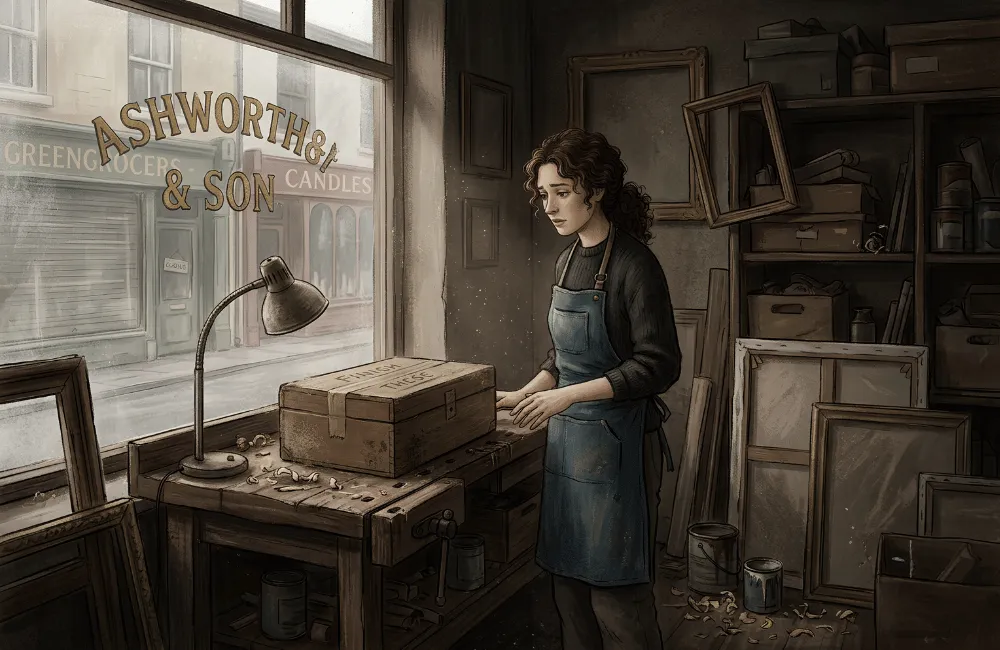

The shop smelled the same as it had for forty years, beeswax, sawdust, and something faintly metallic that Nell had never managed to place, though she suspected it was simply age. Ashworth & Son sat wedged between a vanished greengrocer's and a shop that sold nothing but candles. Its window still bearing her father's hand-painted lettering, slightly chipped at the S. She hadn't changed it. She told herself this was practicality; new signage cost money. Though she knew, if she was honest, that repainting it felt too much like agreeing he was gone.
Six months now. Six months of opening at half nine, sweeping gilding dust into the same corner, fielding the same three customers who wandered in wanting a passe-partout mount for a wedding photograph or a child's watercolour. It wasn't a bad life. It was, if anything, disturbingly manageable, the kind of manageable that made her wonder, at odd hours, what exactly she'd been doing with herself before her father died and left her holding the whole quiet weight of it.
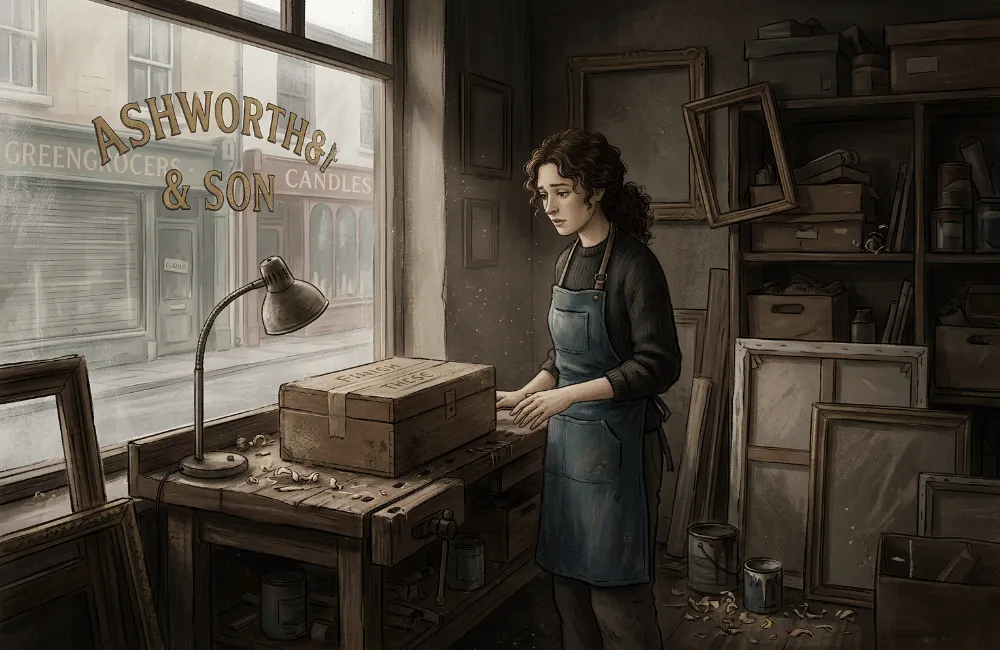
The box arrived on a Tuesday, delivered by a solicitor's clerk who seemed keen to get rid of it. No note beyond a compliment slip, Estate of R. Pellinore, per instruction and Nell's father's handwriting on the lid in grease pencil, half-rubbed away: finish these. Nothing else. No date, no explanation, though the ledger would later tell her the job had been logged eleven years ago and never marked complete, which was, in itself, entirely unlike him.
She didn't open it that first evening. She left it on the workbench under the window and went home, and told herself it was only because the shop was closing and she was tired. But she caught herself thinking about it twice before she fell asleep, not with curiosity exactly, more the way you think about a door left unlocked.
Nothing had happened. Nothing had been said. And yet when she came in the next morning and lifted the lid, the four photo frames inside. Old gilt, chipped in places, wrapped in yellowed newspaper going soft at the folds, seemed, for just a moment, to have been arranged differently than she remembered leaving them.
The Unfinished Work
The ledger lived where it always had, on the shelf behind the till, its spine cracked from decades of being pulled down and shoved back. Nell hadn't opened it since the funeral. She told herself she was looking for the Pellinore account out of tidiness, a loose end wanting to be tied off. However, her hands were less steady than tidiness required as she thumbed back through the years to find it.
R. Pellinore, Thistledown House. Four frames, gilt restoration. Deposit paid in full, 14th March. And then, in the column where her father always wrote Complete in his small, upright hand, nothing. Just a dash. She checked the following months, half-expecting to find it finished and simply misfiled, but the dash sat there, unmoved, page after page, as though he'd meant to come back to it and never had.
She sat with that for longer than she'd admit to anyone. Her father hadn't left work unfinished, not once in thirty years, not even the week he'd had his first turn with his heart.
There was something almost deliberate in it, and that unsettled her more than the gap itself. By the time she closed the ledger, she'd already decided. Not out of duty to a stranger's estate, but because some part of her needed to know what had stopped him, and what he'd wanted her to find in his place.
What the Frame Remembers
The landscape had come with the box, wrapped separately, as though someone had once meant it specifically for the first frame. It was unremarkable enough. A stretch of moorland, a low sky, the kind of amateur oil painting you'd find in any provincial saleroom, unsigned, unloved.
Nell cleaned the gilt with a soft brush and diluted spirit, working slowly along the acanthus moulding the way her father had taught her, and when the photo frame was ready, she set the canvas into it and stood back.
It looked better than it had any right to.
She noticed that first, a small, professional satisfaction, nothing more. The dull ochre of the hillside seemed to have gathered some warmth it hadn't had spread flat on the bench, and the sky, which she'd have sworn was a thin, chalky grey, now carried a bruised violet along its lower edge, as though weather were moving in.
It was only as she was writing up the restoration notes that she paused, pencil lifted, and looked again. There was a figure on the path near the bottom left: small, coated, facing away, that she was almost certain hadn't been there when she'd examined the canvas that morning. She leaned in close enough to smell the old varnish, searching for underpainting, for some trick of restoration she'd overlooked. There was nothing. No ghosting, no pentimento beneath the surface.
She told herself she'd missed it. Tired eyes, poor light, a dozen ordinary explanations queuing up politely to be believed. She wrote completely beside the first frame in the ledger, in her father's old column, and did not look at the painting again before locking up.
A Family Held in Gilt
She found the notebook by accident, tucked behind the ledger where it must have sat for years, not accounts, but her father's private hand, looser and less careful than his working script. Most of it was unremarkable: suppliers, gesso recipes, a sketch of a corner joint. But threaded through the practical entries were lines that read more like confession than craft.
A photo frame does not simply hold a painting, one reads. It holds what the painting cannot say for itself.
There were more, dated across years she recognised without wanting to, the winter her mother died, and the long, silent months after. He'd written about a portrait he'd once reframed for a widower, how the man had wept on collecting it, insisting the likeness had softened, grown kinder, as though grief itself had been drawn out through the gilt. Her father hadn't dismissed it. He'd written it down like evidence.
Nell sat with the notebook a long while, the shop dim around her, and understood something she hadn't let herself before: her father had never simply been a craftsman quietly getting on with things after her mother died. He had been doing exactly what she was doing now, reaching for a small, containable task and asking it to carry something far too large.
She had thought his quietness those years was distance. She saw now it might have been the opposite; a man trying, in the only language he trusted, to hold what he couldn't say aloud.
She closed the notebook gently, the way you might close a door on someone sleeping, and did not go back to the second frame that night.
The Second Frame
She left the portrait until last, though it was next in the box, wrapped tighter than the others, as though someone had wanted it protected rather than simply parcelled. When she finally unwrapped it, she found a woman's likeness, three-quarter turn, the paint darkened with age around the edges, competent work, though not fine, the sort of portrait a family might have commissioned rather than one a gallery would ever want.
The second picture frame took longer to restore than the first. She told herself this was simply the intricacy of the moulding, a foliate pattern gone brittle in places, and not that her hands kept finding reasons to slow down. When at last she set the canvas into it and turned it towards the light, she stood quite still.
The woman's face had changed. Not dramatically, nothing a stranger would remark upon, but the set of the mouth seemed softer than she'd first catalogued it, the eyes carrying a tiredness around them that hadn't been there, or that she hadn't seen. And there was something in the tilt of the head, in the particular way the jaw sat, that struck her with a familiarity she couldn't immediately place, until she could.
It was her mother's expression. Not her mother's face, nothing so exact, so provable, but the exact weary kindness her mother used to wear at the end of long days, an expression Nell hadn't consciously remembered in years and now could not unsee.
She sat down heavily on the workbench stool, painting still in her hands, and made herself ask the question plainly, the way her father never quite had: was the frame doing this, or was she simply grieving two people at once and finally letting herself look?
The Weight of Gilt
She didn't finish the last two photo frames that week. She let them sit, wrapped, while she went back through her father's notebook properly, start to end, and understood at last what he'd been circling without ever quite landing on it. The frames weren't holding anything on their own. They never had been. They simply gave grief somewhere to sit still long enough to be looked at, and looking, not the gilt, was always the hard part.
She thought of the dash beside Pellinore's name. Not an unfinished job, she realised now, but an unfinished conversation her father hadn't known how to have with himself. He'd stopped at three frames because the fourth, perhaps, asked something of him he wasn't ready to give.
Nell finished it herself, on a quiet Thursday, with no painting left to fit inside it, only the picture frame, restored and empty, gilt catching the last of the afternoon light. She didn't need it to hold anything. That, she thought, was rather the point.
She wrote a short letter to the Pellinore family, explaining the delay, and delivered all four frames herself rather than by courier.
An elderly woman answered the door, Pellinore's daughter, it turned out, and cried, briefly and without embarrassment, on seeing the portrait properly framed at last.
Walking back to the shop afterwards, Nell didn't feel lighter exactly. But something in her had settled, the way dust settles once a room has finally been disturbed and can be swept clean. She repainted the sign the following week. She kept the chip in the S.
























Sign in to leave a comment.