

Thread Mill vs. Tap: Which Tool Is Better for CNC Machining?
In the world of precision engineering and machining, selecting a proper threading tool is a significant factor that may affect productivity and quality in machining operations. In this regard, two threading tools that are commonly used in various machining operations are the thread mill and the tap tool. Even though both tools are used for a similar purpose in machining operations, there are significant differences in their working principles and application.
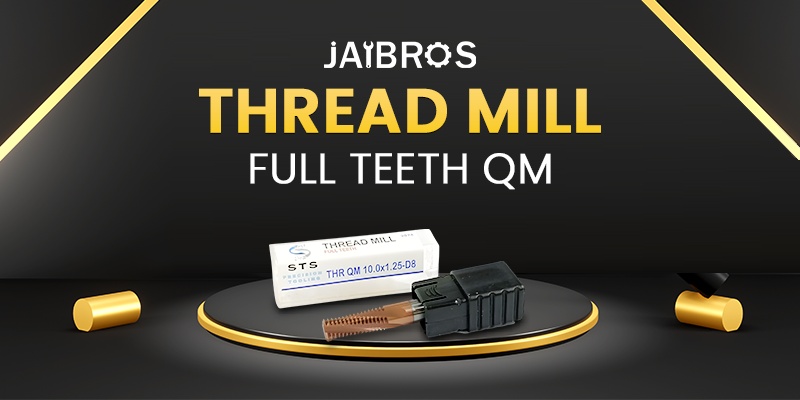
What is a thread-mill?
A thread mill is a specific type of cutting tool used in CNC machining for cutting internal and external threads through a helical interpolation method. A thread mill is different from a tap in that a tap makes a cut in a single pass, but a thread-mill makes a gradual cut.
The method is commonly used with contemporary CNC tools due to its versatility and precision. A thread-mill can be used for cutting multiple sizes of threads, making it an economical choice for most industries.
What is a tap?
A tap is a conventional threading tool that is intended for rapid threading in pre-drilled holes. It cuts threads by rotating into the material and threading it in one motion. Taps are simple to use and may be implemented in both automated and manual systems.
Taps are not as flexible as thread milling. A tap is intended for a specific type and size of threads; therefore, more than one tap is required for various uses.
How Thread Milling Works
The thread-mill operates through a CNC program that controls its movement in three axes. The cutting tool spins at high speed as it makes a circular and vertical movement to gradually cut the threads.
The process is carried out through a thread milling machine that ensures precise synchronization in the movement. This ensures that the thread produces high-quality threads with a good surface finish.
How Tapping Works
Tapping is a simpler process. Here, the tap rotates, enters, and threads the hole, moving downwards. After threading, the tap is withdrawn from the hole.
This process is quicker, but precision is required while creating the hole. If there is any error, tools may break, especially if a single tool is used for multiple processes.
Key Differences Between Thread-Mill and Tap
- There are a number of key differences between these two tools:
- Flexibility: A thread-mill can cut different thread sizes with a single tool, while taps require a separate tool to cut each thread size.
- Precision: Precision is more attainable through thread milling than through taps.
- Tool Breakage: Taps are more likely to break than thread milling tools, especially in hard materials; thread milling minimizes tool breakage.
- Speed: Taps are faster to use than thread milling tools, which makes them more appropriate in high-volume manufacturing scenarios.
- Chip Control: Thread milling tools allow better chip control than taps, which minimizes damage risks.
Advantages of Thread-Milling in CNC Machining
Some benefits that can be obtained by using a threadmill include:
- Improved Accuracy—The use of a CNC machine ensures that accurate results are obtained.
- Versatility—A single tool is capable of producing various types of threads.
- Reduced Downtime—There is a lower probability of tool breakage.
- Improved Finish—The finished threads are smooth.
- Suitable for Hard Materials—Thread milling is applicable to hard metals.
These benefits make thread milling a process that is most applicable in various industries due to its reliability and precision.
When to Use a Tap
However, in spite of its limitations, tapping has its uses in machining operations:
- For simple and repetitive operations
- For operations where speed is more important than flexibility
- For low-cost operations
- For operations on relatively soft materials in which tool breakage is not a significant problem
Taps continue to be used because they are simple and inexpensive.
Cost Considerations and Machine Investment
For example, in considering costs, it is observed that tapping tools have lower initial costs. However, in the long term, it is observed that thread-milling saves costs in tool inventory and tool longevity.
The cost of a thread milling machine may be high based on a CNC system and other features. However, it is observed that such a machine saves costs in efficiency and waste.
Moreover, it is observed that purchasing tools from a reliable online shop for CNC tools in India ensures quality and longevity, which in turn influences machining performance.
Choosing the Right Tool for Your Needs
The choice between a thread-mill and a tap will depend on a number of factors such as:
- Material being machined
- Volumetric production
- Level of precision required
- Cost involved
- Machine capabilities
For high-precision operations and complex operations, it is recommended that a thread-mill be used.
Why Thread-Milling is Gaining Popularity
With the advancement of technology in CNC machines, there is a shift towards more flexible and efficient machining. Thread-milling is becoming more popular as it minimizes risks, is more accurate, and gives better control over the entire process of threading.
With the demand for better quality and tolerance from industries, thread-milling is expected to rise even more.
Jaibros Tools—Trusted CNC Tool Supplier
Jaibros Tools Pvt. Ltd. is a trusted name in the field of industrial cutting tools and machining solutions in India. The company offers a wide range of products, including turning tools, milling cutters, threading tools, and precision measuring instruments. As a reliable CNC tools online shop in India, the company focuses on providing high-quality solutions that meet the needs of modern manufacturing industries. Their products are designed to improve machining performance, enhance productivity, and deliver consistent results across various applications.
FAQs
1. What is the main difference between a thread-mill and a tap?
A thread-mill makes threads using a helical motion, while a Tap makes threads using a linear motion.
2. Is thread-milling better than tapping?
Thread-milling is better, as the process is more accurate and flexible and minimizes the chances of breakage.
3. Can a thread mill tool completely replace taps?
No, Taps are still useful for simple and high-speed operations, while thread milling is used for accurate operations.
4. Does thread-milling require a CNC machine?
Yes, thread-milling is performed using a CNC machine or a thread milling machine.
5. Where can I buy quality threading tools in India?
You can buy quality threading tools from a reliable “CNC Tools Online Shopping India”.






























Sign in to leave a comment.