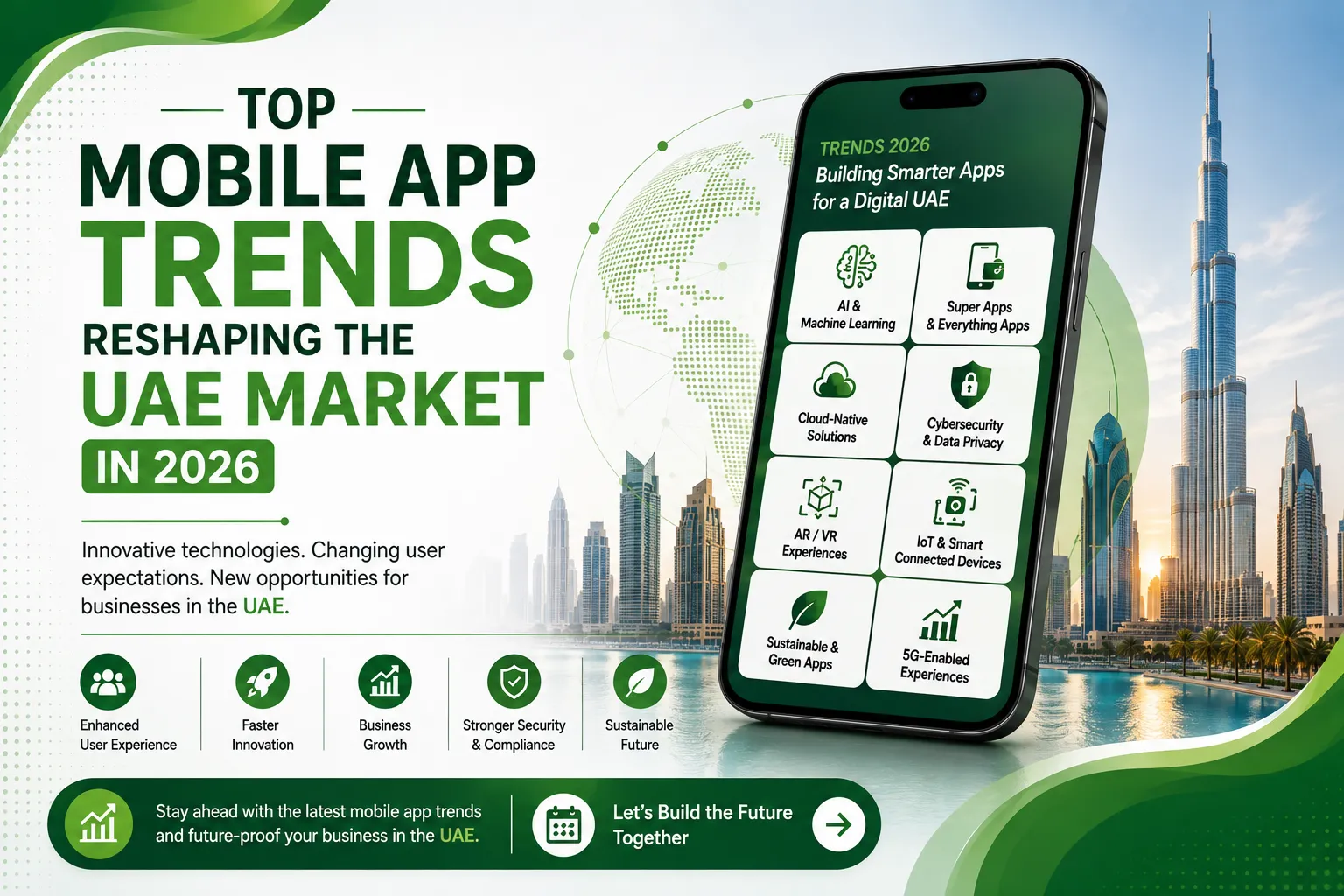

The United Arab Emirates (UAE) has established itself as one of the world's most digitally advanced economies. With widespread smartphone adoption, high-speed internet, government-led digital transformation initiatives, and a tech-savvy population, mobile applications have become an essential part of everyday life.
From ordering food and booking taxis to managing finances, shopping online, and accessing healthcare, consumers in the UAE expect fast, secure, and personalised mobile experiences. Businesses across industries are responding by investing in innovative mobile applications that improve customer engagement and drive growth.
As we move through 2026, mobile app development is evolving rapidly. Emerging technologies such as Artificial Intelligence (AI), cloud computing, IoT, blockchain, and immersive experiences are transforming how businesses connect with customers.
In this article, we'll explore the top mobile app trends reshaping the UAE market in 2026 and how businesses can leverage these trends to stay competitive.
Why the UAE Is a Leading Mobile App Market
The UAE continues to be a global hub for digital innovation. Government initiatives, smart city projects, and increasing investments in technology have accelerated digital adoption across industries.
Several factors are driving mobile app growth in the UAE:
- High smartphone penetration
- Tech-savvy consumers
- Strong digital infrastructure
- Government support for innovation
- Rapid growth of eCommerce
- Expansion of digital payment systems
- Rising demand for on-demand services
As customer expectations continue to rise, businesses need mobile applications that deliver speed, convenience, and seamless user experiences.
Top Mobile App Trends
These are some top mobile app trends reshaping the UAE market in 2026 and how businesses can leverage these trends to stay competitive.
1. AI-Powered Mobile Applications
Artificial Intelligence is no longer a futuristic concept—it has become a core feature of modern mobile apps.
Businesses are integrating AI to automate tasks, personalise user experiences, and improve customer service.
Popular AI Features
- AI chatbots
- Personalised recommendations
- Voice assistants
- Predictive analytics
- Smart search
- Automated customer support
For example, an eCommerce app can recommend products based on a user's browsing history, while a healthcare app can provide AI-driven health insights.
Business Benefits
- Better customer engagement
- Faster support
- Higher conversion rates
- Increased operational efficiency
- Personalised user experiences
AI is helping businesses deliver smarter and more intuitive mobile applications.
2. Super Apps Continue to Grow
Consumers increasingly prefer having multiple services within a single application.
Instead of downloading separate apps for payments, shopping, transportation, food delivery, and messaging, users want everything in one place.
Super apps are becoming increasingly popular in the UAE because they offer convenience and seamless experiences.
Common features include:
- Digital wallets
- Bill payments
- Food ordering
- Ride booking
- Online shopping
- Loyalty rewards
- Appointment scheduling
Businesses are exploring super app models to improve customer retention and increase engagement.
3. Mobile Commerce (mCommerce) Expansion
Mobile shopping continues to dominate consumer behaviour.
Today's customers expect:
- Fast checkout
- Secure payments
- Personalised offers
- Easy returns
- Real-time order tracking
Retailers are investing heavily in mobile commerce applications to improve customer experiences.
Key Features
- One-click purchasing
- Mobile wallets
- AI recommendations
- Push notifications
- Live order tracking
An optimised shopping app can significantly increase sales while improving customer loyalty.
4. Contactless and Digital Payments
Cashless transactions have become the preferred payment method for many UAE consumers.
Mobile applications now integrate multiple payment options, including:
- Digital wallets
- QR code payments
- Contactless payments
- Buy Now, Pay Later (BNPL)
- Bank transfers
Security remains a top priority, making encryption and biometric authentication essential features.
Business Advantages
- Faster transactions
- Improved customer convenience
- Reduced payment friction
- Higher purchase completion rates
Payment flexibility plays a major role in improving user satisfaction.
5. IoT-Enabled Mobile Apps
The Internet of Things (IoT) continues to reshape industries across the UAE.
Mobile apps are becoming central control hubs for connected devices.
Popular IoT applications include:
- Smart homes
- Smart offices
- Connected healthcare
- Industrial monitoring
- Fleet management
- Smart parking
Businesses are using IoT-powered apps to improve operational efficiency and deliver better customer experiences.
6. Augmented Reality (AR) Experiences
Augmented Reality is changing how customers interact with products and services.
Retail, real estate, and interior design businesses are adopting AR to provide interactive experiences.
Examples include:
- Virtual furniture placement
- Home decoration previews
- Virtual clothing try-ons
- Interactive property tours
- Product visualization
AR helps customers make more confident purchasing decisions while increasing engagement.
7. Stronger Mobile App Security
As mobile usage increases, so do cybersecurity threats.
Businesses are prioritising security to protect customer information and comply with data privacy regulations.
Essential security measures include:
- Multi-Factor Authentication (MFA)
- Biometric login
- End-to-end encryption
- Secure cloud storage
- Real-time threat monitoring
- API protection
Customers are more likely to trust businesses that prioritise security and transparency.
8. Cloud-Native Mobile Applications
Cloud technology is enabling businesses to build more scalable and reliable applications.
Cloud-native apps offer several advantages:
- Faster deployment
- Better performance
- Easy scalability
- Reduced infrastructure costs
- Improved disaster recovery
Cloud integration also supports remote work, collaboration, and real-time data synchronisation.
9. Cross-Platform App Development
Businesses are increasingly choosing cross-platform frameworks to reduce development costs and launch faster.
Instead of building separate apps for Android and iOS, companies can create a single codebase that works across multiple platforms.
Benefits include:
- Lower development costs
- Faster time to market
- Easier maintenance
- Consistent user experience
- Broader audience reach
For startups and growing businesses, cross-platform development offers an efficient way to maximise ROI.
10. Personalised User Experiences
Modern users expect apps to understand their preferences and provide relevant experiences.
Personalisation is becoming a key competitive advantage.
Popular personalisation features include:
- Customized dashboards
- Product recommendations
- Personalised offers
- Location-based services
- Smart notifications
- Dynamic content
By delivering tailored experiences, businesses can improve customer satisfaction and increase user retention.
Conclusion
The UAE's mobile app ecosystem is evolving rapidly, driven by technological innovation, changing consumer expectations, and a strong digital economy. Trends such as AI-powered experiences, super apps, cloud-native development, IoT integration, AR, mobile commerce, enhanced security, and personalised user experiences are shaping the future of mobile applications in 2026.
Businesses that embrace these trends will be better positioned to improve customer engagement, streamline operations, and gain a competitive edge in the market.
As mobile technology continues to advance, investing in a modern, scalable, and secure mobile application is no longer optional—it's essential for long-term success.
If you're planning to build a next-generation mobile app for the UAE market, LoudOwls is your trusted technology partner. From strategy and design to development and ongoing support, we create innovative mobile solutions that help businesses thrive in today's digital-first world.



























Sign in to leave a comment.