
The ubiquity of technology has reached new heights since the COVID-19 pandemic. Technological innovations were already transforming our lives, one invention after another, but with COVID-19 on the horizon, things accelerated rapidly. In the aftermath of the pandemic, technology became the saviour for governments and businesses to salvage a lose-lose situation. These innovations affect all facets of our lives, and marketing products to potential customers is no different.
The share of digital marketing budgets is increasing day by day, as one survey highlights an increase in spending for 63% of companies surveyed. Content marketing is gaining much traction, as evident by the popularity of digital platforms. Millennials and the Gen-Z population are especially keen on getting their information from digital platforms, so businesses scramble to put their products online. The increased dependence on online marketing has led to many innovations, including using Natural Language Processing to detect customers' emotions from their online interactions.
Sentiment analysis is a tool that allows businesses to gauge customer sentiments, be they positive, neutral or negative, by reviewing customers' online behaviour. Sentiment analysis tools scour the internet for online posts on social media platforms and online blogs and then extract customer emotions. Such sentiment analysis tools don't just extract emotions but are also powerful enough to analyze them for your branding needs. Businesses can now perform market research, customer feedback analysis, and more using these analytical tools.
One powerful tool that enhances sentiment analysis is text visualization. Text visualization allows analysts to represent and visualize text data simply yet comprehensively. These visual representations enable researchers, data scientists, and decision-makers to identify patterns, trends, and sentiments more efficiently and effectively. In this article, we will explore various tips and ideas on leveraging text visualization for sentiment analysis. We will delve into different visualization techniques, discuss their benefits, and provide practical advice on applying them to sentiment analysis tasks.
Importance of Sentiment Analysis
With tons of data available at any business' disposal, analysing such data to find meaningful insights that could help your business grow has become difficult. Here, technology through sentiment analysis tools play a big part in solving this problem for business owners and marketing agencies. Sentiment analysis lays bare the emotions found in user posts online, be it social media posts, news articles or blogs. It offers valuable insights into the customer mindset so businesses can manufacture products and deliver services tailor-made for their consumers.
· Customer Understanding and Satisfaction
Sentiment analysis helps businesses gain valuable insights regarding customer emotions and their opinions towards a product or service. Customer feedback is the single most important thing for any business to evolve and improve its services. Identifying positive and negative sentiments sets the company strategy and helps executives make key data-based decisions.
· Brand Monitoring and Reputation Management
With the proliferation of social media and online platforms, public opinions about brands can spread rapidly. Sentiment analysis helps monitor brand mentions and sentiment across these platforms, enabling businesses to track their brand reputation in real-time. This real-time identification of sentiments helps the brand mitigate crises and protect the brand's image.
· Market Research and Competitive Analysis
Sentiment analysis is a valuable tool for performing market research and competitor analysis. By analyzing consumer sentiments regarding specific products, features, or market trends, businesses can gain insights into market demand, identify emerging trends, and evaluate the success of marketing campaigns. Furthermore, sentiment analysis helps organizations understand comparative strengths and weaknesses with rivals.
· Customer Feedback Analysis and Product Improvement
Sentiment analysis lets businesses reviews customer feedback that may include online reviews and customer surveys. Businesses can gain actionable insights for product improvement, service enhancements, and addressing customer pain points by categorising and analysing sentiments expressed in this feedback.
Role of Text Visualization in Sentiment Analysis
Text visualization plays a significant role in sentiment analysis by providing visual representations of textual data, enabling analysts to better understand sentiment patterns, trends, and relationships.
· Visualizing Sentiment Distribution
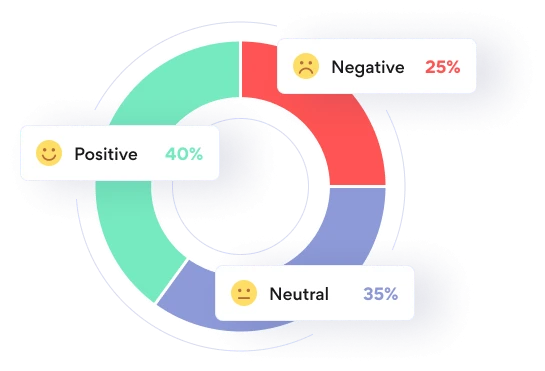
One key role of text visualization in sentiment analysis is visualizing the distribution of sentiments within a dataset. Analysts can quickly grasp the overall distribution by representing sentiment categories (such as positive, negative, or neutral) using visual elements such as bar charts, pie charts, or treemaps.
· Identifying Sentiment Trends over Time
Text visualization enables analysts to examine sentiment trends over time by visualizing sentiment changes across different time periods. Such classifications can be done daily, weekly, or monthly, thus identifying the temporal patterns in sentiment. Text visualization tools such as line graphs and heat maps capture the shifting trends in customer sentiments over time.
· Exploring Sentiment by Textual Features
Text visualization allows analysts to explore sentiments based on specific textual features. Analysts can identify areas that generate strong positive or negative sentiments by visualizing sentiment distributions within different categories, such as product features, service aspects, or customer segments.
· Visualizing Sentiment Associations and Relationships
Text visualization helps analysts uncover linkages between sentiments and other variables. Analysts can identify interesting patterns and insights by visualizing sentiment correlations with demographic factors or product attributes. Network diagrams and scatter plots help brands understand how marketing interventions or influencer marketing is affecting the brand’s visibility and reach.
· Enhancing Interpretability and Communication
Text visualization aids in the interpretation and communication of sentiment analysis results. By presenting sentiment analysis findings through visually appealing and intuitive visualizations, analysts can effectively communicate insights to stakeholders, decision-makers, or non-technical audiences.
Understanding Sentiment Analysis
· Definition and Goals of Sentiment Analysis
The main objectives of sentiment analysis:
Sentiment Classification: The first goal of sentiment analysis is to classify text into predefined sentiment categories, typically positive, negative, or neutral, by assessing the sentence's polarity.Sentiment Quantification: Sentiment analysis aims to quantify the intensity or strength of sentiment in textual data. Sentiment analysis techniques can assign sentiment scores or values to indicate the degree of positivity or negativity the text conveys.Opinion Extraction: Sentiment analysis involves the extraction of opinions or subjective information from text.Aspect-based Sentiment Analysis: In addition to overall sentiment, sentiment analysis can identify sentiment associated with specific aspects or features within the text. This categorized analysis helps to understand sentiment variations related to different components or attributes of a product, service, or experience.Trend Analysis: Sentiment analysis can provide insights into sentiment trends and changes over time by analyzing sentiment patterns across different time periods.Comparative Analysis: Sentiment analysis allows for comparative analysis between different entities, products, or topics, thus giving users the ability to make data-driven decisions.Customer Feedback Analysis: Sentiment analysis is often applied to analyze customer feedback, such as reviews, surveys, or social media comments gauging customer satisfaction or dissatisfaction levels regarding a product or service.· Methods and Techniques Used in Sentiment Analysis
Sentiment analysis employs various methods and techniques to extract, analyze, and interpret sentiments from textual data. Let's explore the three commonly used approaches to perform sentiment analysis:
Rule-based Approach
The rule-based approach of performing sentiment analysis is made by the lexicon-based method or by defining linguistic roles. An NLP model is trained to assess the text and to identify the polarity based on predefined rules. Each word is assigned a sentiment score, and an aggregate score is calculated to find the overall sentiment rating of the text.
Supervised Machine Learning Approach
In supervised machine learning, a training dataset is created by manually annotating text with sentiment labels (e.g., positive, negative). The labelled data helps train the ML (machine learning) model, which then extracts sentiments from the text. Different algorithms are then applied to extract feature-based sentiments or other categorized sentiments (topic modelling) from the data.
Hybrid Approaches
Finally, hybrid methods combine multiple techniques or approaches to enhance sentiment analysis performance. For example, a rule-based approach can be combined with machine learning algorithms to leverage both rule-based patterns and statistical learning from data.
Overall, sentiment analysis methods and techniques continue to evolve with advancements in NLP and machine learning, enabling more accurate and nuanced analysis of sentiment in textual data.
· Challenges and Limitations of Sentiment Analysis
Challenges in performing sentiment analysis arise from the complexity of language, the subjectivity of sentiments, and the contextual nuances present in textual data. Here are some common challenges and limitations of sentiment analysis:
Subjectivity and Context: Sentiments expressed in the text are often subjective and context-dependent. The same words can be used in different contexts; thus, analytical models may struggle to accurately capture these nuances, leading to misinterpretations or incorrect sentiment assignments.
Ambiguity and Sarcasm: Textual data frequently contain ambiguous or sarcastic expressions that can be challenging to interpret correctly. Sarcastic remarks, irony, or negations can reverse the sentiment conveyed by specific words or phrases, leading to inaccurate results.
Domain and Cultural Differences: Sentiment analysis models trained on generic datasets may not perform well in specific domains or cultural contexts. Language use, sentiment expressions, and cultural norms vary across different industries, regions, or communities.
Data Availability and Quality: The availability and quality of labelled training data can significantly impact the performance of sentiment analysis models. In other words, only a well-worked training model will yield accurate sentiment analysis scores.
Sentiment Disagreements: Different individuals may have varying interpretations and opinions about sentiment in text. Sentiment analysis models may not always align with human judgments, leading to disagreements in sentiment classification.
Multilingual and Multimodal Challenges: Sentiment analysis becomes more complex when dealing with multilingual data or multimodal inputs that combine text, images, or audio. Translating sentiments across languages or extracting sentiment from non-textual sources requires additional processing and may introduce additional challenges and inaccuracies.
Conclusion
In conclusion, text visualization is a powerful tool that enhances sentiment analysis capabilities by providing visual representations of sentiment patterns, trends, and relationships within textual data. By leveraging various visualization techniques, analysts can better understand sentiment distribution, temporal sentiment analysis, and finding linkages between entities.
Text visualization not only aids in interpreting and exploring sentiment analysis results but also facilitates effective communication of insights to stakeholders. Sentiment analysis is a key tool business use to extract meaningful insights from raw text. Such raw textual data is easily available, but sentiment analysis provides the finishing touch to make the data more useful.
Using text visualization in tandem with sentiment analysis can reduce some of the challenges related to both techniques. Brands and businesses can improve their services and products based on customer feedback extracted through sentiment analysis.










Sign in to leave a comment.