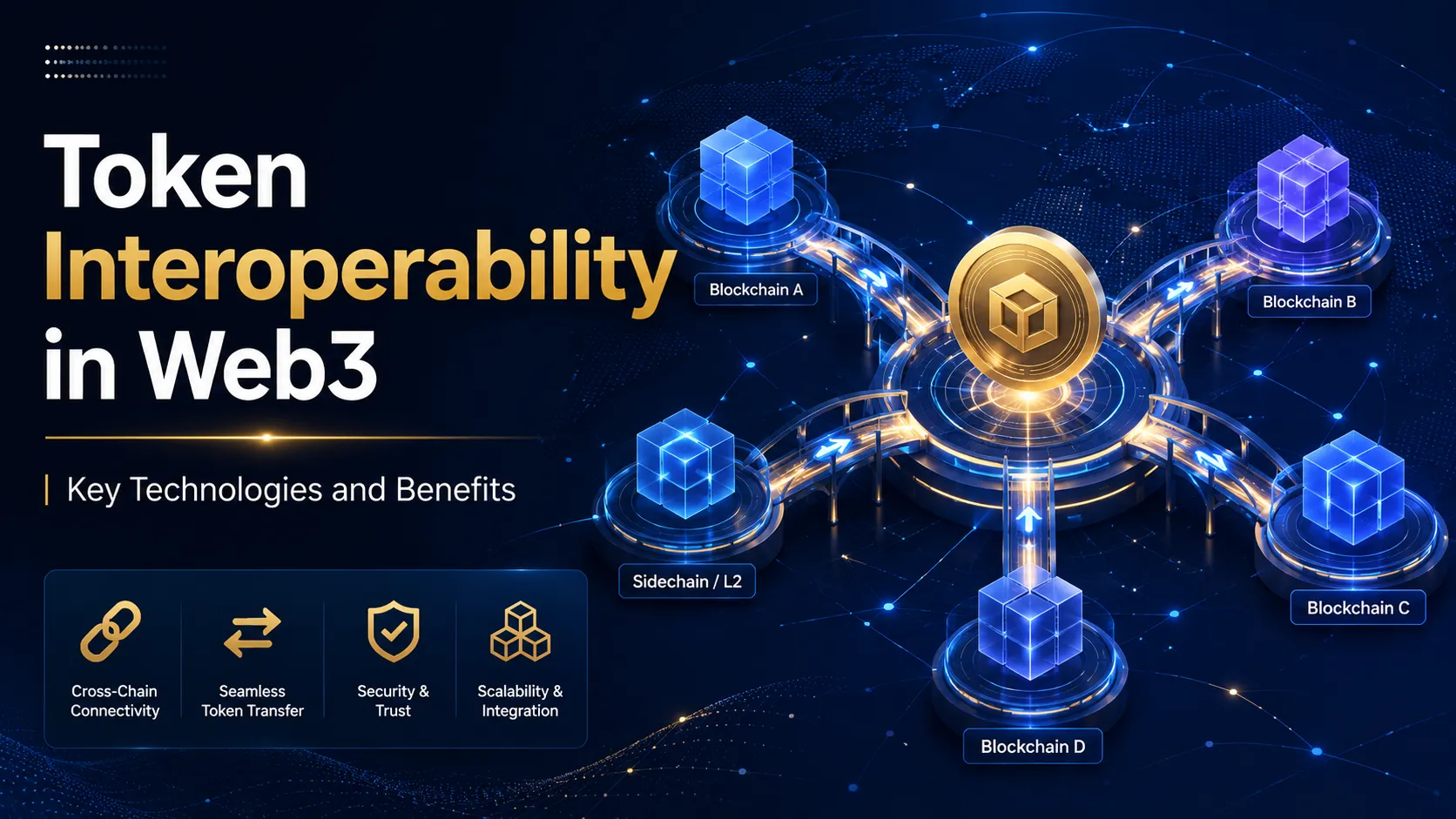

Web3 is no longer limited to a single blockchain environment. Users, applications, liquidity, and digital assets increasingly operate across Ethereum, Layer 2 networks, Solana, BNB Chain, and other ecosystems. This fragmentation creates a practical challenge for token projects. An asset created for one network does not automatically become usable elsewhere.
Token interoperability addresses this problem by allowing tokens and token-related instructions to move, communicate, or maintain coordinated functionality across different blockchain networks. The technology behind interoperability ranges from token bridges and wrapped assets to cross-chain messaging protocols and native multi-chain token standards.
For businesses exploring token development, interoperability can expand user access and application integrations. It also introduces additional technical and security considerations. A successful strategy requires more than connecting two blockchains. It requires clear control over token supply, message verification, liquidity, permissions, and failure handling.
What Is Token Interoperability?
Token interoperability is the ability of a digital asset and its associated applications to operate across different blockchain networks while preserving defined ownership, supply, and transaction rules. For projects working with Blockchain App Factory, this approach can support token ecosystems designed for broader multi-chain accessibility.
A simple example involves a token initially issued on Ethereum. Users may later need to use the asset on an Ethereum Layer 2 or another supported network. An interoperability system can coordinate that movement through mechanisms such as locking and minting, burning and releasing, or cross-chain messaging.
The important point is that interoperability does not mean every blockchain becomes technically identical. Each network retains its own execution environment and consensus model. The interoperability layer provides the communication or asset-transfer mechanism between them.
For token issuers, this distinction matters because cross-chain functionality changes the architecture surrounding the token. Blockchain App Factory can help businesses evaluate token architecture, blockchain selection, smart contract development, and multi-chain requirements as part of a structured token development strategy.
Why Token Interoperability Matters
Blockchain fragmentation creates friction for both users and developers.
A user holding tokens on one network may need to move them before interacting with an application on another network. A decentralized application may also need information from another chain to complete an operation.
Interoperability can reduce these barriers.
For example, a gaming ecosystem could allow users to move an in-game asset between supported networks. A DeFi application could use cross-chain messaging to respond to events from another blockchain. A tokenized asset platform could maintain controlled representations across multiple environments where its users operate.
The business value comes from access and connectivity, not from supporting more networks for its own sake.
A project should expand across chains when interoperability solves a real user or product requirement.
Key Technologies Behind Token Interoperability
Several technologies can support cross-chain token functionality. They do not all provide the same security model or user experience.
Token Bridges
Bridges connect blockchain networks by coordinating asset movement between them.
A common model locks tokens on the source chain and creates a corresponding representation on the destination chain. When users return the assets, the destination representation is burned and the original assets are released.
This approach requires strict supply accounting.
If a project has 100 million tokens in existence, its bridge architecture must prevent unauthorized creation of additional representations. A failure in the bridge's control mechanism can create serious economic and security problems.
Projects should examine the bridge's validator, verification, custody, and emergency-control architecture before relying on it for valuable assets.
Wrapped Tokens
Wrapped assets represent an asset from one blockchain in another blockchain environment.
The representation is useful because applications on the destination chain can interact with the asset using that network's token standards.
The limitation is that the wrapped asset depends on the mechanism maintaining the relationship between the original asset and its representation.
For this reason, users and token issuers need to understand who controls custody, how reserves are verified, and how redemption works.
Cross-Chain Messaging
Cross-chain messaging allows information or instructions to move between networks.
Chainlink's Cross-Chain Interoperability Protocol, or CCIP, is one example. Its documentation describes CCIP as infrastructure for sending messages and transferring tokens across supported blockchain networks. Chainlink also documents capabilities for programmable token transfers, where token movement and instructions can be combined.
Messaging can support more advanced applications than simple token transfers.
For instance, a user could initiate an action on one blockchain while a smart contract on another network responds to a verified message.
Native Multi-Chain Token Standards
Some interoperability architectures aim to make tokens available across multiple networks while coordinating supply and token behavior through a standardized framework.
LayerZero's Omnichain Fungible Token model is one example of this approach. Its documentation describes OFTs as tokens that can be transferred between supported chains without relying on wrapped versions of the asset.
The underlying architecture matters because the project needs a clear answer to one fundamental question:
Where does the canonical token supply reside, and how is supply controlled across networks?
How Cross-Chain Token Transfers Work
A simplified cross-chain transfer can follow several stages.
Suppose a user owns 1,000 tokens on Network A and wants to use them on Network B.
The interoperability system can:
- Verify the user's transaction on Network A.
- Lock or burn the source tokens depending on the architecture.
- Generate a verified cross-chain message.
- Deliver the message to Network B.
- Mint or release the corresponding tokens.
- Update the destination user's balance.
The exact process differs between protocols.
The important architectural requirement is consistency. The system must prevent double spending and unauthorized supply creation while maintaining a reliable relationship between the source and destination representations.
Token Interoperability and Liquidity
Interoperability can improve access to liquidity, but it does not automatically create deeper markets.
A token available on five networks may have fragmented liquidity across those ecosystems. Each network may have different trading pairs, liquidity pools, users, and market makers.
Consider a token with $5 million of total liquidity distributed across five markets. The aggregate number looks useful, but each individual market can remain relatively shallow.
This can affect:
- Slippage
- Price discovery
- Trade execution
- Arbitrage
- Market depth
- User experience
Token teams should evaluate liquidity at the network and market level, rather than looking only at aggregate figures.
Security Is the Biggest Interoperability Challenge
Cross-chain infrastructure creates additional security assumptions.
A conventional token contract already requires careful testing and access control. A cross-chain token adds components responsible for communication, verification, and supply management.
Potential risk areas include:
- Bridge contracts
- Message verification
- Validator infrastructure
- Relayers
- Administrative keys
- Upgrade permissions
- Token minting authority
- Liquidity pools
- Chain-specific smart contracts
The history of blockchain bridges shows why this area deserves special attention. The Ronin Bridge exploit in 2022 demonstrated how compromised validator keys can result in substantial unauthorized asset transfers. The FBI attributed the incident to the North Korean group Lazarus Group.
The lesson for token developers is broader than any single bridge. Cross-chain systems need security controls covering both smart contracts and operational infrastructure.
Interoperability for Different Token Use Cases
DeFi Tokens
DeFi projects can use interoperability to access users and liquidity across multiple ecosystems. Cross-chain messaging can also allow applications to coordinate activity between networks.
The main challenge is maintaining consistent pricing, liquidity, and risk controls across environments.
Gaming Tokens
Gaming applications can benefit from interoperability when users want to use assets across different games or networks.
Low transaction costs and fast confirmation can be important for high-frequency gaming activity.
RWA and Security Tokens
Real-world asset platforms face more complex requirements. Token transfers can depend on investor eligibility, jurisdiction, KYC requirements, and permission controls.
Cross-chain architecture must preserve these restrictions across every supported environment. A token cannot become unrestricted simply because it has moved to another network.
Governance Tokens
Cross-chain governance allows token holders on different networks to participate in coordinated decision-making.
The challenge is preventing double voting and maintaining accurate voting power across networks.
Benefits of Interoperable Token Development
A well-designed interoperability strategy can provide several advantages.
Broader user access: Users can interact with the token through multiple ecosystems.
Greater application compatibility: Tokens can connect with applications operating on different networks.
Expanded liquidity opportunities: Projects can establish markets across relevant ecosystems.
Flexible infrastructure: Teams can choose networks based on application requirements rather than restricting the entire product to one chain.
Improved user experience: Properly designed cross-chain systems can reduce the need for users to manually manage multiple assets.
These benefits depend on actual adoption. Supporting additional networks without users or applications can create maintenance costs without meaningful business value.
What Does the Future Hold for Token Interoperability?
The direction of blockchain infrastructure suggests that interoperability will remain important as applications operate across more execution environments.
Ethereum's roadmap, for example, continues to focus on scaling while supporting an ecosystem of Layer 2 networks.
The future is unlikely to be defined by every token existing on every blockchain. Instead, successful projects will choose networks based on user demand, product requirements, liquidity, security, and ecosystem fit.
Interoperability becomes valuable when it removes a genuine barrier between users and applications.
Conclusion
Token interoperability is becoming an important architectural consideration for Web3 projects operating across multiple blockchain ecosystems. Bridges, cross-chain messaging, wrapped assets, and multi-chain token standards provide different ways to connect networks, but each approach introduces its own technical and security considerations.
For businesses planning token development, interoperability should begin with a clear business requirement. The project should define where users operate, which networks support the product, how token supply will be controlled, where liquidity will exist, and how cross-chain security will be managed. A well-designed interoperability strategy can connect users and applications without turning multi-chain expansion into unnecessary technical complexity.
























Sign in to leave a comment.