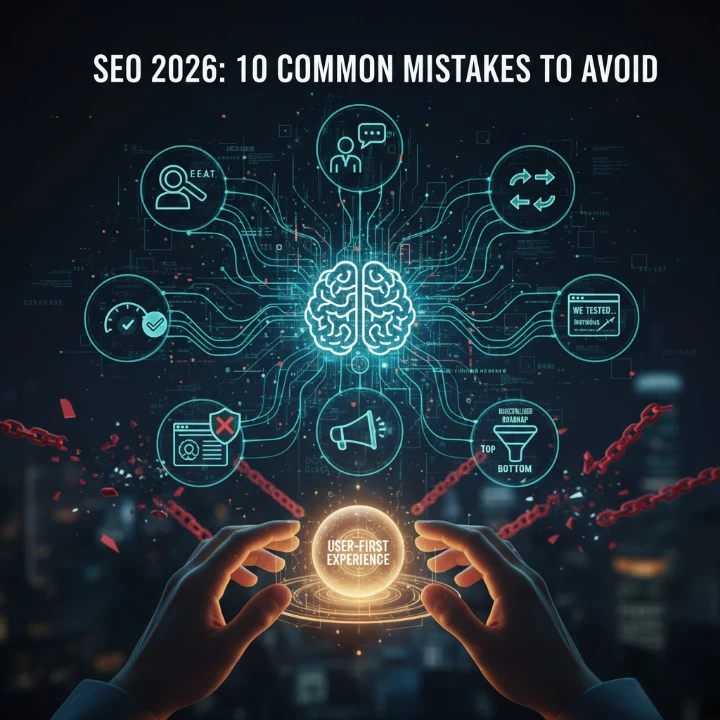

SEO continues to be an essential channel for organic growth, but the strategies that worked five, or even two years ago, are no longer enough. In 2026, the industry is defined by smarter algorithms, the integration of AI in search, and an unwavering demand for trustworthy, user-first experiences. Success hinges on adapting to these shifts while avoiding critical pitfalls that can sink your visibility.
This article tells you the ten most common SEO mistakes to avoid in 2026, providing a clear roadmap for building a strategy that is both resilient and effective.
1. Ignoring the Dominance of E-E-A-T
The Mistake: Treating E-E-A-T (Experience, Expertise, Authoritativeness, and Trustworthiness)
as a minor ranking factor instead of the cornerstone of your content strategy.
The 2026 Reality: Google is increasingly rewarding smaller blogs and websites created by individuals with real, lived experience over faceless corporate content. This is largely a response to the influx of AI-generated text, making social proof more critical than ever. E-E-A-T is not just what you say about yourself; it's what others say about you. A website's failure to build and demonstrate its E-E-A-T will struggle to rank, regardless of its technical optimization.
How to Fix It:
- Build Social Proof: Actively seek opportunities to be featured on other reputable sites. Go on industry podcasts, participate in interviews, and encourage case studies from your clients.
- Showcase Experience: Don't just write about a topic; write from your experience. Use first-person pronouns, share personal anecdotes, and include original photos, videos, or data from your own testing.
- Do Your Reputation Research: Regularly search for your brand name and see what others are saying. Positive reviews, forum mentions, and news articles all contribute to a trustworthy online reputation.
2. Creating Complex, Unclear Content
The Mistake: Writing content that is overly technical, jargon-heavy, and difficult for the average reader to understand.
The 2026 Reality: Search engines prioritize content that is readable, clear, and genuinely helpful . Google's algorithms are designed to identify content that satisfies user intent, and complicated writing that fails to provide a clear answer will be pushed down in the rankings. The goal is the "perfect click"—when a user finds your page so satisfying they don't need to hit the back button.
How to Fix It:
- Simplify Your Language: Break down long, complex sentences into shorter, direct ones. Swap out industry jargon for terms your audience actually uses.
- Use Active Voice: Write in an active voice to make your content more engaging and easier to follow.
- Structure for Scannability: Use descriptive subheadings, bullet points, and numbered lists to break up text and help users (and AI) find information quickly.
3. Having Poor or No Internal Linking
The Mistake: Treating internal links as an afterthought or failing to use them at all, leaving pages as isolated "orphans."
The 2026 Reality: A strong internal linking structure is the backbone of a healthy website. It helps search engines understand your site's architecture, discover new pages, and, most importantly, pass authority (link equity) from your strong pages to newer or less established ones. Without it, you are failing to leverage your own site's potential.
How to Fix It:
- Build a Web of Links: Make sure every page on your site has at least a few relevant internal links pointing to it and is linking out to other relevant pages.
- Use Descriptive Anchor Text: Instead of linking generic text like "click here," use short, descriptive anchors that tell users and Google what the linked page is about.
- Conduct a Linking Audit: Regularly use tools like Screaming Frog to audit your internal links, identify orphaned pages, and fix broken links.
4. Neglecting Technical SEO and Site Speed
The Mistake: Overlooking the foundational health of your website, leading to slow loading speeds and a poor user experience.
The 2026 Reality: Page speed remains a critical factor for both user experience and rankings. A slow site leads to higher bounce rates and signals to search engines that your site provides a subpar experience. Furthermore, ignoring technical upkeep means you're building your content on a shaky foundation.
How to Fix It:
- Compress Images: Large images are a primary cause of slow loading. Use modern formats and compression tools to reduce file sizes without sacrificing quality.
- Minify Code: Remove unnecessary spaces, characters, and code from your CSS, JavaScript, and HTML files.
- Perform Regular Health Checks: Use Google Search Console and other auditing tools to regularly monitor for and fix technical issues like broken links, crawl errors, and faulty redirects.
5. Misusing the 'Disallow' Directive
The Mistake: Making catastrophic errors in your robots.txt file that inadvertently block search engines from your entire site or critical resources.
The 2026 Reality: The Disallow directive is a powerful but dangerous tool. A single misplaced slash or wildcard can have devastating consequences. A common modern mistake is blocking CSS and JavaScript files, which prevents Google from properly rendering your pages and can severely depress your rankings .
How to Fix It:
- Never Use
Disallow: /: This directive will block crawlers from your entire website—use with extreme caution. - Allow Critical Assets: Ensure your
robots.txtfile does not block CSS, JS, or image files that are essential for displaying your pages. - Test Rigorously: Always use the Google Search Console Robots.txt Tester and the URL Inspection tool to verify that your most important pages are accessible and rendering correctly.
6. Overlooking Off-Site Brand-Building
The Mistake: Focusing exclusively on non-branded search traffic while ignoring strategies to grow your brand recognition.
The 2026 Reality: An increase in branded search volume (people searching for your brand by name) creates a "tide that lifts all boats," improving the rankings for all your target keywords . Google interprets branded searches as a powerful trust signal. If no one is searching for you, it's harder to prove your authority.
How to Fix It:
- Manufacture Word-of-Mouth: Use social media campaigns, influencer partnerships, or digital PR to get people searching for "{your brand name} + {target keyword}" .
- Build a Presence on Forums: Engage authentically on platforms like Reddit and Quora to build a community and direct recognition back to your brand .
- Invest in Digital PR: Earn mentions and links from authoritative news sites and industry blogs to build your reputation at scale . This is where working with a seasoned SEO consultant Dubai can provide the specialized outreach and strategy needed to build your brand's profile in a competitive market.
7. Writing Weak, Impersonal Title Tags
The Mistake: Sticking with generic, SEO-optimized title tags that lack personality and fail to entice clicks.
The 2026 Reality: Google is increasingly rewarding title tags that resemble compelling YouTube titles—ones that use first-person pronouns and emotional hooks to increase click-through rates (CTR) . In a search landscape where AI overviews compete for attention, a high CTR is a powerful ranking signal.
How to Fix It:
- Inject Personality: Shift from "10 Best Adjustable Dumbbells" to "We Tested 10 Adjustable Dumbbells for 6 Months (2026 Results)."
- Promise Value: Make a specific, compelling promise in your title that your content delivers on. Avoid empty clickbait .
- Use Pronouns: Incorporate "I," "We," or "You" to create a more personal and engaging connection with the searcher.
8. Forgetting the Power of Video Content
The Mistake: Treating YouTube as a separate channel instead of an integral part of your SEO strategy.
The 2026 Reality: Video is a powerful tool for building trust and authority, often converting visitors better than written content alone . Furthermore, having a video embedded in your article can improve its dwell time and provide another avenue to rank in search results.
How to Fix It:
- Repurpose Top Content: Turn your best-performing blog posts into YouTube videos and embed those videos directly back into the original articles .
- Show, Don't Just Tell: Use video for tutorials, product demonstrations, and behind-the-scenes looks that are difficult to convey with text alone.
- Build a Channel: Dedicate resources to building a YouTube presence as a long-term bet for brand authority and diversified traffic.
9. Focusing Only on Top-Funnel Content
The Mistake: Creating only broad, informational content that is most susceptible to "zero-click" searches where users get their answer directly from an AI overview.
The 2026 Reality: While approximately 60% of Google searches end without a click, bottom-of-the-funnel transactional queries have a much lower no-click rate . A strategy focused solely on top-funnel content may generate brand awareness but will struggle to drive conversions and qualified leads.
How to Fix It:
- Balance Your Content Funnel: Continue creating top-funnel content for authority, but prioritize middle and bottom-funnel content like in-depth "best X" lists, comparison guides, and product reviews that users are likely to click on .
- Target Commercial Intent: Research and create content for keywords that indicate a user is ready to buy or hire. For a business looking to scale, this strategic shift in content planning is a core service offered by a dedicated SEO Dubai agency.
10. Chasing Tactics Instead of Building a Discipline
The Mistake: Panicking over every new algorithm update or AI tool and constantly changing direction without a balanced, disciplined strategy.
The 2026 Reality: The most successful SEO teams don't chase shiny objects. They build a disciplined strategy that balances short-term wins, long-term bets, and essential maintenance . This structured approach cuts through the noise and ensures sustainable growth.
How to Fix It:
- Divide Your Focus: Allocate your resources strategically. Spend 60-70% on short-term wins you can execute yourself (like adding FAQs or structured data). Dedicate 10-20% to long-term bets that require cross-team coordination (like building a YouTube channel or a Reddit presence). Use the remaining time for maintenance and learning .
- Set SMART Goals: Keep projects focused and measurable to prove impact and maintain stakeholder trust .
- Prioritize by Dependencies: Understand that a project requiring a developer is not a short-term win. Classify projects correctly to manage expectations and resources effectively .
Concluding Words: Succeeding in SEO by Avoiding Common Pitfalls
The path to SEO success in 2026 is less about finding secret tricks and more about diligently executing a user-focused, authoritative, and technically sound strategy. The common thread among these mistakes is a disconnect between what the website offers and what both users and search engines value: a trustworthy, helpful, and seamless experience.
By avoiding these ten mistakes—from ignoring E-E-A-T to neglecting technical health and chasing fleeting trends—you can build an online presence that not only ranks but also resonates with your audience and drives meaningful business results.




























Sign in to leave a comment.