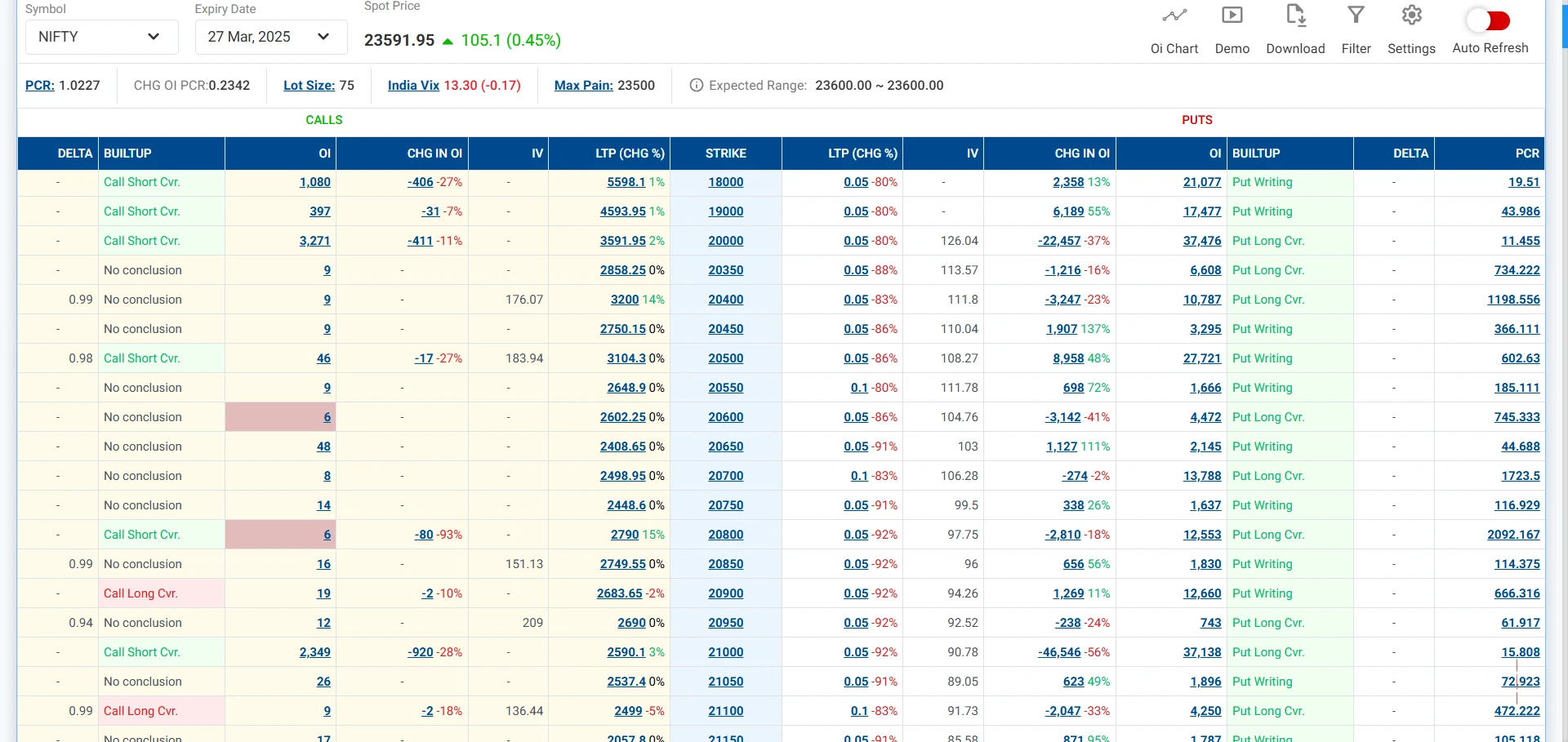

The NSE Option Chain is a powerful tool for traders looking to analyze market sentiment and make informed trading decisions. By understanding how to interpret the NSE Option Chain, traders can identify potential opportunities and optimize their strategies for maximum profitability. In this blog, we will explore the top five strategies that can help traders leverage the NSE Option Chain effectively.
1. Understanding Open Interest (OI) for Trend Confirmation
One of the key indicators in the NSE Option Chain is Open Interest (OI). It represents the number of outstanding contracts in the market and helps traders determine the strength of a trend.
How to Use OI for Trading?
- Rising OI with Increasing Price: Indicates a strong bullish trend as more traders are entering long positions.
- Rising OI with Decreasing Price: Suggests a strong bearish trend with increasing short positions.
- Declining OI with Increasing Price: Signals short covering, meaning the trend may weaken soon.
- Declining OI with Decreasing Price: Indicates long unwinding, a bearish sign.
By monitoring OI levels in the NSE Option Chain, traders can confirm trends and avoid false breakouts.
2. Identifying Support and Resistance Levels Using the NSE Option Chain
The NSE Option Chain provides crucial insights into support and resistance levels by analyzing the strike prices with the highest OI.
How to Identify Key Levels?
- High Call OI at a particular strike price acts as a resistance level since sellers are expecting the price to stay below it.
- High Put OI at a strike price serves as a support level, as put sellers anticipate the price to remain above it.
- Shifts in OI from one strike price to another indicate changing market sentiment, helping traders adjust their positions accordingly.
Using the NSE Option Chain to spot support and resistance levels allows traders to set accurate entry and exit points for their trades.
3. Using Put-Call Ratio (PCR) for Market Sentiment Analysis
The Put-Call Ratio (PCR) is a valuable metric derived from the NSE Option Chain that helps gauge market sentiment.
How to Interpret PCR?
- PCR > 1: More puts than calls, indicating bearish sentiment.
- PCR < 1: More calls than puts, signaling bullish sentiment.
- PCR Near 1: Suggests a neutral market with no clear trend.
By tracking changes in PCR over time, traders can anticipate potential reversals and align their trades with the prevailing sentiment.
4. Implied Volatility (IV) and Its Role in Option Trading
Implied Volatility (IV) is another crucial aspect of the NSE Option Chain that impacts option pricing. It measures the expected volatility of the underlying asset.
How to Use IV for Trading?
- High IV: Indicates greater market uncertainty, leading to higher option premiums. Traders can sell options in such conditions to benefit from time decay.
- Low IV: Suggests stable market conditions, making it favorable for buying options as premiums are lower.
- IV Crush: Happens after major events like earnings announcements, causing option prices to drop significantly.
Traders should use IV insights from the NSE Option Chain to select the right trading strategy based on market volatility.
5. Option Chain-Based Straddle and Strangle Strategies
The NSE Option Chain is instrumental in executing non-directional strategies like Straddles and Strangles, which are designed to profit from volatility.
How to Execute These Strategies?
- Straddle: Buy a Call and a Put at the same strike price to profit from big moves in either direction.
- Strangle: Buy a Call and a Put at different strike prices (OTM options) for a lower cost than a straddle, benefiting from large price swings.
By analyzing IV and support/resistance levels from the NSE Option Chain, traders can maximize gains using these volatility-based strategies.
Final Thoughts
Mastering the NSE Option Chain can significantly enhance a trader’s ability to make informed decisions and improve profitability. By incorporating these five strategies—Open Interest analysis, support/resistance identification, Put-Call Ratio interpretation, Implied Volatility assessment, and Straddle/Strangle strategies—traders can gain an edge in the options market.
Understanding and effectively using the NSE Option Chain requires continuous learning and practice. However, once mastered, it becomes an indispensable tool for maximizing trading success in the derivatives market.
By applying these insights and regularly monitoring the NSE Option Chain, traders can make better-informed decisions and capitalize on profitable opportunities in the options market.





























Sign in to leave a comment.