
Top 5 Sunscreen Mistakes You're Likely Committing, and Their Solutions
Sunscreen is an indispensable item for summer, acting as your unseen defence against sun-induced burns, harm to the skin, and the effects of ageing. However, here's a sobering thought: Many of us unintentionally undermine our defence against the sun’s rays due to minor yet consequential errors.
You might be faithfully applying it each day, which is an excellent start, but the reality is that even seemingly insignificant mistakes can severely diminish the efficacy of your sun protection strategy. Neglecting to use a sufficient quantity, forgetting to reapply, or overlooking crucial areas can render your skin susceptible and prone to accelerated ageing, pigmented blemishes, and harm triggered by ultraviolet radiation.
The good news is that correcting the majority of these errors is straightforward once you're conscious of them.
Let’s examine the five most frequently encountered sunscreen application mistakes, alongside the methods to rectify them, ensuring your skin receives professional-grade protection.

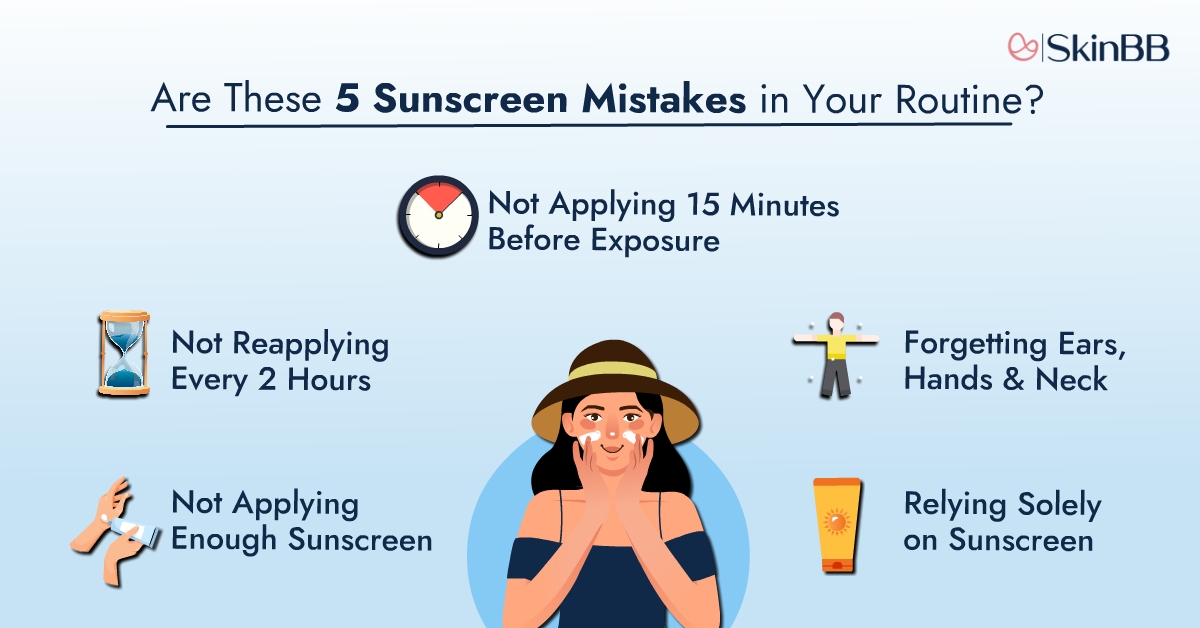
Mistake #1: Using Too Little SPF: Why a Tiny Dab Is Insufficient
One of the most typical blunders when it comes to sunscreen is applying an insufficient amount.
Applying a tiny bit, like an amount the size of a pea for your face, may seem sufficient, but it is actually far from what you need. Dermatologists advise using a quantity of sunscreen equivalent to the length of two full fingers for your face and neck surfaces by themselves. This is roughly equivalent to half a teaspoon.
Despite this, numerous individuals hesitate to put on the suggested quantity. One typical factor is concern over the whitening effect that certain sunscreens leave behind, particularly those containing mineral-based substances such as zinc oxide or titanium dioxide that serve as ultraviolet filters.
However, using less than the suggested amount has a substantial negative effect on the real SPF that your skin gets. Studies indicate that the majority of people only use between 25 and 50 percent of the amount that is required, which may result in a reduction in sun protection of one-half or even more.
How to Fix It:
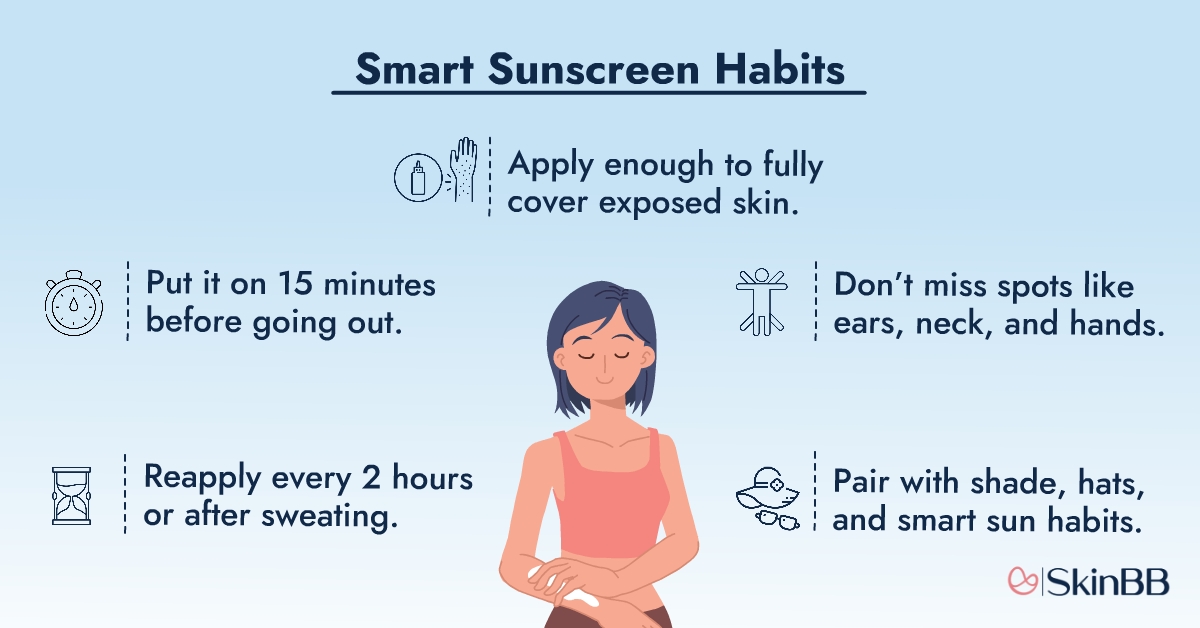
- Use a quantity of sunscreen that is equal to the length of two fingers in order to adequately cover the skin on your face and neck.
- For your whole body, begin by using about 1 ounce (about 2 tablespoons) of sunscreen.
Mistake #2: Applying Once? Why Sunscreen Is Not a Continuous Shield
Is it a major error to put sunscreen on once in the morning and then forget about it for the rest of the day? Absolutely, it is.
Sunscreen does not provide all-day protection; its ability to protect you decreases with time, particularly when you are sweating, swimming, or just spending a significant amount of time in the sun.
According to research that was carried out on 500 individuals residing in Jammu & Kashmir, India, the study found that even though many participants reported using sunscreen, only 4% did so again while they were out in the sun.
This indicates that fewer than one in twenty individuals were able to maintain an acceptable level of protection throughout the day, which left the great majority vulnerable to the dangers of sunburn, accelerated ageing, and photo-induced skin damage that lasted for a considerable amount of time.
How to Fix It:
- Reapply sunscreen every two hours, particularly when engaging in activities outside.
- Carry sunscreen that is suitable for travel in either your handbag or your car.
- For quick and easy reapplication, use sunscreen sticks or sprays.
- Before reapplying, make sure to wipe away any sweat so that it adheres correctly.
Mistake #3: Neglecting the 15-Minute Rule Before Rushing Out
You are all set to leave, so you get your sunscreen, put it on in a thick layer, and then go out the door. Everything seems in order, yes? Not precisely.
To allow sunscreens to effectively create a shield and fully soak in, it usually takes about 15 minutes. When you use it and go outside right away, the sunscreen doesn't have enough time to properly adhere to the skin, leaving it exposed. For this reason, the FDA suggests using sunscreen at least 15 minutes before going outside.
How to Fix It:
- Apply sunscreen between 15 and 20 minutes before being in the sun.
- Use your phone to set an alarm so you don't forget to apply sunscreen before going outside.
Mistake #4: Overlooked Sunscreen Areas: Hands, Ears, Lips
We've probably all done this: applying sunscreen for face and maybe the arms and stopping there. However, the sun affects all skin equally. Parts of your body, like your ears, neck, the tops of your hands, your feet, and even your head, are just as easily affected and are likely to age prematurely or develop skin cancer.
Studies indicate that 54.8% of athletes rarely or never use sunscreen on body parts like their hands, ears, lips, or chest and only do so while playing sports.
How to Fix It:
- Apply sunscreen to your ears, neck, the tops of your hands, feet, and the areas where you part your hair.
- Use SPF hand cream for easy, everyday application.
- Use lip balm with SPF to protect your lips.
- For areas that are hard to reach, try using sunscreen spray or powder.
Mistake #5: Thinking Sunscreen is the Only Solution
Surprisingly, no sunscreen, not even SPF 100, can completely block UV rays. That's why you shouldn't rely on sunscreen as your only form of sun protection.
According to a study in Cancer Causes & Control, relying only on sunscreen, without also seeking shade, wearing clothing with a UPF rating, or using sunglasses, will still leave your skin susceptible to UV damage.
UV rays can harm your skin even when it's cold. Check out this SkinBB video about using sunscreen in the winter to understand why it's not just for the summer.
Think of sunscreen as the first step in protecting your skin, not the only one. Using the appropriate tools together is essential for effective sun protection.
How to Fix It:
- Avoid being in direct sunlight between 10 AM and 4 PM, when UV radiation is at its strongest.
- Wear UV-protective clothing, long-sleeved shirts, and hats with wide brims.
- Look for clothing with an Ultraviolet Protection Factor (UPF) rating.
- To protect the sensitive skin around your eyes, use UV-blocking sunglasses.
- Keep yourself hydrated since dehydration can make skin damage and sensitivity to the sun worse.
Want to Know What’s in Your Sunscreen?
Use Label Looker to scan your sunscreen's label, understand the ingredients, and receive a customized report based on your skin type. Do you have any more questions? Ask our SkinBB Community experts for free. Learn more about why using sunscreen inside is beneficial and how it helps shield your skin from everyday light exposure.
Conclusion: Protect Yourself Wisely for Healthy Skin
Sunscreen for face is more than just a skincare step; it serves as your skin's everyday primary safeguard. However, this protective measure is only effective when applied correctly. Adopting these five minor adjustments can significantly enhance your defense, aiding in the protection of your skin against sunburn, age spots, early ageing signs, and the potential development of skin malignancies.
✅ Ensure adequate application
✅ Maintain consistent reapplication
✅ Start before you step out
✅ Cover all areas
✅ Use it with shade, hats, and mindful practices
Your skin chronicles your experiences, so ensure it narrates a tale of attentiveness, not disregard. Given the sun's perpetual presence, your sun defense should be equally steadfast. Handle your skin with the care it deserves as a lifelong partner: deliberately, consistently, and affectionately.
Reference:
1. Robinson, J. K. (1994). Sun exposure, sun protection, and vitamin D. Archives of Dermatology, 130(10), 1371–1374. https://doi.org/10.1001/archderm.1994.01690050135029
2. Autier, P., Boniol, M., Severi, G., & Dore, J. F. (2001). Quantity of sunscreen used by European students. Archives of Dermatology, 137(10), 1319–1320. https://doi.org/10.1001/ARCHDERM.138.10.1319
3. Diffey, B. L. (2001). When should sunscreen be reapplied? Journal of the American Academy of Dermatology, 45(6), 882–885. https://doi.org/10.1067/mjd.2001.117385
4. De Villa, D., Da Silva Nagatomi, A. R., Paese, K., Guterres, S., & Cestari, T. F. (2010). Reapplication Improves the Amount of Sunscreen, not its Regularity, Under Real Life Conditions†. Photochemistry and Photobiology, 87(2), 457–460. https://doi.org/10.1111/j.1751-1097.2010.00856.x
5. Glanz, K., Buller, D., & Saraiya, M. (2011). Reducing ultraviolet radiation exposure among outdoor workers: State of the evidence and recommendations. Cancer Causes & Control, 22(10), 1459–1471. https://doi.org/10.1007/s10552-011-9780-1
6. U.S. Food and Drug Administration. (2022). Sunscreen: How to help protect your skin from the sun. https://www.fda.gov/drugs/understanding-over-counter-medicines/sunscreen-how-help-protect-your-skin-sun
7. American Academy of Dermatology. (2023). New AAD survey reveals growing importance of sun protection. https://www.aad.org/news/new-aad-survey-reveals-growing-importance-sun-protection
8. Martinez, J. et al. (2023). Sunscreen Use and Reapplication Among Collegiate Athletes. Journal of Dermatology Nurses’ Association. https://www.sciencedirect.com/science/article/abs/pii/S0738081X23001530





Sign in to leave a comment.