
Client Background
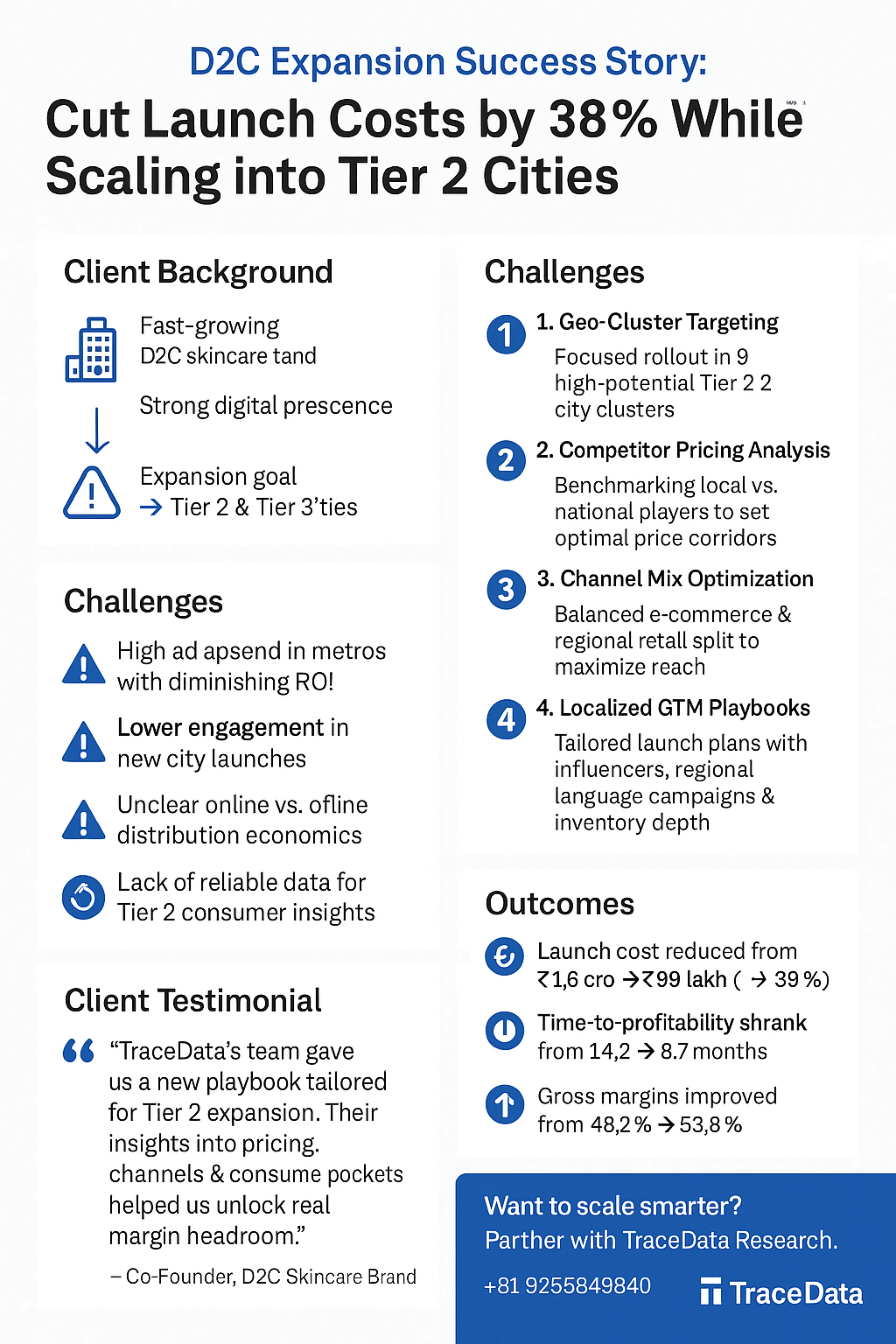
The client is a fast-growing direct-to-consumer (D2C) skincare brand known for its science-backed formulations and strong digital presence. After establishing a robust footprint across metropolitan markets through e-commerce and influencer-driven campaigns, the brand aimed to expand into Tier 2 and Tier 3 cities to drive the next phase of growth. The objective was to achieve scale while maintaining cost efficiency and brand integrity across diverse geographies.
Challenges They Faced
While the brand had seen early success in urban markets, its go-to-market (GTM) strategy began to show signs of strain, the following are the key challenge they faced:
· Digital saturation in metros led to escalating ad spend with diminishing returns.
· Frequent product rollouts were losing effectiveness, with lower engagement and conversion in newer city launches.
· The cost-benefit of online vs. offline distribution in Tier 2 cities was unclear, making it harder to plan inventory and marketing budgets.
· The brand lacked reliable data on pricing benchmarks, customer preferences, and competitor activity in smaller cities.
The need for a more targeted, data-backed expansion strategy became clear.
TraceData Research adopted a multi-pronged strategy to realign the brand’s expansion model with cost efficiency and market fit:
1. Geo-Cluster Targeting: We used proprietary clustering techniques to identify high-potential Tier 2 cities with favourable demand patterns, infrastructure readiness, and lower media saturation. This enabled a phased rollout into 9 focused city clusters rather than a scattered national push.
2. Competitor Pricing Analysis: We benchmarked local and national skincare players, both offline and D2C, across price points, bundles, and discounts. The data revealed optimal pricing corridors for premium perception without alienating price-sensitive shoppers.
3. Channel Mix Optimization: A detailed profitability model was created comparing CAC, retention, and logistics cost across e-commerce vs. regional retail partnerships. This led to a revised retail-eCommerce split, maximizing reach while protecting margins.
4. Localized GTM Playbooks: We tailored launch plans for each cluster, including influencer mixes, sampling tactics, regional languages, and inventory depth per channel.
Outcome
The revised market entry strategy enabled the brand to scale smarter. By shifting focus from high-cost urban blitzes to precision-led Tier 2 expansion, the brand achieved meaningful gains in both cost-efficiency and market impact:
· The average cost per market launch dropped from ₹1.6 crore to ₹99 lakh by reallocating budgets toward high-potential Tier 2 clusters and trimming metro-based media spends.
· Time-to-profitability shrank from 14.2 months to 8.7 months per location, driven by improved customer acquisition cost (CAC) and quicker offline distribution ramp-up.
· Gross margins rose from 48.2% to 53.8% as a result of reduced dependence on deep discounting and more localized pricing schemes.
· First-purchase to repeat-purchase conversion jumped from 21% to 39% in new clusters, outperforming the brand’s metro retention rates for the first time.
Client Testimonial
"We had been stuck in a rinse-repeat cycle of launching with heavy discounts in saturated metro markets. TraceData’s team gave us a new playbook tailored for scale. Their detailed insights into Tier 2 consumer pockets, pricing dynamics, and channel trade-offs helped us unlock real margin headroom. It’s rare to find a partner that blends analytics with execution so seamlessly."
- Co-Founder, D2C Skincare Brand
FAQ’s
1. What challenges was the D2C skincare brand facing before engaging TraceData Research?
The brand was struggling with high digital ad spends in saturated metro markets, declining effectiveness of frequent product rollouts, uncertainty around the cost-benefit of online vs. offline distribution in Tier 2 cities, and a lack of reliable data on local pricing, customer preferences, and competitor activity.
2. How did TraceData Research help the brand optimize its expansion strategy?
TraceData adopted a multi-pronged approach that included:
- Geo-cluster targeting to focus on high-potential Tier 2 cities.
- Competitor pricing analysis to identify optimal pricing corridors.
- Channel mix optimization by balancing e-commerce with regional retail partnerships.
- Localized GTM playbooks with influencer strategies, regional language content, and customized inventory planning.
3. What measurable results did the brand achieve through this strategy?
The brand achieved:
- A 38% reduction in launch costs (from ₹1.6 crore to ₹99 lakh per city).
- Faster profitability (time reduced from 14.2 to 8.7 months).
- Higher gross margins (48.2% → 53.8%).
- A jump in repeat purchase conversion (21% → 39%) in Tier 2 markets.
4. Why was TraceData Research’s approach impactful for the client?
TraceData blended data-driven insights with practical execution, helping the brand escape its reliance on costly metro launches. By tailoring strategies for Tier 2 markets—considering consumer behavior, pricing, and channel dynamics—TraceData enabled the brand to scale efficiently while strengthening profitability and retention.






























Sign in to leave a comment.