
Introduction
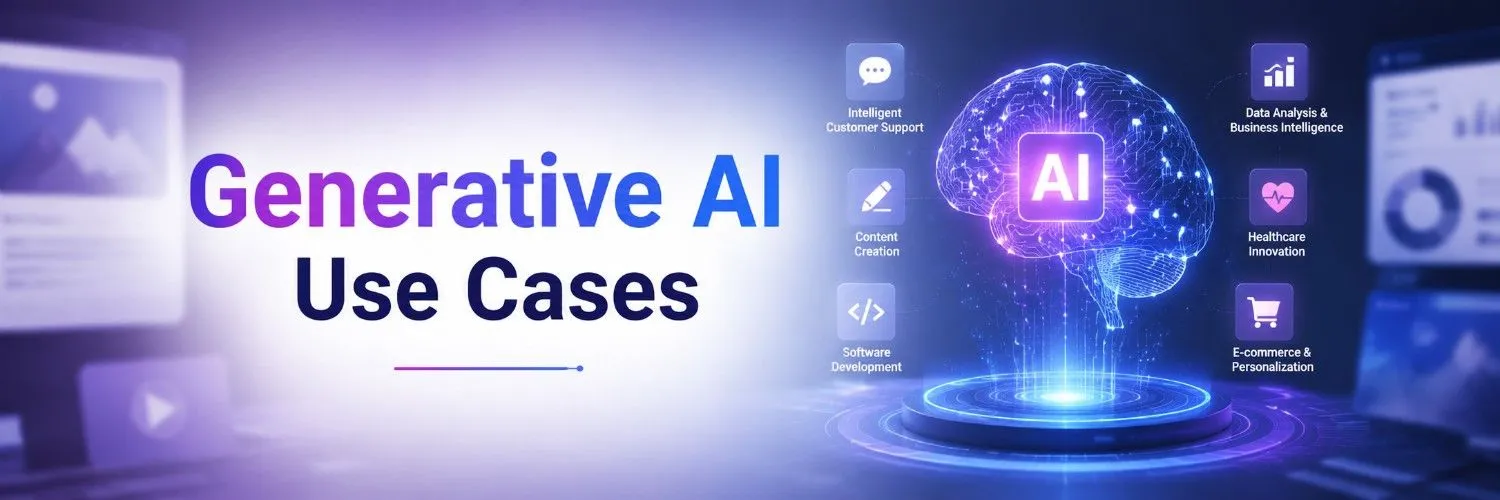
Generative AI use cases are rapidly reshaping the way businesses innovate, automate, and deliver customer experiences. From generating personalized marketing content and writing software code to improving customer support and accelerating product design, Gen AI has evolved from an emerging technology into a strategic business asset.
According to McKinsey, Gen AI could contribute up to $4.4 trillion annually to the global economy by enhancing productivity across industries. Organizations are increasingly adopting AI-powered solutions to streamline operations, reduce costs, improve decision-making, and unlock new revenue opportunities.
In this guide, we'll explore the most impactful Generative AI use cases, their business benefits, real-world applications, and best practices for successful implementation.
What is Generative AI?
Generative AI is a branch of artificial intelligence that creates new content based on patterns learned from existing data. Unlike traditional AI, which primarily analyzes or predicts outcomes, Generative AI can generate text, images, videos, audio, code, and even synthetic data.
Popular Gen AI technologies include Large Language Models (LLMs), image generation models, AI copilots, and multimodal AI systems that understand and generate different types of content.
Today, businesses are integrating Gen AI into everyday workflows to improve efficiency while enabling employees to focus on higher-value tasks.
Top Generative AI Use Cases Across Industries
1. Intelligent Customer Support
Customer expectations for fast and personalized support continue to grow, and AI-driven solutions is helping businesses meet those demands. AI-powered chatbots and virtual assistants can answer customer queries instantly, provide personalized recommendations, and resolve common issues without human intervention. These solutions operate 24/7, ensuring uninterrupted support while reducing response times and improving overall customer satisfaction. Businesses also benefit from reduced support costs and increased operational efficiency.
Benefits:
- Faster customer support
- Lower operational costs
- Personalized interactions
- Multilingual assistance
2. Content Creation and Marketing
AI-powered solutions is transforming the way marketing teams create and distribute content. It can generate blog articles, email campaigns, product descriptions, ad copy, social media posts, and video scripts in a fraction of the time required by traditional methods. AI also analyzes customer behavior to personalize content for different audiences, helping businesses improve engagement, increase conversions, and maintain consistent brand communication across multiple channels.
3. Software Development
Software development teams are using Gen AI to accelerate coding, debugging, and documentation. AI-powered coding assistants can suggest code snippets, identify errors, generate test cases, and even explain complex programming concepts. By automating repetitive tasks, developers can focus on solving business problems and building innovative applications. This not only speeds up project delivery but also improves code quality and team productivity.
4. Healthcare Innovation
Healthcare providers are leveraging Gen AI to improve patient care and streamline administrative tasks. AI can summarize clinical notes, assist with medical documentation, support diagnosis by analyzing patient records, and create personalized treatment recommendations. It also helps researchers analyze large datasets to accelerate medical discoveries. As a result, healthcare professionals spend less time on paperwork and more time focusing on patient care.
5. Financial Services
Banks and financial institutions use Modern AI technologies to automate routine processes, generate financial reports, detect fraudulent activities, and provide personalized financial advice. AI-powered systems can quickly analyze vast amounts of financial data, helping organizations make informed decisions while minimizing risks. Additionally, AI-driven virtual assistants improve customer service by answering banking queries and simplifying financial transactions.
6. Product Design and Innovation
Generative AI is enabling manufacturers and product designers to innovate faster than ever before. It can generate multiple product design concepts, simulate real-world performance, and optimize engineering designs before production begins. This reduces the need for physical prototypes, lowers development costs, and shortens the overall product development cycle. Businesses can bring innovative products to market more quickly while maintaining high quality.
7. Sales Enablement
Sales teams use Modern AI technologies to automate repetitive administrative tasks and improve customer engagement. AI can generate personalized sales emails, create proposals, summarize client meetings, and provide recommendations based on customer behavior. With AI handling time-consuming activities, sales professionals can focus on building relationships, understanding customer needs, and closing more deals.
8. Human Resources
Generative AI is simplifying recruitment and employee management by automating many HR processes. It helps create job descriptions, screen resumes, generate interview questions, and prepare onboarding documents for new employees. AI also assists with employee training, knowledge management, and internal communication, improving efficiency across the HR department while enhancing the employee experience.
9. Education and Training
Educational institutions and corporate organizations are using advanced AI technology to deliver more personalized learning experiences. AI can generate quizzes, training materials, course content, and interactive assessments tailored to individual learning styles and skill levels. This helps learners understand complex topics more effectively while enabling instructors to save time on content creation and curriculum planning.
10. Data Analysis and Business Intelligence
Businesses generate massive volumes of data every day, making analysis a challenging task. Gen AI simplifies this process by converting complex datasets into easy-to-understand reports, dashboards, and executive summaries. Decision-makers can ask questions in natural language and receive actionable insights instantly, enabling faster and more informed business decisions while reducing dependence on technical teams.
Benefits of Generative AI for Businesses
Organizations adopting AI-powered technology gain advantages that go far beyond automation. It helps improve operational efficiency, enhances customer experiences, and supports innovation across departments. As businesses continue their digital transformation journey, Generative AI has become a valuable tool for driving sustainable growth and maintaining a competitive advantage.
Increased Productivity
Generative AI automates repetitive and time-consuming tasks, allowing employees to focus on strategic initiatives and creative problem-solving. This improves overall workplace efficiency and accelerates project completion across various business functions.
Improved Customer Experience
AI delivers personalized interactions by analyzing customer preferences and behavior. Businesses can provide faster responses, relevant recommendations, and consistent support, resulting in higher customer satisfaction and stronger brand loyalty.
Faster Innovation
From designing products to developing software and creating marketing content, AI-based solutions significantly reduces the time required to bring new ideas to life. This enables businesses to innovate more quickly and stay ahead of changing market demands.
Cost Optimization
By automating manual processes and reducing repetitive workloads, Generative AI lowers operational expenses and improves resource utilization. Organizations can achieve higher productivity without proportionally increasing staffing or infrastructure costs.
Better Decision-Making
Generative AI analyzes large volumes of structured and unstructured data to generate meaningful insights. Business leaders can make faster, data-driven decisions supported by accurate reports, forecasts, and predictive analytics.
Scalable Operations
As business demands grow, Generative AI helps organizations scale their operations efficiently. AI-powered systems can handle increasing workloads, support more customers, and streamline processes without compromising performance or service quality.
Industries Benefiting from Generative AI
Generative AI is transforming nearly every industry by improving productivity, enhancing customer experiences, and accelerating innovation. Some of the sectors experiencing the greatest impact include:
- Healthcare
- Banking & Financial Services
- Retail & E-commerce
- Manufacturing
- Education
- Logistics & Supply Chain
- Real Estate
- Media & Entertainment
- Telecommunications
- Information Technology
Best Practices for Implementing Generative AI
Successfully implementing Generative AI requires more than choosing the right technology. Organizations should develop a clear strategy, prepare quality data, and establish responsible AI practices to maximize long-term business value.
Define Clear Business Objectives
Start by identifying specific business challenges that Generative AI can solve. Having clear objectives helps prioritize use cases, measure success, and ensure the AI solution aligns with overall business goals.
Ensure High-Quality Data
The effectiveness of any AI model depends on the quality of the data it learns from. Clean, accurate, and well-organized datasets improve the reliability, relevance, and consistency of AI-generated outputs.
Prioritize Responsible AI
Organizations should establish governance frameworks that promote transparency, fairness, and ethical AI usage. Protecting sensitive information and minimizing bias are essential for building trust with customers and stakeholders.
Integrate with Existing Systems
Generative AI should work seamlessly with your existing business applications, cloud platforms, CRM systems, ERP software, and workflows. Smooth integration improves adoption and maximizes return on investment.
Monitor Performance
Regularly evaluate AI-generated outputs to ensure they remain accurate, relevant, and aligned with business objectives. Continuous monitoring and optimization help improve model performance over time.
Train Employees
Employees should understand how to effectively use AI tools alongside their existing workflows. Providing training and encouraging collaboration between human expertise and AI technology leads to better productivity and successful adoption.
Challenges of Generative AI Adoption
Despite its advantages, organizations should prepare for several challenges:
- Data privacy and security concerns
- AI hallucinations and inaccurate outputs
- Regulatory compliance requirements
- Integration complexity
- High-quality training data requirements
- Change management and employee adoption
A well-planned AI strategy helps businesses overcome these challenges while maximizing long-term value.
Future Trends in Generative AI
Generative AI continues to evolve at an unprecedented pace. Emerging trends include:
- AI Copilots for enterprise productivity
- Multimodal AI models
- Autonomous AI agents
- Industry-specific foundation models
- AI-powered digital twins
- Hyper-personalized customer experiences
- Low-code AI development platforms
- Responsible and explainable AI
These innovations will further accelerate digital transformation across industries.
Why Choose BigDataCentric for Generative AI Solutions?
At BigDataCentric, we help organizations unlock the full potential of AI innovation by delivering customized, scalable, and enterprise-ready AI solutions. Our experts combine deep expertise in AI, machine learning, cloud technologies, and data engineering to build solutions tailored to your unique business objectives.
Why Partner with BigDataCentric?
- End-to-End AI Consulting – From strategy and use case identification to deployment and optimization.
- Custom Generative AI Solutions – AI applications built specifically for your industry and business needs.
- Enterprise AI Integration – Seamlessly connect AI with your existing systems and workflows.
- Responsible & Secure AI – Implement governance, privacy, and compliance best practices.
- Scalable AI Architecture – Future-ready solutions designed for long-term business growth.
- Continuous Support – Ongoing monitoring, optimization, and AI model improvements.
Whether you're looking to automate workflows, enhance customer experiences, or develop AI-powered products, BigDataCentric provides the expertise to turn your AI vision into measurable business outcomes.
Conclusion
Gen AI is no longer a technology of the future—it's a competitive advantage for businesses today. From customer service and software development to healthcare, finance, and marketing, Generative AI use cases are transforming how organizations operate, innovate, and create value.
By strategically implementing Generative AI, businesses can improve productivity, reduce operational costs, enhance decision-making, and deliver highly personalized customer experiences. As AI capabilities continue to evolve, organizations that embrace this technology early will be better positioned to lead innovation and stay ahead in an increasingly digital marketplace.
Partnering with experienced AI experts like BigDataCentric ensures a smooth adoption journey, helping you build secure, scalable, and impactful AI-driven solutions that drive sustainable business growth.
























Sign in to leave a comment.