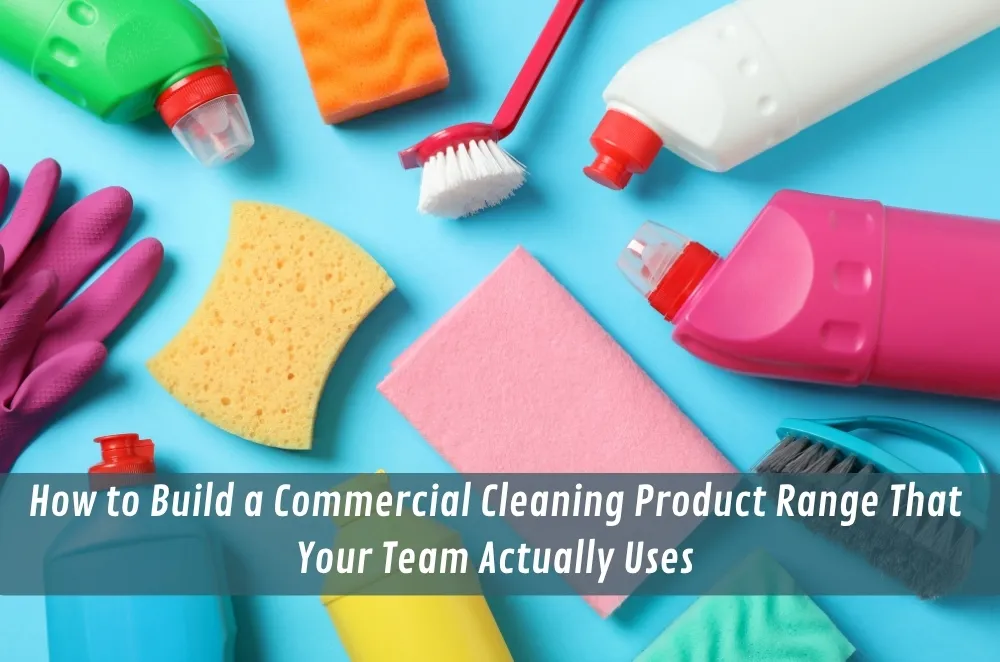

Walk into most back-of-house cupboards and you’ll find the same story: half-used bottles, mystery sprays, and a reorder process that depends on whoever notices something is empty.
If you’re trying to standardise Australian range of cleaning products the goal isn’t to buy more products.
It’s to choose fewer, clearer options that match the real jobs on site, then make them easy for staff to use correctly.
Start with the outcome, not the catalogue
Most businesses build their cupboard by browsing categories and picking what “sounds right”.
A better method is to start with outcomes and constraints, because those are what drive day-to-day consistency.
Define what “clean” means in each area:
- Presentation standard: streak-free, no residue, no odour, no visible dust.
- Turnaround time: can it be cleaned quickly during service or between meetings?
- Who cleans it: trained staff, casuals, contractors, or “everyone when they can”.
- Surface sensitivity: natural stone, sealed timber, stainless, painted walls, polished concrete.
- Safety requirements: ventilation, PPE expectations, storage, spill response, signage.
When you define outcomes first, the products become a toolset rather than a cluttered collection.
Map spaces and “soils” before you choose products
A one-page map of your premises is the fastest way to avoid overbuying.
List your space types (the “where”):
- Reception and offices
- Toilets and amenities
- Break rooms and kitchens
- Floors (hard floors, carpet, mats)
- High-touch points (handles, taps, switches, rails)
- Entryways and exterior thresholds
- Storage rooms and waste areas
Then list your soil types (the “what”):
- Dust and general grime
- Body oils and fingerprinting
- Food residue and grease
- Soap scum and hard-water build-up
- Spills and stains
- Odour hotspots (bins, drains, soft furnishings)
This mapping step matters because “one product for everything” often fails on either grease or bathroom build-up, and those failures create rework.
Build a small core kit that covers most jobs
Most SMEs can cover 80–90% of routine cleaning with a surprisingly small core kit.
The key is making each product’s role unambiguous, so staff don’t guess.
A practical core kit often includes:
- General surface cleaner for desks, benches, partitions, and light soil
- Bathroom cleaner suited to soap scum and mineral build-up
- Floor cleaner matched to the dominant floor type and equipment used
- Glass and mirror cleaner that doesn’t leave haze
- Degreaser for kitchens, loading areas, and oily build-up
- Hand wash and washroom consumables (soap, paper, dispensers as applicable)
- Waste management basics (liners, bin systems, odour approach)
If a product can’t be explained in one sentence (“Use this for X, not for Y”), it usually adds confusion.
Add-ons that earn their place
Add specialist items only when they clearly reduce labour or prevent repeat issues.
Good add-on triggers include:
- A recurring stain type on carpet or upholstery
- Persistent scale in wet areas (where suitable for your surfaces)
- A defined sanitising approach where workplace requirements call for it (always follow labels/SDS and workplace procedures)
Too many specialists increases training load, increases mis-use, and makes reordering messy.
Make safety and consistency the system, not the lecture
In workplaces, cleaning products are a safety topic before they’re a cleaning topic.
The goal is simple controls that keep everyone aligned without turning it into a compliance circus.
1) Labels and SDS are the source of truth
Train staff to check the label first, and keep SDS accessible where products are stored and used.
2) Standardise dilution and application
If concentrates are used, inconsistent dosing is the silent budget killer and a common reason results look “random” across shifts.
3) Make PPE expectations task-based
People remember “gloves for bathrooms” better than “gloves for Product A”, especially when staff rotate.
Operator Experience Moment: The biggest improvement I’ve seen usually comes from a boring change—putting the right bottle and the right cloth in the right place, every time. Once a team stops hunting through cupboards and starts following a simple “this lives here for this job” setup, quality improves because the process becomes consistent. It’s less about a perfect product and more about fewer decisions under time pressure.
Decision factors when choosing products and suppliers
Once you know what you need, you can compare options in a way that supports daily operations rather than “best price on paper”.
Use decision factors that reflect the real cost of cleaning:
- Surface compatibility: Will it damage finishes, strip coatings, or leave residue over time?
- Ease of use: Can a new staff member follow the method in 60 seconds?
- Consistency across sites: If you have multiple locations, can you standardise the same range?
- Dispensing and packaging: Bulk concentrates can work well, but only if dosing is controlled.
- Availability and lead time: A “great” product that’s frequently out of stock creates last-minute substitutions and inconsistent results.
- Training support: Clear naming, consistent labelling, and simple usage guidance reduce mistakes.
- Total cost of use: Consider dilution rates, wastage, rework time, and tool/equipment compatibility.
If you’re comparing suppliers, look for the one that makes standardisation easiest, not the one with the biggest catalogue.
Concentrates vs ready-to-use
Ready-to-use reduces training overhead and avoids dilution errors.
Concentrates can reduce packaging and cost, but only when dosing is managed and the team is stable enough to keep the method consistent.
A practical test is to trial one area for two weeks and track both usage and rework time, not just unit price.
Common mistakes that waste money and create risk
Most cleaning problems aren’t caused by “bad products”.
They’re caused by mismatched processes that make the wrong choice easy.
Common mistakes include:
- Buying duplicates that do the same job (staff pick whichever is closest)
- Using one product for everything (fails on grease or wet-area build-up, leading to rework)
- No dilution control (too weak to work, or too strong and wasteful)
- Products stored wherever there’s space (instead of at point of use with clear rules)
- Tools not matched to tasks (cloth type, mop head, pads, squeegees, and buckets matter)
- Reordering based on panic (you pay more, substitute more, and lose consistency)
- No ownership (everyone assumes someone else is checking stock)
Practical Opinions: Standardise fewer products before you optimise prices.
Practical Opinions: Train for habits (where things live, how they’re labelled), not for product trivia.
Practical Opinions: If dilution is inconsistent, fix dosing before you swap brands.
A simple 7–14 day plan to get control
You don’t need a major “project” to improve cleaning consistency.
Treat it like an operational reset with clear steps and a defined finish line.
Days 1–2: Audit what you already have
- List products by function (not by brand name)
- Flag duplicates and anything rarely used
- Identify the top three pain points (complaints, odours, streaks, slippery floors, repeat stains)
Days 3–5: Define your core kit
- Choose baseline products based on your space/soil map
- Decide ready-to-use vs concentrates per area (based on who cleans it)
- Align tools to tasks (cloth colours, mop heads, pads, buckets)
Days 6–9: Fix storage and access
- Store products where the work happens, not in a single “mystery cupboard”
- Label shelves with tasks (“Bathrooms”, “Kitchen”, “Glass”, “Floors”)
- Keep SDS accessible and align any PPE/signage expectations to tasks
Days 10–14: Train and lock in reordering
- Do a 15-minute walkthrough per shift: what to use, where it lives, what not to mix
- Set minimum stock levels (often a two-week buffer works well)
- Assign ownership to a role (not a person) so it survives roster changes
If the system depends on “someone remembering”, it will fail under pressure.
Local SMB mini-walkthrough (Australia)
A suburban office with 12 staff and shared amenities starts by auditing the cupboard and binning duplicates.
They reduce the range to a core set: general surface, bathroom, glass, floor, degreaser, plus consumables.
Ready-to-use bottles are kept for shared areas to minimise dilution errors across rotating shifts.
Shelves are labelled by task: “Daily desks”, “Bathrooms”, “Kitchen”, “Floors”, and “Spills”.
A two-week minimum stock level is set, with a Friday afternoon check added to the closing routine.
SDS are stored at the cupboard, and PPE expectations are made task-based for wet areas.
After two weeks, one product is swapped due to streaking, and cloth type is adjusted for better pickup.
Key Takeaways
- Start with outcomes and constraints, then choose products to match spaces and soils.
- A smaller, clearer core kit usually beats a big cupboard of “maybe useful” bottles.
- Consistency comes from storage, labelling, dosing control, and simple training that survives staff changes.
- Choose based on total cost of use (time, rework, availability), not just unit price.
Common questions we get from Aussie business owners
How many products does a small business usually need?
Usually, a small business can cover most needs with 5–8 core products plus consumables, depending on floors and whether there’s food prep on site. A practical next step is to map your spaces and soils on one page and assign one product role per job type. In Australia, this helps when different sites have different floor finishes and shared amenities.
Should we switch to concentrates to save money?
It depends on whether dilution can be controlled and whether staff turnover is low enough to keep methods consistent. A good next step is to run a two-week trial in one area with a measuring system or dispenser, then compare usage and rework time. In many Australian SMEs, savings disappear if dosing varies between shifts.
How do we stop staff using the wrong product in the wrong place?
In most cases, it’s a storage and labelling problem more than a motivation problem. The next step is to store products at point of use and label shelves by task, then add a one-page “this job uses this bottle” guide. In Australian workplaces where cleaning is shared across roles, clarity beats complexity every time.
What’s the easiest way to stop running out of essentials?
Usually, minimum stock levels and a weekly check beat ad-hoc ordering because they don’t rely on memory. The next step is to set a two-week minimum for each core item and assign one role to check it on a fixed day. In Australia—especially outside metro areas—delivery variability makes buffers and consistency even more important.



























Sign in to leave a comment.