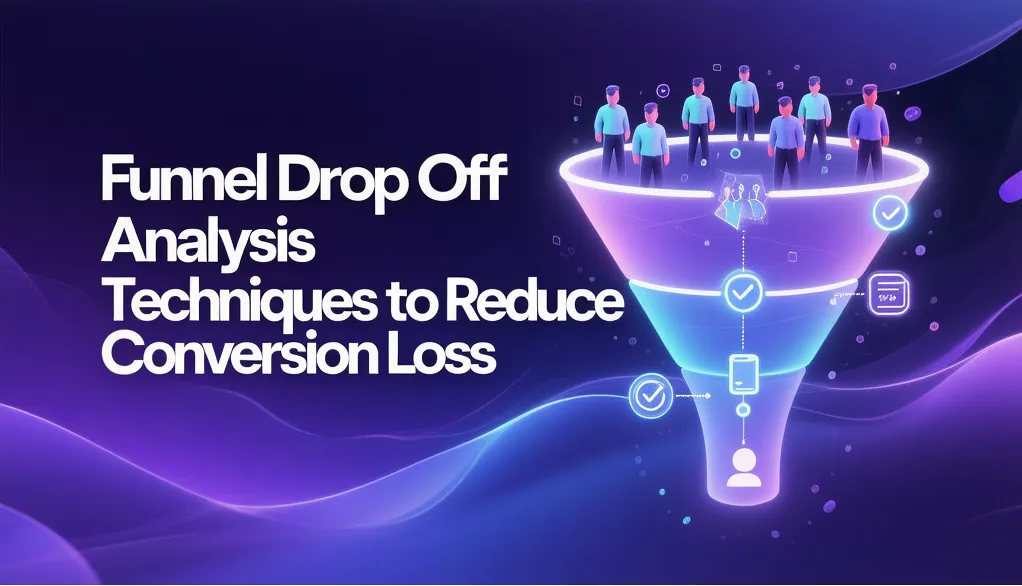

Most conversion problems don't announce themselves. They hide in the gap between a visitor who seemed interested and a sale that never happened.
Your analytics show the traffic arrived. Your reports show the session started. What they rarely show clearly is the specific moment the experience stopped working, the point where a genuinely interested user decided continuing wasn't worth it.
That's the gap funnel drop-off analysis is designed to close.
Why Funnel Drop-Off Analysis Is a CRO Priority
When drop-offs go unexamined, the default response is to buy more traffic. But more traffic flowing into a leaking funnel produces more exits at the same rate, higher spend, same underlying problem.
The numbers behind the opportunity are hard to ignore. Improving checkout usability alone can lift conversion rates by up to 35.26%. An estimated $260 billion in ecommerce revenue is recoverable through better funnel optimization. These aren't theoretical projections, they reflect the scale of friction that already exists in most digital funnels, waiting to be addressed.
Teams that run funnel analysis on a regular cadence not just when performance dips, find problems earlier and fix them before they compound into quarterly misses. That consistency is what turns analysis from a diagnostic tool into a genuine competitive advantage.
Understanding Conversion Drop-Offs Beyond Surface Metrics
Conversion rates give you an outcome. Funnel drop-off analysis gives you an explanation. Those are different things, and treating them as equivalent is where most optimization programs go wrong.
Real user behavior doesn't follow the clean linear path a funnel diagram suggests. Users revisit pages, hesitate at decision points, compare options mid-session, and exit without leaving a clear reason in your data. Aggregate metrics flatten all of that complexity into a single number that tells you something is wrong but not what or where.
Drop-offs emerge from combinations of factors:
- UX friction — navigation that doesn't flow naturally, forms that demand too much, CTAs that leave users uncertain about what happens next
- Technical failures — pages that load slowly, elements that break on mobile, tracking that doesn't fire correctly at critical steps
- Psychological barriers — trust signals that are missing or buried, pricing that feels unclear, decision fatigue at high-commitment moments
- Intent mismatch — the page didn't deliver what the acquisition message promised
Good conversion funnel analysis works through both dimensions, identifying where users exit and building a credible explanation for why the experience stopped working at that specific point.
Common Causes of Funnel Drop-Offs
UX and Usability Friction
Friction accumulates quietly. A form that's two fields longer than necessary. A CTA that doesn't clearly indicate what clicking it will do. A checkout process with one more step than users expected. None of these feel catastrophic in isolation, but together they raise the effort threshold until continuing feels harder than starting over somewhere else.
Checkout Complexity
48% of shoppers abandon purchases when unexpected costs appear at checkout. Shipping fees, taxes, and handling charges that weren't visible earlier feel like a last-minute reveal, and they break trust at the exact moment it matters most. Limited payment options and checkout forms that drag on compound the problem for users who were already committed to buying.
Mismatch in User Intent
Paid campaigns create expectations. When the landing page doesn't meet them, users don't pause to investigate they leave. The analytics log a bounce. The actual problem a disconnect between what the ad promised and what the page delivered, often goes undiagnosed until someone looks specifically for intent alignment issues.
Technical Barriers
Performance problems and broken elements create drop-offs at the worst possible moments, when user intent is highest and the path to conversion is shortest. A structured conversion rate optimization audit is usually what surfaces these issues, because they're rarely visible in standard reporting. For a clear picture of the scope involved, reviewing what a CRO audit systematically examines helps set accurate expectations before starting.
Trust Deficits
35% of shoppers abandon carts when trust signals are absent. Security indicators, return policy clarity, and transparent pricing aren't design preferences they're functional requirements for conversion. Users who feel uncertain at a high-commitment step don't push through the uncertainty. They find somewhere that feels safer.
How to Identify Conversion Drop-Offs in Analytics
Step 1: Define Funnel Stages Based on Business Logic
A funnel built around real decision points produces useful insights. A funnel built around page views produces noise.
- Ecommerce: Product view → Add to cart → Checkout start → Payment → Confirmation
- Lead gen: Landing page → Form interaction → Submission → Qualification
Each stage should represent a moment where the user made a deliberate choice to continue. If it doesn't, it's adding complexity without adding clarity.
Step 2: Use GA4 Funnel Exploration for Behavioral Insights
GA4's Funnel Exploration visualizes drop-off rates at each step, accommodates non-linear user paths with flexible entry points, and enables segmentation by device, channel, geography, and campaign. It gives direct visibility into how to identify conversion drop-offs in analytics across different user cohorts, which is where the actionable insight usually lives.
None of that analysis is reliable without clean data underneath it. A GA4 audit before drawing conclusions from funnel reports is a necessary step not an optional one. Misconfigured events and inconsistent naming produce authoritative-looking reports that point optimization effort in the wrong direction.
Step 3: Segment Before You Conclude
Aggregate drop-off rates create the appearance of a single problem when the reality is often several different problems affecting different user groups differently. A 43% checkout abandonment rate looks uniform until device segmentation shows mobile users leaving at 69% while desktop users convert normally. That's not one problem with one fix, it's two separate issues requiring two separate approaches.
Standard segmentation cuts to run before concluding anything: device type, traffic source, new vs. returning users, campaign performance.
Step 4: Analyze Step-Level Conversion Rates
Final conversion rate benchmarks performance. Step-level conversion rates locate the problem. Track the transition between every stage: where does the largest drop occur? Is it sudden or gradual? Does it align with a recent UX change, a new campaign, or a technical deployment? The transition showing the steepest decline is almost always where the most fixable friction is concentrated.
Using GA4 for Funnel Drop-Off Analysis
GA4's event-driven model captures behavioral context that session-based analytics never could. The capabilities that matter most for funnel work:
Funnel Exploration Reports — Custom funnels with flexible entry points that reflect how users actually move through your site rather than how you wish they did. Essential for journeys that don't follow a predictable linear sequence.
Path Analysis — Visual maps of actual user navigation that surface unexpected exits, repeated steps, and off-path behavior that standard funnel views don't capture.
Segmentation and Comparisons — Side-by-side cohort analysis to identify where specific user segments underperform and quantify the size of the gap.
Event-Based Tracking — Scroll depth, click patterns, and time spent at each stage. The behavioral context that explains a drop-off rather than simply recording that one occurred.
Reliable analysis depends entirely on reliable implementation. Events need to be configured correctly, named consistently, and audited as the site evolves. Without that foundation, the reports look credible but the conclusions aren't.
From Analysis to Optimization: Closing the Loop
Finding drop-offs is diagnostic work. Fixing them is where the value is realized. Three principles determine whether analysis actually produces results:
Prioritize stages with the highest revenue impact. High traffic volume combined with a significant drop-off rate and clear revenue correlation is where optimization effort returns the most. Spending resources on low-volume friction points rarely moves the overall conversion number in a meaningful way.
Validate hypotheses through testing. Funnel data produces informed hypotheses about what's causing a problem. CRO and A/B testing validates whether a proposed fix actually solves it before full deployment. Assumption-based changes frequently address the wrong problem. Tested changes don't have that risk.
Treat optimization as continuous, not episodic. User behavior shifts. Markets change. What's working today may not be the right configuration six months from now. For practical guidance on where to focus conversion effort immediately after completing funnel analysis, the tips to improve online conversion rates identifies the actions that tend to move results earliest.
Integrating Funnel Analysis into CRO Strategy
Funnel analysis is what gives CRO programs direction. Without it, experimentation is pointed at assumptions. With it, each test addresses a specific, measured friction point with behavioral evidence supporting the hypothesis.
A structured CRO cycle runs through four connected phases: diagnostic analysis identifies where drop-offs occur, hypothesis development explains the most likely cause, experimentation tests a proposed fix, and measurement evaluates whether the outcome actually improved. Funnel analysis feeds the first phase, and since each subsequent phase depends on the quality of that input, underinvesting in diagnostics tends to produce a lot of experiments that generate data without generating results.
Operationalizing Funnel Drop-Off Analysis Across Teams
Funnel analysis generates its full value when it informs decisions across the organization, not just when it appears in one team's weekly reporting cadence.
In practice, that means:
- Marketing uses findings to identify where acquisition messaging creates intent mismatches with landing page content
- Product uses them to prioritize UX improvements at the stages where friction is measurably highest
- Analytics uses them to maintain tracking accuracy and catch data quality issues before they corrupt conclusions
- Leadership uses them to direct optimization investment toward funnel stages with the clearest revenue correlation
When analysis shapes how decisions get made across functions rather than sitting in a dashboard that one team monitors, it becomes a growth system. It improves how efficiently acquisition spend converts to revenue, reduces the cost of friction at scale, and produces compounding returns that reactive, one-time audits never achieve.
Moving Toward Predictive Funnel Optimization
Most teams use funnel analysis to understand what already happened. The more valuable capability is anticipating what's about to happen and acting before conversion is lost rather than after.
Predictive funnel optimization uses historical behavioral patterns to identify which stages carry elevated exit risk under specific conditions. The goal is proactive intervention: flagging a high-risk stage before it becomes an expensive drop-off trend, rather than diagnosing the damage after a bad month. Building this capability takes time, but it starts with the same practices that underpin good reactive analysis, clean data, consistent segmentation, and regular review cycles rather than occasional deep dives triggered by performance problems.
Closing Perspective
Funnel drop-off analysis isn't about finding what's broken and patching it. It's about understanding the gap between what your users expected and what they experienced and closing that gap deliberately, stage by stage.
In an environment where acquiring traffic costs more every year, the most efficient path to growth is converting more of what you already have. That means understanding your funnel with precision, acting on what the data reveals, and building the organizational habits that make optimization continuous rather than reactive.
Funnel drop-off analysis is where that work begins. And where it begins is exactly where it should — at the point where your current journey breaks.





























Sign in to leave a comment.