
A tube can look round leaving the mill and still carry a slight bow that ruins the next operation. A tube straightening machine catches that problem before it reaches assembly, welding, or threading. This piece covers the issues these machines solve, what to weigh up before buying one, and which industries depend on them.
Common Manufacturing Challenges Solved by Tube Straightening Machines
A number of production problems trace back to tube straightness more than people expect. The sections below outline where this equipment earns its place on the line.
Correcting Bent and Warped Metal Tubes
Tubes coming off a mill or draw bench often carry a slight bow before annealing evens things out. Once the tube passes through straightening rolls, that bow gets corrected through rotary pressure and controlled deflection. Because of this, downstream operations such as cutting, threading, or welding start from a tube that behaves as expected.
Improving Tube Alignment for Precision Processing
Alignment matters most when a tube feeds directly into automated cutting, forming, or fitting equipment down the line. A slight bend that seems harmless on its own can throw off feed accuracy once several stations work in sequence. Straightening resolves this early, so precision processing further downstream doesn't inherit an avoidable problem.
Reducing Material Waste and Production Rework
Any warping that occurs in the tube prior to its reaching the final inspection stage will eventually be scrapped or repaired, and both these actions are time-consuming and resource-intensive. Correcting straightness earlier in the process keeps that waste from building up across a full run. As a result, manufacturers protect their yield instead of finding the problem only at the end.
Maintaining Consistent Straightness Across Production Batches
Consistency across batches depends on repeatable roll settings, not on adjusting each tube by feel. Built-in dial gauges make it possible to record a setting once and return to it for the next batch. This is why straightness figures like 1 mm over 1000 mm hold steady across long runs, not just the first few tubes.
Factors to Consider When Selecting a Tube Straightening Machine
Choosing between models involves more than comparing sticker prices. A handful of specifications ultimately decide whether a tube straightening machine fits a given production line.
Tube Material, Diameter and Wall Thickness
Ferrous and non-ferrous tubes respond differently to roll pressure, so material choice shapes the machine setup. Diameter range matters too, since models built for tubes from 12 mm to 127 mm cannot handle sizes outside that band. Wall thickness plays a similar role, because thinner tubes need gentler pressure to avoid distortion.
Required Production Capacity and Line Speed
Line speed needs to match whatever feeds the straightener, whether that's a tube mill or a separate draw bench. Speeds above 100 metres per minute are achievable on some models, though real throughput depends on tube size and material. Mismatched speed between stations tends to create bottlenecks rather than solve them.
Number of Straightening Rolls and Machine Configuration
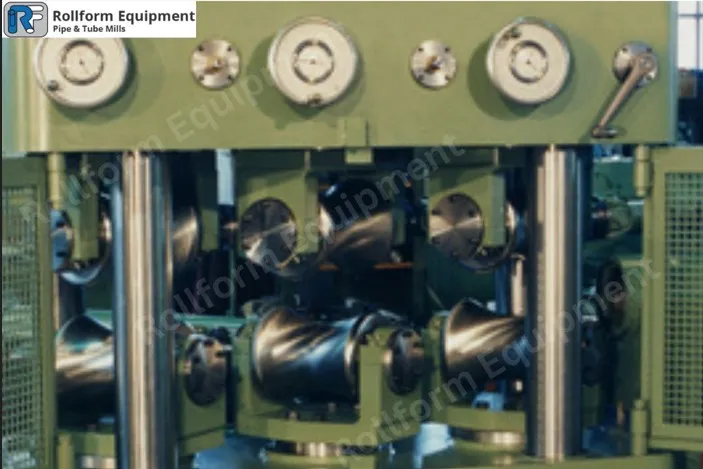
The number of rolls used impacts both the quality of the process and its cost; there are three standard roll setups; 6, 10, and 14 rolls. As a trusted provider, Rollform Equipment engineered a roll profile that keeps full contact along the roll length, using differential geometry to correct out-of-roundness more precisely. Without that contact, only part of each roll pair actually touches the tube, and straightness suffers.
Automation Features and Maintenance Requirements
Manual, semi-automatic, and fully automatic models all exist, and the right choice depends on changeover frequency. Some lines also pair a straightener with a tube threading machine for downstream fitting work, so controls need to communicate cleanly between stations. Maintenance-light designs, with antifriction bearings and independent roll mechanisms, keep downtime low across long shifts.
Industries That Depend on Tube Straightening Machines for Quality Production
Not all industries require high standards of tube straightness. These sectors depend on it daily rather than only occasionally.
Automotive and Precision Engineering
Automotive components often need dimensional tolerances that a bent tube simply cannot meet. Fortune Business Insights values the global metal forming machine tools market at USD 31.18 billion in 2026, rising to USD 64.85 billion by 2034. That growth reflects how precision-driven automotive and engineering work has become.
Construction, Infrastructure and Fabrication
Structural tubes in the field of construction require straightness for strength performance rather than merely aesthetic purposes. Stainless steel tubes and ERW tubes require straightening to ensure that their welded joints remain square during fabrication. Infrastructure projects, in particular, cannot afford tolerance issues once tubes reach the installation stage.
Oil and Gas, Power and Industrial Equipment Manufacturing
Oil and gas applications demand tubes that hold their shape under pressure and repeated handling. Power generation and industrial equipment manufacturers face similar requirements, since misaligned tubing affects fit and function later on. Straightening at this stage protects performance long before the tube reaches its final installation.
Bent tubes cause alignment issues, wasted material, and inconsistent batches. The right machine corrects all three, from roll configuration to automation. A trusted provider like Rollform Equipment builds that reliability into every straightening machine it makes.

























Sign in to leave a comment.