

An international corporate executive relocating to Dubai contacts a local security manager to arrange personal protection for their family and executive residence. Expecting the operational setups common in high-risk global regions, the executive requests a dedicated team of armed bodyguards carrying visible firearms. The manager immediately clarifies that in the UAE, private security operates under strict statutory limitations where carrying lethal weapons is almost universally prohibited for private contractors.
When evaluating vendor capabilities, partnering with an accredited security guard company requires a clear understanding of federal and emirate-level security legislation. The United Arab Emirates maintains one of the lowest violent crime rates globally, built upon strict firearms control laws, comprehensive electronic surveillance networks, and highly efficient public police forces. Consequently, the private security sector functions primarily through preventive surveillance, physical access control, de-escalation, and tactical containment rather than armed deterrence.
The Regulatory Governance: SIRA and ASSD Frameworks
Private security operations across the UAE do not operate in a regulatory vacuum. Every guard, supervisor, and security enterprise must strictly comply with regional regulatory authorities:
- Security Industry Regulatory Agency (SIRA): Regulates, licenses, and audits all private security firms, technical systems, and physical guards operating within the Emirate of Dubai to ensure continuous compliance with municipal safety codes.
- Auxiliary Security Services Department (ASSD): Oversees and enforces private security licensing, operational standards, and compliance protocols across Abu Dhabi and the Northern Emirates under federal oversight.
Under both regulatory bodies, private security personnel are explicitly classified as non-lethal, preventive safety operatives. The default legal mandate for all private commercial guarding across office towers, shopping malls, residential communities, and construction sites is strictly unarmed.
Unarmed Guarding: The Standard for Commercial Protection
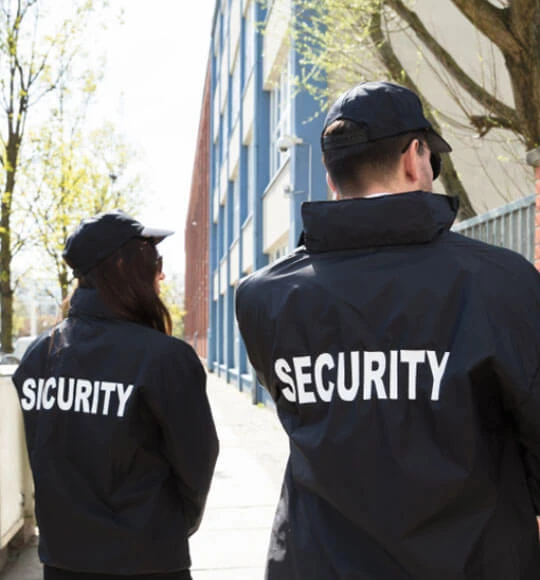
The vast majority of commercial and residential security deployments rely entirely on professional unarmed personnel. Rather than relying on weapons, unarmed officers protect physical assets through structured surveillance, access control hardware, visitor logging, and conflict management techniques.
Key Duties of Unarmed Security Officers
Unarmed guards serve as the primary human defense layer across private and commercial properties, undertaking complex operational duties that demand high situational awareness and continuous vigilance. Their primary responsibilities include:
- Entry Control and Visitor Vetting: Managing gatehouses, lobby turnstiles, and sophisticated visitor management systems to prevent unauthorized access, verify credentials, and maintain meticulous digital access logs for every person entering the facility.
- Perimeter Patrols and Inspections: Conducting regular foot and mobile sweeps across expansive perimeters to identify physical vulnerabilities, check exterior door latches, test emergency exits, and spot potential safety hazards before they escalate into security breaches.
- Incident Containment and Reporting: Employing advanced verbal de-escalation tactics during tenant disputes, trespassing incidents, or public disturbances while documenting every event with comprehensive, time-stamped digital logs and incident reports.
- Emergency Coordination: Leading organized venue evacuations during fire alarms or medical emergencies, operating building life-safety systems, and directly guiding responding emergency services such as the Dubai Police or Abu Dhabi Police to the exact scene of the incident.
What the Law Allows: Exceptions for Armed Security
A common question among corporate directors is whether armed private security exists anywhere within the UAE. Federal law and municipal regulations maintain an extraordinarily narrow scope for armed private operations.
| Security Category | Legal Status | Operational Scope & Equipment |
| Commercial & Retail Guarding | Strictly Unarmed | Baton, flashlights, hand-held metal detectors, two-way radios. |
| Residential & Community Security | Strictly Unarmed | Access control panels, guard tour scanners, perimeter checks. |
| Executive Close Protection | Unarmed / Non-Lethal | Defensive driving, physical evasion, defensive body armor, tactical escort. |
| Cash-in-Transit (CIT) | Highly Restricted | Specialized armored vehicles, tracking systems, direct police links. |
| Critical Infrastructure & Military | State Forces Only | Government military, law enforcement, or state-affiliated armed details. |
Cash-in-Transit (CIT) Protocols
Companies handling high-value currency transfers, bank deliveries, and gold bullion transport operate under specialized CIT regulations. While CIT vehicles utilize heavy armor plating, GPS tracking, and multi-lock safes, armed escorts are strictly regulated under direct oversight from state police authorities rather than independent private choices.
Executive Protection Officers (CPOs)
Personal bodyguards assigned to foreign dignitaries, public figures, or high-net-worth individuals operate under close protection mandates. CPOs in Dubai are trained extensively in evasive driving, physical containment, rapid extraction, and threat assessment. However, private bodyguards do not carry firearms. Their primary goal is to spot threats early, establish physical barriers, and escort the principal out of danger to a secure location.
Permitted Equipment for Private Security Staff
While lethal firearms are strictly prohibited for standard private guards across the UAE, top security guards companies equip their personnel with specialized, non-lethal tools designed to maximize situational awareness, communication speed, and daily operational efficiency:
- Communication Tools: Encrypted two-way radios and body-worn push-to-talk cellular systems that link guards directly to central command centers, enabling instantaneous coordination during multi-zone patrols or unexpected security incidents.
- Screening Technology: Portable handheld metal detectors, baggage inspection wands, and under-vehicle inspection mirrors used to inspect visitor bags and arriving transport at secure entry points.
- Personal Defense and Safety Gear: High-visibility tactical vests, high-lumen defensive flashlights for dark perimeters, and basic medical trauma kits to administer immediate first aid during emergencies.
- Digital Verification Systems: Handheld NFC checkpoint scanners and mobile terminals that capture real-time, time-stamped proof of patrol completion and instantly upload digital incident reports to management dashboards.
Choosing the Right Guarding Model in the UAE
When contracting professional security services in Dubai business owners depend on, legal compliance must be the starting point. Working with an agency that promises armed private guards for standard commercial or residential sites is a major red flag, as operating outside SIRA or ASSD guidelines carries severe legal penalties, hefty municipal fines, and trade license cancellation.
The effectiveness of security in the UAE lies not in lethal weaponry, but in thorough guard training, rapid de-escalation, modern technical surveillance, and seamless integration with law enforcement. By engaging a fully certified, licensed security partner, property owners can ensure their premises remain completely safe, operational, and fully compliant with local laws.





















Sign in to leave a comment.