
Introduction
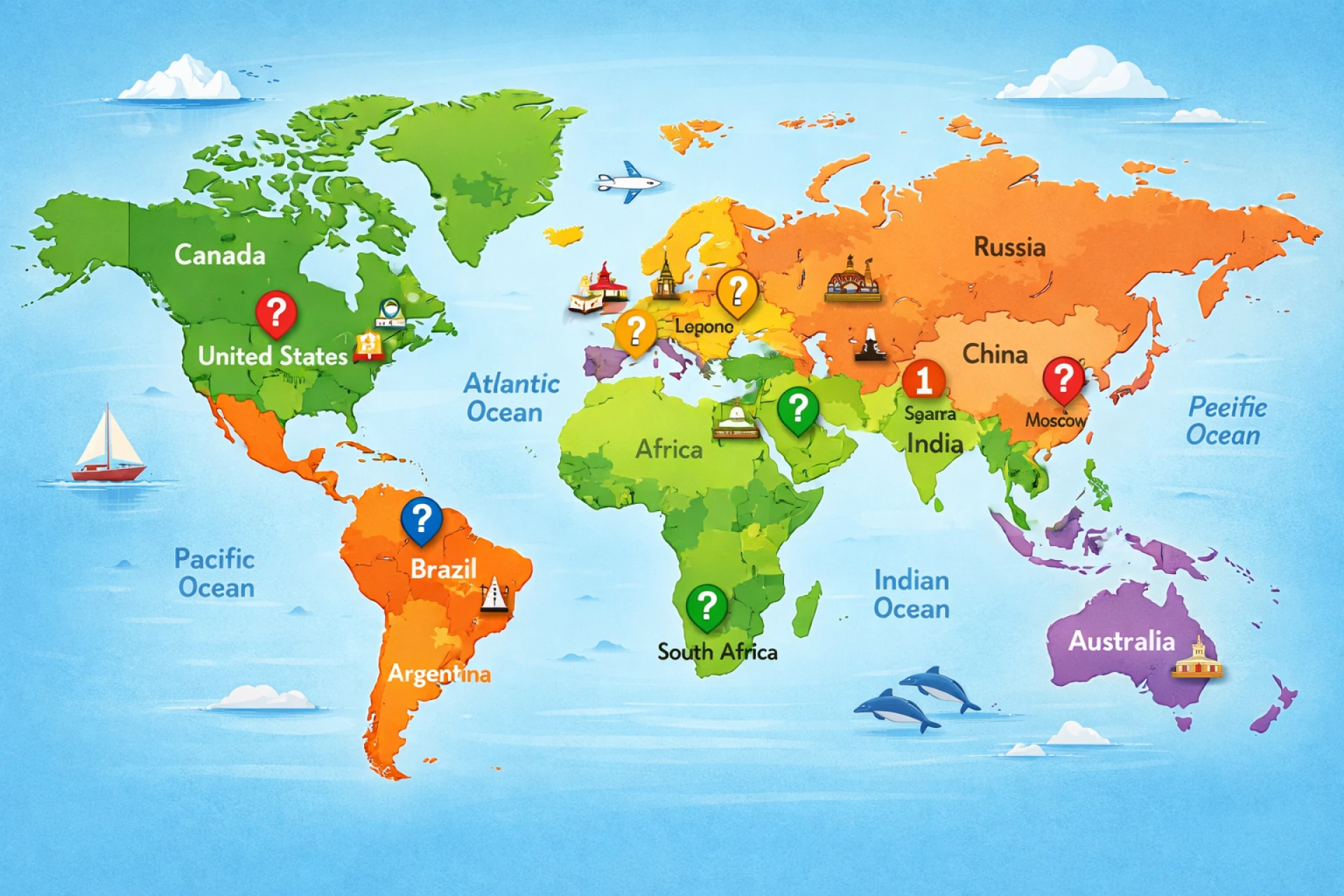
Geography is more than memorizing place names. It is a way of understanding how people, environments, cultures, and ecosystems connect across the planet. For students, teachers, and lifelong learners, practicing geography through interactive quizzes and map activities can strengthen memory, visual reasoning, and contextual understanding in a way that static study often cannot.
Trusted educational research highlights that active learning — especially retrieval practice — increases retention and deepens comprehension. Activities that invite learners to identify, recall, and apply geographic information help build durable skills.
Why Interactive Geography Practice Matters
Geographic literacy supports students in subjects ranging from history and social studies to environmental science. According to the National Geographic Society, understanding geography equips learners to interpret issues like cultural diversity, climate change, and human-environment interaction with greater clarity.
Interactive tools that involve maps, locations, capitals, or flags encourage learners to engage directly with information rather than passively read or memorize it. Research in cognitive science shows that retrieval practice — repeatedly recalling information — strengthens memory pathways more effectively than simple review.
Types of Geography Quiz Activities
Different formats of quizzes help learners build varied geography skills:
- Map Identification: Finding countries or regions on a blank map helps develop spatial awareness and visual localization.
- Capital Matching: Linking capital cities with their countries reinforces political geography and memory of administrative centers.
- Flag Recognition: Identifying flags strengthens symbol recognition and cultural context.
- Border Puzzles: Recognizing borders enhances understanding of regional relationships and geographic patterns.
Combining multiple quiz types creates a more comprehensive learning experience than studying each element in isolation.
Try an Interactive Geography Quiz
Here is a map quiz that helps learners practice their geography skills in a visual, interactive format:
https://geomapgame.com/us-state-capital-quiz/
This activity prompts you to identify U.S. state capitals on a map, reinforcing both name recognition and spatial placement through active recall.
How to Use Quizzes Effectively in Learning
To get the most educational value from map-based quizzes, consider these strategies:
- Set specific goals for each session — for example, focus on one region or topic like capital cities or national flags.
- Review incorrect answers to understand patterns or gaps in knowledge.
- Mix formats across sessions to strengthen memory through varied practice.
- Supplement with traditional maps or atlases to add real-world context to abstract representations.
These techniques help transform information from short-term familiarity into long-term understanding.
Supporting Research on Active Learning
Education studies suggest that structured, interactive tasks like quizzes increase both engagement and memory retention. Instead of passively reading information, learners repeatedly retrieve and apply knowledge, which reinforces neural pathways responsible for long-term storage.
Furthermore, activities that involve visual elements — such as maps and symbols — support spatial reasoning and pattern recognition, additional skills essential for geography literacy.
Conclusion
Interactive geography quizzes are large tools for building spatial understanding, memory recall, and contextual knowledge. When combined with traditional study methods such as atlases or guided instruction, these activities help learners of all levels connect facts to real-world spatial relationships.
























Sign in to leave a comment.