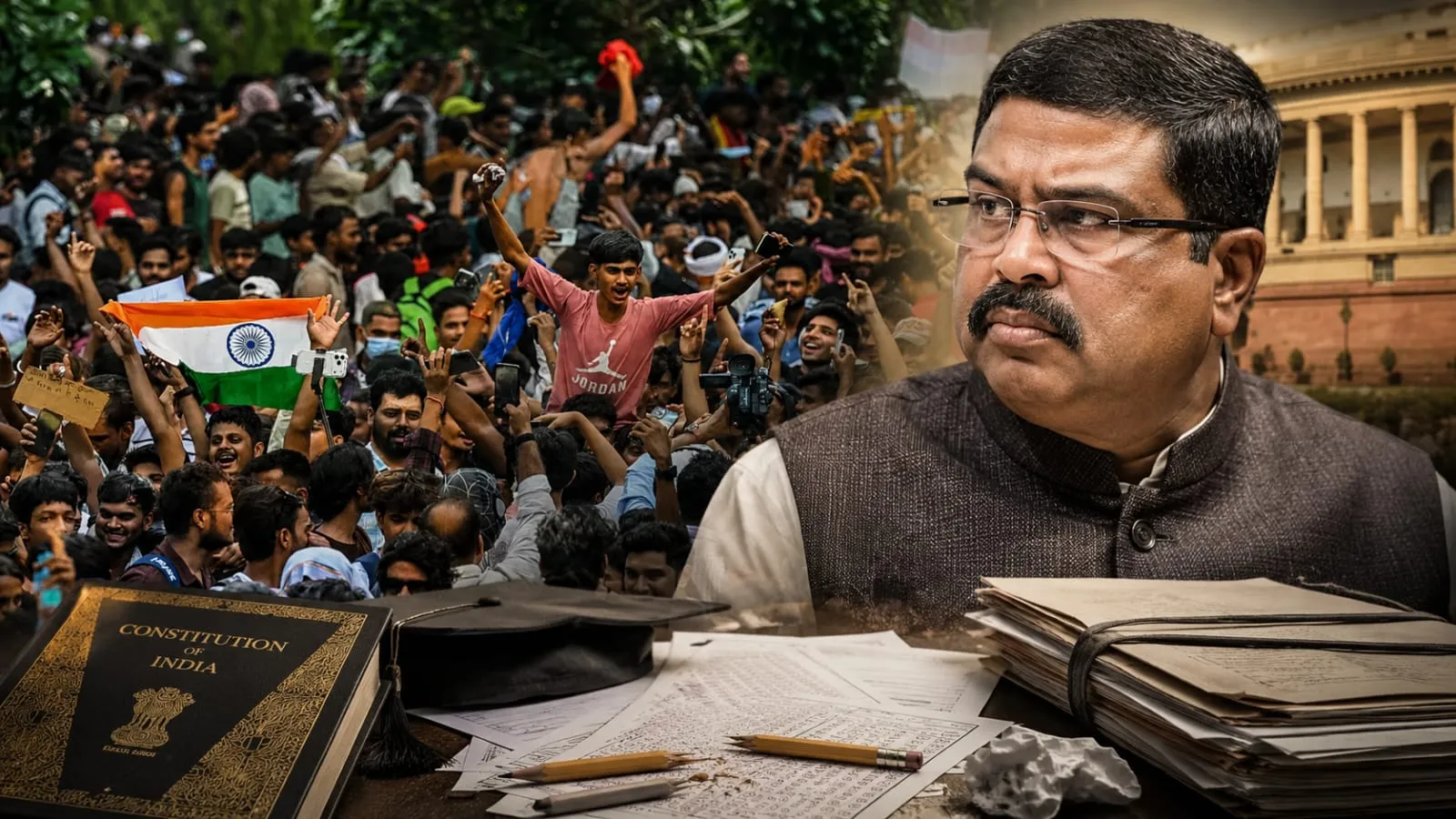

Recently, a significant political development took place in India's education sector with the resignation of Dharmendra Pradhan from the post of Education Minister. Naturally, this has brought a sense of relief and satisfaction to many. From several perspectives, it may also be viewed as a symbolic victory; especially for India's younger generation, Gen Z, who have consistently raised their voices on issues affecting education.
However, our primary objective was never merely to secure the resignation of the Education Minister. The real goal should be to transform the system that has repeatedly given rise to these problems. The resignation of an individual cannot be considered a meaningful achievement if the machinery responsible for these failures remains unchanged.
This can be understood through a simple analogy. If we pluck a rotten fruit from a tree but leave the disease affecting its roots untreated, the tree will eventually produce the same rotten fruit again. Likewise, removing one individual while leaving the flawed system untouched only ensures that the same problems will reappear in the future.

The core issue is not the individual; it is the system. An education system that lacks accountability, transparency, and responsibility inevitably produces crises such as examination paper leaks, administrative failures, and even student suicides. Unless these fundamental principles are embedded within the system, such problems will continue to emerge on a large scale. Therefore, reforms must go beyond replacing individuals; they must bring about comprehensive institutional change.
This principle extends far beyond the education sector. Other vital areas of governance; including Defense, Finance, Transport, Local Development, and Healthcare—also require transparency, accountability, and responsibility. Demanding these values is not merely our right as citizens; it is our civic duty. If we work towards achieving them today, we will build a safer, stronger, and more prosperous future for the generations to come.
We must also recognize that any new person appointed to a position will still function within the same existing framework. If the system itself remains unchanged, even the most capable individual will face the same structural limitations. Therefore, our focus must not only be on changing people but also on reforming policies, institutions, and mechanisms of accountability.
The present moment offers us an opportunity; not merely to celebrate a resignation, but to reflect on the deeper reforms that are needed. We must ask ourselves what practical steps we can take to build an education system that is transparent, accountable, efficient, and fair.
Ultimately, true victory will be achieved only when we reform the system that lies at the root of these problems. A resignation alone is not a complete solution. The real solution lies in systemic reform, institutional accountability, and the creation of a strong, impartial, and future-oriented education system.
As responsible citizens, it is our duty to stand by the truth and have the courage to call out wrongdoing whenever we see it. We must remain vigilant, because the future of our nation depends not on a single leader or institution, but on each one of us. The choices we make today will shape the India of tomorrow. This is not the time to remain silent or be passive—it is the time to act. After all, meaningful change never happens on its own; it is brought about by those who are willing to work for it.
Jai Hind.



























Sign in to leave a comment.