
Introduction
Modern enterprises process massive amounts of data daily, yet much of this information remains trapped in isolated databases, third-party software applications, and legacy cloud environments. Raw data scattered across various platforms cannot generate business value on its own. Organizations require a centralized mechanism to organize, transform, and deliver this information seamlessly across different departments.
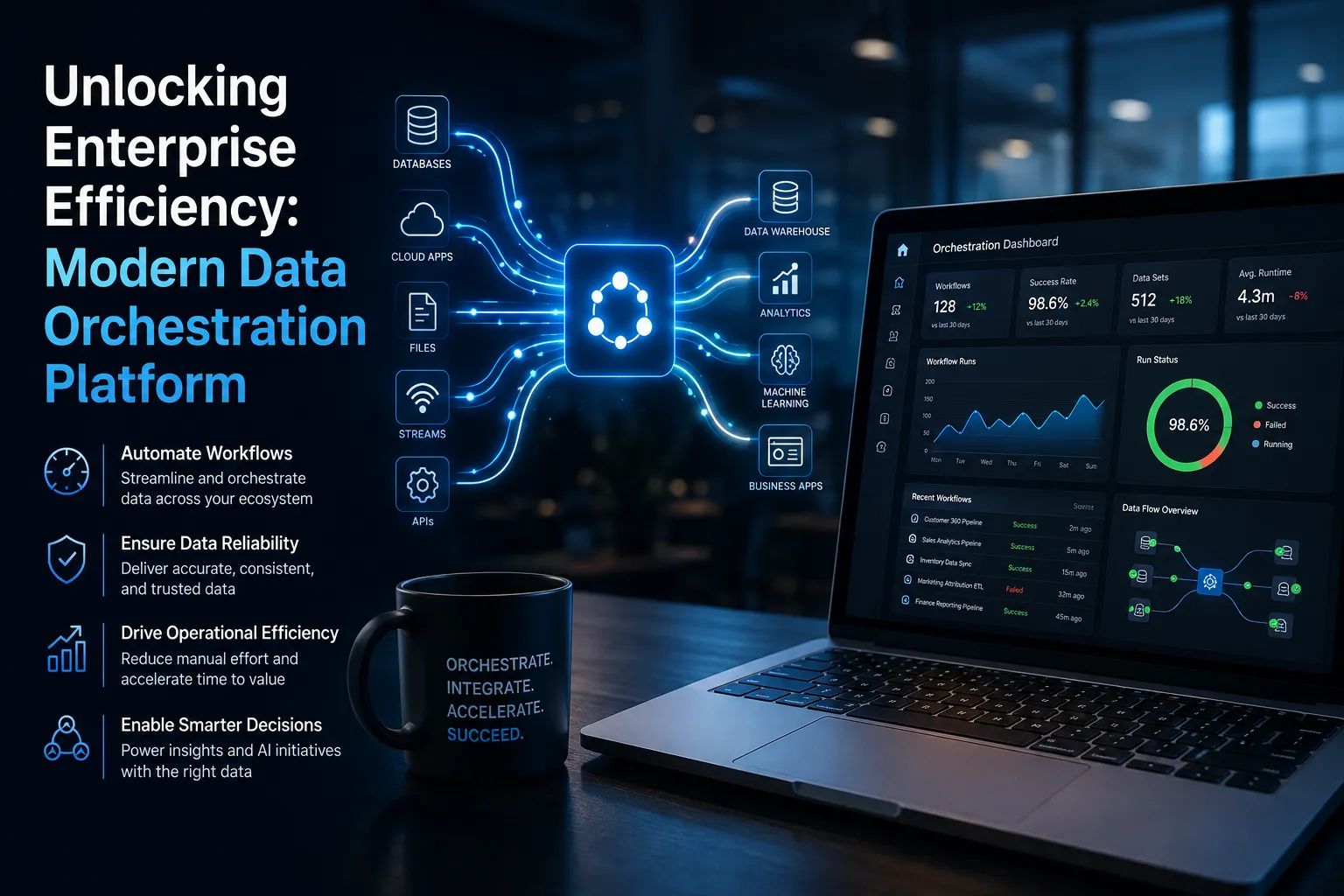
This critical operational need brings us to the modern data orchestration platform. Serving as the central nervous system of modern data architecture, a data orchestration platform coordinates data pipelines, automates complex workflows, and guarantees that clean datasets reach downstream analytics tools right on time. Business leadership and engineering teams can rely on an enterprise data orchestration platform to eliminate data silos, reduce operational friction, and power high-performing artificial intelligence models.
Core Mechanics of a Data Orchestration Platform
To understand how a data orchestration platform functions, it helps to examine the underlying execution cycle. Rather than merely storing data, a data orchestration platform actively supervises tasks, manages dependencies, and automates processes across disparate tech stacks.
The first stage involves automated data collection. A data orchestration platform establishes real-time or batch connections to external APIs, transactional databases, and SaaS tools to aggregate raw datasets without manual intervention.
The second stage handles task dependency and transformation. Data engineering teams set rules specifying that step B must only trigger after step A completes successfully. During this middle phase, the data orchestration platform standardizes schemas, cleans invalid entries, and enforces strict governance policies to protect data integrity.
The final stage focuses on automated activation. Once the datasets pass validation checks, the data orchestration platform feeds structured inputs directly into enterprise cloud warehouses, business intelligence dashboards, and machine learning pipelines.
Key Business Advantages of Platform Deployment
Integrating a dedicated data orchestration platform provides transformative benefits to growing organizations. Beyond basic scheduling tasks, a enterprise-grade data orchestration platform builds long-term operational resilience.
Eliminating silent pipeline failures stands out as a top advantage. When uncoordinated data jobs run independently, broken scripts often go unnoticed until dashboards display inaccurate metrics. A modern data orchestration platform monitors end-to-end execution, triggering instant alerts or automated retries whenever upstream disruptions occur.
Accelerated decision-making represents another significant gain. Automated routing managed by a data orchestration platform reduces data latency significantly. Executives gain access to fresh real-time analytics instead of waiting days for engineering teams to manually process static reports.
Enhanced security and compliance governance further justify adoption. A data orchestration platform records complete data lineage, allowing security compliance officers to audit origin points, access privileges, and security modifications effortlessly.
Selecting the Right Data Orchestration Platform
Selecting the optimal data orchestration platform requires evaluating system flexibility, developer usability, and overall organizational scale. Engineering-driven teams frequently lean toward code-centric frameworks that offer granular control over complex workflow logic.
Meanwhile, enterprise organizations with broader team structures often choose cloud-native solutions or low-code options that accelerate setup time. Evaluating how easily a prospective data orchestration platform connects to existing database infrastructure, analytics endpoints, and third-party APIs guarantees long-term success.
Conclusion
As cloud systems grow more complex, managing unstructured workflows manually becomes impossible. Implementing a reliable data orchestration platform bridges the gap between raw information and actionable business growth. By streamlining data movement, enforcing validation rules, and empowering real-time decision-making, an agile data orchestration platform serves as an indispensable technology foundation for modern enterprises.




























Sign in to leave a comment.