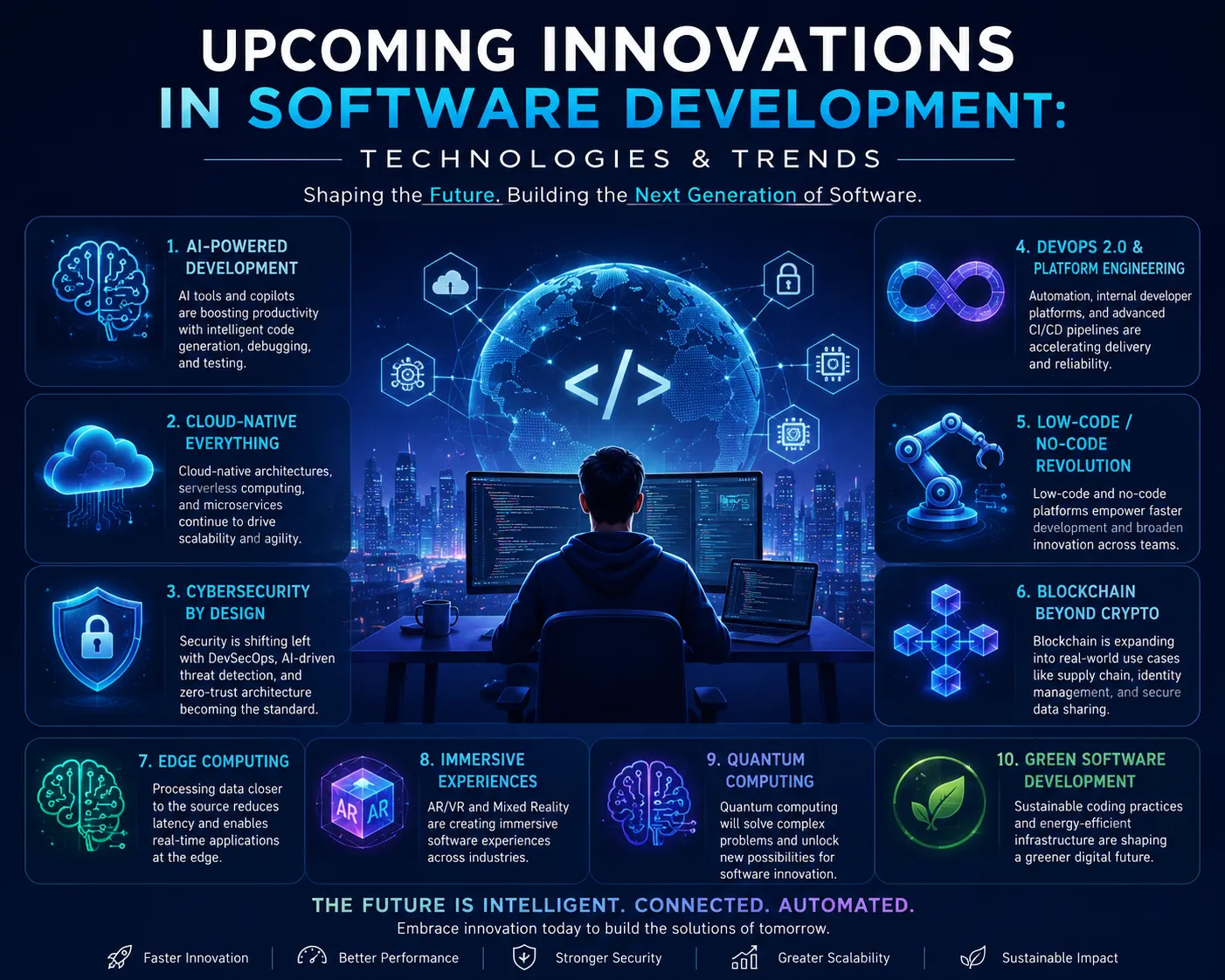

A new software release may soon involve fewer typed lines but more planning, testing, and review. AI tools can write code, cloud services can scale on demand, and edge systems can process data closer to users. These changes are shortening development cycles while raising expectations for security, privacy, accessibility, and system reliability.
The strongest software teams will adopt useful tools without chasing every new claim. They’ll measure results through delivery speed, defect rates, operating costs, user experience, and developer focus. The following upcoming innovations in software development show where practical value is most likely to appear.
How Upcoming Innovations in Software Development: Technologies & Trends Will Change Delivery
AI coding assistants will handle routine engineering work
Tools such as GitHub Copilot, Amazon Q Developer, and Google Gemini Code Assist can generate code, explain unfamiliar APIs, create tests, and suggest refactoring. They work best with boilerplate, repetitive changes, documentation, and small transformations that follow clear rules.
Generated code can still contain errors, insecure patterns, or licensing concerns. Developers should review every change, run automated tests, follow repository standards, and keep confidential data out of external AI systems.
AI agents will coordinate multistep tasks
An assistant answers a prompt, while an agent can plan work, edit several files, run tests, inspect failures, and open a pull request. This makes agents useful for bug triage, dependency updates, migration projects, test repairs, and internal developer support.
Agents need narrow permissions, sandboxed execution, audit logs, rollback plans, and human approval gates. Teams should judge them by measurable outcomes such as successful pull requests, reduced repair time, and fewer regressions, rather than polished demonstrations.
AI-native applications need new controls
Applications built around foundation models, retrieval-augmented generation, vector databases, and multimodal inputs require careful design. Teams must manage prompts, model versions, inference costs, response time, evaluation data, monitoring, and fallback behavior.
Hallucinations, prompt injection, data leaks, model drift, and inconsistent answers can harm users. Version prompts and models, test AI behavior often, record data sources, and define clear acceptable-use rules.
Cloud-Native and Edge Architectures Will Bring Software Closer to Users
Serverless platforms will simplify suitable workloads
Functions, managed databases, event buses, and hosted services reduce infrastructure work for APIs, scheduled jobs, automation, event processing, and bursty traffic. Developers can focus on business logic while the provider handles much of the underlying capacity.
Cold starts, execution limits, vendor dependence, distributed debugging, and changing usage costs still matter. Model event flows before coding, keep functions focused, monitor costs, and make operations idempotent so repeated events don’t create duplicate results.
Edge computing will support fast local responses
Edge computing processes data near users or devices instead of sending every request to a central cloud region. It can help gaming, industrial systems, connected devices, video delivery, and real-time collaboration when response time matters.
Content delivery networks, edge functions, and regional processing can reduce delay, but edge deployment adds security and monitoring work. Teams must manage limited local resources, consistent releases, data synchronization, and service behavior across many locations.
Platform engineering will improve developer experience
Internal developer platforms can provide infrastructure templates, service catalogs, deployment paths, observability tools, and automated compliance checks. They connect DevOps practices with self-service workflows, standard environments, infrastructure as code, and clear “golden paths.”
A platform should remove delivery friction instead of creating another layer of process. Measure adoption, time saved, reliability, and developer satisfaction rather than counting platform features.
Software Development Will Become More Composable and Interoperable
API-first design will speed product integration
API-first teams define contracts before implementation, giving internal teams and partners a shared way to build. Good APIs include documentation, examples, authentication, rate limits, version rules, monitoring, and a clear retirement process.
REST, GraphQL, event-driven interfaces, and protocol-based integrations fit different needs. Define compatibility rules early, publish working examples, and monitor how consumers use each API.
Modular architectures will reduce change costs
Modular monoliths, domain-driven design, bounded contexts, and event-driven systems help teams assign ownership and test features in smaller areas. They can also support selective deployment without forcing every component into its own service.
Excessive microservices create network failures, data consistency problems, monitoring work, and added team overhead. Choose an architecture based on domain boundaries, team structure, scale, and change frequency.
Low-code tools will expand software creation
Low-code and no-code platforms help business teams build dashboards, workflows, internal tools, and early prototypes. Professional developers can also use them for departmental automation that doesn’t need a custom system.
Poor controls can create shadow IT, repeated logic, weak accessibility, and difficult data transfers. Approved platforms, security reviews, ownership records, integration standards, and clear handoff rules can keep useful prototypes maintainable.
Security and Privacy Will Become Core Development Requirements
Secure-by-design practices will shape architecture
Security requirements belong beside functional requirements, not at the final review. Threat modeling, least privilege, secure defaults, secrets management, strong authentication, authorization, and data minimization should guide each system boundary.
Identity-centered security and zero-trust principles fit distributed applications well. Classify sensitive data, document trust boundaries, rotate secrets, restrict access, and review high-risk dependencies before release.
Supply chain security will protect the build process
Open-source packages, package repositories, CI/CD systems, build tools, and third-party services can all introduce risk. Software bills of materials, dependency scanning, signed artifacts, provenance records, reproducible builds, and protected release pipelines improve visibility.
The NIST Secure Custom Software Development Framework and Open Source Security Foundation provide useful guidance. Keep a dependency inventory, patch according to risk, limit build permissions, and watch for unusual package or pipeline activity.
Privacy-enhancing technology will support safer data use
Encryption, confidential computing, federated learning, differential privacy, tokenization, and careful anonymization can reduce exposure during analytics and machine learning. Each method has limits, and anonymized data can still create risks when combined with other records.
Collect only needed data and set retention periods before implementation. Document legal and ethical assumptions, restrict access, and review privacy controls as systems and data sources change.
Quality Engineering Will Shift Toward Continuous Validation
Automated testing will become more targeted
Modern teams combine unit, integration, contract, end-to-end, property-based, mutation, visual regression, and AI-assisted test generation. These checks find defects earlier and support frequent releases, but generated tests still need human review.
High test counts don’t guarantee meaningful coverage. Pair automation with exploratory testing, usability reviews, accessibility checks, and production monitoring.
Observability will guide post-release improvements
Logs, metrics, traces, profiles, real-user monitoring, synthetic checks, and business indicators help teams connect technical failures to user impact. OpenTelemetry provides an open framework for collecting telemetry across many services and tools.
Set service-level objectives and link telemetry to releases. Protect personal data in logs, then use blameless incident reviews to fix system weaknesses instead of assigning fault.
Reliability will become a product responsibility
Site reliability engineering, graceful degradation, disaster recovery, capacity planning, and chaos testing help teams prepare for failure. Controlled failure injection can expose weak backups, missing alerts, and poor service dependencies before a major outage.
Define recovery time and recovery point targets for important systems. Test backups, rehearse incident procedures, and focus resilience work on failures with the greatest customer impact.
Sustainable and Human-Centered Engineering Will Guide Technology Choices
Green software practices will cut waste
Efficient algorithms, caching, right-sized infrastructure, workload scheduling, storage cleanup, and carbon-aware computing can lower resource use and operating costs. Efficient model selection also matters because small tasks don’t always need the largest AI model.
Measure compute, storage, and data transfer instead of assuming one hosting model is greener. Remove wasteful background jobs, reduce unnecessary transfers, and review resource use during normal maintenance.
Accessibility will define software quality
Accessible products support people with disabilities and often work better across devices, settings, and user abilities. Teams should follow the Web Content Accessibility Guidelines through semantic HTML, keyboard support, readable contrast, captions, focus management, and clear error messages.
Automated scanners catch only part of the problem. Test with keyboards, screen readers, and other assistive tools, then include users with relevant lived experience.
Ethical engineering will guide high-impact systems
Healthcare, finance, employment, education, and public services need strong controls for bias, consent, explainability, and human oversight. Automated decisions can affect housing, income, safety, and access to care.
Model cards, data provenance records, risk reviews, and clear user disclosures improve accountability. Define escalation paths, monitor harmful outcomes, and give people meaningful human control when software affects their lives.
Conclusion
Upcoming innovations in software development will bring faster coding, flexible cloud delivery, composable systems, stronger testing, and smarter operations. They’ll also create new risks involving security, privacy, reliability, accessibility, cost, and human judgment.
The practical path is clear: pilot AI on low-risk workflows, build security and observability into daily delivery, choose modular designs when they reduce complexity, and set governance before scaling agents, low-code tools, or third-party services. Track results with real engineering and business measures.
Organizations that experiment carefully, test their assumptions, and maintain strong foundations will gain the most from the next wave of software innovation. Speed matters, but trusted software creates lasting value.



























Sign in to leave a comment.