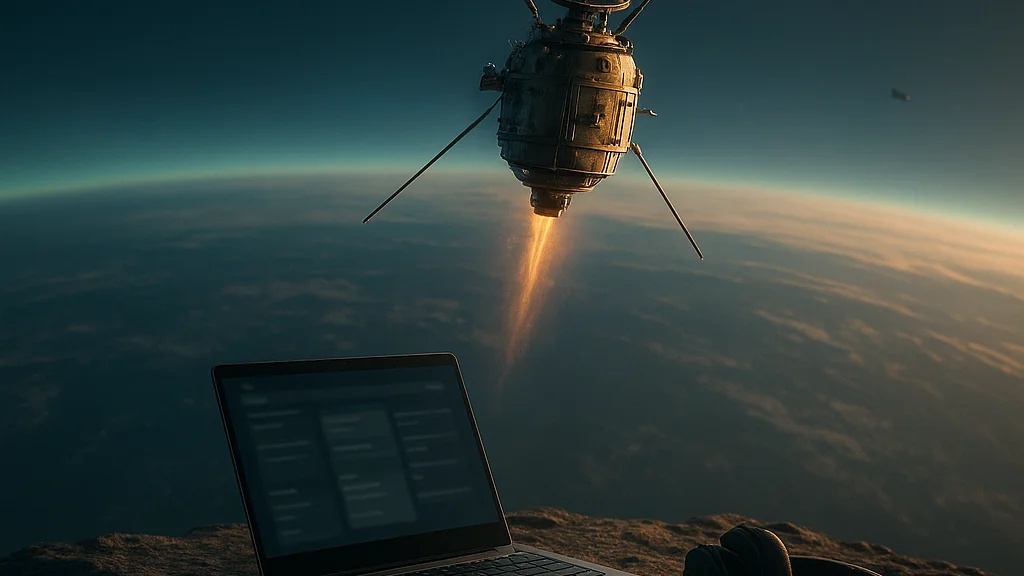

A space headline that exposes a work problem on Earth
Three things usually go wrong when a dramatic science headline hits the internet during the workday. First, Slack turns into a rumor mill. Second, people mistake uncertainty for danger. Third, knowledge workers burn an hour pretending they are “staying informed” when they are really just doomscrolling with better vocabulary. That is why the news that a roughly 1,300-pound NASA probe is making an uncontrolled plunge through Earth’s atmosphere today matters far beyond aerospace. It is a live stress test for remote work attention.
The object in question has drawn interest because “uncontrolled reentry” sounds cinematic and because the phrase invites the worst kind of online behavior: speculation detached from probability. NASA and major news organizations have long treated reentries as technical events governed by orbital decay, atmospheric drag, and wide uncertainty windows, not as random apocalypse theater. Reuters has repeatedly reported on past spacecraft reentries with the same core message: some hardware may survive, the exact landing corridor is broad, and the risk to any individual person is extremely low. The European Space Agency and Aerospace Corporation have made similar points in other reentry cases.
For remote workers, the practical issue is not whether the sky is falling. It is whether your attention system falls apart every time a high-velocity headline enters your feed. That sounds harsh. Good. Most teams still have terrible protocols for handling breaking news during distributed work. They confuse awareness with urgency, and then wonder why deep work disappears by lunch.
If you want the straight news framing first, WriteUpCafe has already tracked the event in NASA’s 1,300-Pound Probe Makes Uncontrolled Earth Atmosphere Plunge in 2026 and NASA’s 1,300-Pound Probe Plunges Uncontrolled Through Earth’s Atmosphere. What interests me here is the second-order effect: why a legitimate but low-probability space event can wreck a remote team’s output faster than a bad manager or a broken VPN.
Breaking news does not destroy productivity because it is dramatic. It destroys productivity because most digital workplaces have no rules for deciding what deserves interruption.
That is the unpopular thing first. Now the defense. Remote work rewards people who can distinguish signal from spectacle. A reentry story is useful if you need verified updates, scientific context, or risk communication practice. It becomes destructive when every employee becomes a part-time orbital analyst in six browser tabs.
How we got here: uncontrolled reentry is normal, panic is optional
There is a tendency to treat any uncontrolled reentry as evidence of institutional failure. That is too simplistic. Spacecraft and probes age out. Fuel margins disappear. Mission profiles change. Sometimes controlled disposal is possible; sometimes it is not. Once an object in Earth orbit loses enough altitude, atmospheric drag does the rest. The final descent can be forecast, but not with pinpoint certainty until close to reentry because upper-atmosphere conditions change and small variations compound quickly.
NASA has dealt with this kind of scrutiny before, and so have other agencies. Reuters, the Associated Press, and BBC News have all covered prior reentries involving retired satellites, rocket stages, and mission hardware. The pattern is familiar. Public interest spikes because the object has a memorable size or mission history. Scientists explain that most of the vehicle burns up. Analysts note that some denser components can survive. Then agencies publish updated windows as tracking improves. The event is real, but the internet’s emotional reaction is usually out of proportion to the statistical risk.
That mismatch matters in work culture because remote teams consume news in fragmented, personalized streams. In an office, one person might mention a headline and the room moves on. In a distributed setup, every employee gets a custom panic delivery system: X posts, Reddit threads, YouTube explainers, niche Discord chatter, and push alerts from apps that monetize anxiety. The result is not just distraction. It is synchronized distraction, which is worse.
Consider the mechanics of uncertainty. Reentry predictions often narrow over time rather than begin precise. That means updates are expected, not suspicious. Yet many workers interpret each revision as a dramatic escalation. The same cognitive bug shows up in project management. Teams see changing estimates and assume chaos, when the real story is that forecasts improve as more data arrives. Aerospace just makes the lesson visible.
- Orbital decay forecasts usually tighten as the event approaches.
- Most reentering mass burns up before reaching the ground.
- Risk corridors can span large geographic areas while individual risk remains tiny.
- Public uncertainty is often a feature of honest modeling, not a sign that experts are clueless.
That last point should be tattooed on every remote team handbook. Honest uncertainty is not incompetence. It is what serious analysis looks like before the final data comes in.
Why this kind of headline derails remote workers faster than office staff
Remote work did not create distraction, but it industrialized it. The home office is supposed to free workers from commute waste and open-plan noise. Fair enough. It also removes friction that once limited context switching. Nobody sees you alt-tabbing from a budget model to a live reentry tracker. Nobody notices the ten-minute “quick check” that mutates into a Reddit expedition through amateur sky maps and catastrophe threads. Bad UX trained us for this. Every platform is built to make the next update feel essential.
Gallup, Microsoft, and other workplace researchers have spent years documenting the fragmentation problem in digital work, even if their reports focus more broadly on meetings, messaging volume, and after-hours contact. Microsoft’s Work Trend Index has repeatedly highlighted how workers are interrupted by chats, emails, and meetings at a pace that makes sustained concentration difficult. Add a global headline with perceived public-safety stakes and you get a perfect interruption storm. People do not merely switch tasks; they switch emotional states.
The emotional state shift is the real tax. A remote worker reading a verified Reuters update may spend two minutes. The same worker reading speculative threads about debris paths, government secrecy, or “what they are not telling you” can lose twenty. After that, returning to cognitively demanding work is harder because the brain is still scanning for novelty and threat. Productivity software cannot fix that. A timer app is not going to save you from your own curiosity dressed up as civic responsibility.
Three operational weaknesses get exposed by events like this:
- No interruption policy: Teams rarely define what kind of public news justifies pausing work.
- No source hierarchy: Employees bounce between NASA statements, mainstream reporting, influencers, and random forum posts as if all carry equal weight.
- No reentry path back to work: Once attention is blown up, there is no agreed routine for resetting priorities.
That is why these headlines hit remote teams harder. The problem is not the probe. The problem is a work culture that treats every alert as democratically urgent. It is the productivity version of bad product design: too many buttons, no hierarchy, and a giant red notification badge screaming maybe important.
Remote work succeeds when people can process uncertainty without turning every developing story into a full-day side quest.
There is also a social layer. In distributed teams, posting a breaking-news update in a shared channel can function as status signaling. It says, “I am informed.” Sometimes it also says, “I am available for low-value chatter instead of hard work.” That sounds mean. Again: good. Plenty of teams need to hear it.
The data problem: low physical risk, high cognitive cost
If you strip away the drama, uncontrolled reentry is a numbers story. The physical risk to any specific person is typically extremely low, according to reporting by Reuters on previous reentries and analyses by aerospace experts. The cognitive cost inside a remote organization, by contrast, can be immediate and measurable even when nobody tracks it formally. One afternoon of fragmented attention across a 50-person knowledge team can erase dozens of productive hours.
Let’s put rough structure around that. Suppose a team of 40 remote employees spends an average of 18 minutes checking updates, chatting, and reorienting after the headline spikes. That is 720 minutes, or 12 work hours, gone in a single cycle. If a second update window hits later in the day and each person loses another 12 minutes, the total rises to 20 lost hours. No meteor needed. Just phones, feeds, and weak norms.
The irony is brutal. Companies obsess over software subscriptions, AI copilots, and dashboard instrumentation while ignoring the obvious leak: unmanaged attention. A sensational but low-probability event is exactly where that leak becomes visible. Teams with mature communication habits barely wobble. Teams with sloppy norms spiral into pseudo-analysis, duplicate fact-checking, and chatter inflation.
Here are the metrics leaders should actually watch during major news interruptions:
- Message volume per employee in nonessential channels during the event window
- Task completion slippage on same-day deliverables
- Average response delay on priority work after the first alert cycle
- Meeting derailment rate, especially when agendas are abandoned for headline talk
- Number of duplicate links or repeated questions, a strong signal of source confusion
Notice what is missing: moral panic about whether workers looked at the news at all. Adults are allowed to be curious. The goal is not robotic silence. The goal is proportionality. According to workplace studies from Microsoft and other enterprise researchers, the biggest productivity losses in digital work often come from task switching and fragmented focus rather than from any single long distraction. A reentry headline is effective because it triggers repeated micro-switches. Each one seems harmless. In aggregate, they are expensive.
There is a second lesson in risk communication. Agencies often publish broad windows because that is the honest state of the model. Managers should copy that discipline. If your company says, “We are aware of the news; unless there is a local safety advisory, continue normal work and check one verified update at 3 p.m.,” you have transformed ambient anxiety into bounded information handling. That is leadership. Not because it is flashy, but because it removes ambiguity.
What changed recently and why 2026 work culture makes this worse
The 2026 angle is not that uncontrolled reentries suddenly exist. The change is the media environment remote workers now inhabit. AI summaries, algorithmic feeds, and cross-platform reposting have made it easier to consume a story without understanding either its source quality or its uncertainty. A single legitimate NASA-related update can now spawn hundreds of derivative posts within minutes, each stripping away caveats for engagement. By the time the item reaches a team chat, what began as “tracking continues; risk remains very low” has become “object could hit Earth any minute,” which is technically true in the least useful possible sense.
That distortion hits productivity because modern remote work stacks are built for speed, not discernment. Slack, Teams, email digests, browser notifications, AI assistants, social tabs, and mobile alerts all compete in the same visual field. The result is a kind of cognitive open office, except the noise follows you into your apartment and pretends to be information. If you have ever watched a founder on contrarian Twitter turn a nuanced report into a thread about civilizational collapse, you already know the pattern.
Recent years have also blurred the boundary between professional and personal feeds. Many workers keep the same browser profile open for project docs, news tabs, creator newsletters, and social media. That means a science event with public-interest framing can breach work attention faster than a sports score or celebrity scandal. It feels more legitimate. Which makes it more dangerous to focus.
Another recent shift is the normalization of “ambient expertise.” People skim a few updates, absorb the tone, and begin speaking with confidence they have not earned. In remote teams, that can produce a mini-economy of misinformation where colleagues repeat half-understood claims in good faith. One person cites a headline, another embellishes it, a third asks whether the company should issue guidance, and suddenly a low-risk orbital event has become a workflow bottleneck.
The better response is boring, which is why many teams avoid it. Designate one channel for verified public-safety or infrastructure disruptions. Require source naming. Ban speculative reposts in work channels. Encourage employees to read a direct update or a mainstream wire service summary rather than ten hot takes. Yes, that sounds unsexy. So does backups management. Until the day you need it.
For readers who want the event-specific reporting while thinking about these broader habits, the two WriteUpCafe pieces linked earlier provide a straightforward snapshot of the probe story without turning it into theater.
A practical playbook for remote teams when breaking news hits
Most productivity advice is too polite. Here is the blunt version: if your team cannot survive one dramatic headline without losing a half day, your remote operating system is fragile. The fix is not mindfulness wallpaper or another app subscription. It is protocol.
Start with a source ladder. For a NASA reentry story, that means employees should rely first on official agency statements and established news organizations such as Reuters or AP when available, not clipped posts from creators farming engagement. If no local emergency authority has issued guidance relevant to your area, the event is information, not interruption. That distinction should be explicit.
Then create a time box. Teams can agree that for developing public-interest stories, one designated person posts a verified update at set intervals, such as noon and 3 p.m., unless circumstances materially change. This cuts off the endless refresh cycle that destroys concentration while preserving legitimate awareness.
A useful policy framework looks like this:
- Classify the event: Is it locally actionable, globally interesting, or merely viral?
- Name the source: Every shared update must identify the reporting source or agency.
- Set review windows: Do not permit rolling commentary in core work channels.
- Protect priority blocks: Deep-work sessions remain intact unless there is a direct safety reason to pause.
- Reset after the update: Managers restate top deliverables so attention has somewhere concrete to return.
This is not authoritarian. It is adult supervision for digital environments designed by people who think every notification deserves equal billing. Workers also need personal rules. Keep a separate browser profile for work. Disable nonessential push alerts. If a story is genuinely important, it will still exist in 45 minutes. The internet acts like every update is a hostage situation. It usually is not.
There is a counterargument worth taking seriously. Some headlines do affect employees emotionally even when they pose no direct local risk. Fair point. Good managers leave room for that. But emotional acknowledgment and channel chaos are not the same thing. One is humane. The other is operationally stupid.
The best remote teams do not suppress curiosity. They contain it, verify it, and stop it from colonizing the whole day.
That containment mindset scales beyond this NASA event. Use it for market shocks, weather scares, platform outages, political headlines, and celebrity-tech meltdowns alike. The mechanism is the same: separate relevance from intensity.
The larger lesson: productivity is really a risk-management discipline
People like to talk about productivity as if it were mainly a motivation issue. Wrong frame. Three things matter more: attention allocation, interruption control, and recovery speed. Motivation is nice. Systems decide outcomes. A headline about a 1,300-pound probe reentering Earth’s atmosphere makes that painfully clear because it sits at the intersection of uncertainty, spectacle, and legitimate public interest. In other words, exactly the kind of event that exposes whether a remote team has any discipline at all.
The strongest organizations treat information risk the way engineers treat physical risk. They assume noise will appear. They assume uncertainty will be misread. They assume some employees will overreact, others will disengage, and a few will become self-appointed analysts on company time. Then they build procedures that make those tendencies less costly.
There is even a cultural upside. Teams that handle events like this well tend to be better at everything else: incident response, client communications, deadline protection, and executive decision-making under ambiguity. Why? Because they have practiced the core skill of modern knowledge work: deciding what deserves attention and what merely demands it loudly.
That is the real story hiding beneath the NASA headline. Not fear. Not debris fantasies. Not a temporary spike in search traffic. The useful lesson is that remote productivity lives or dies by how people process uncertain information. If your team can watch a scientifically interesting, emotionally sticky event unfold without collapsing into chatter and tab-hopping, you probably have a healthy operating culture. If not, the probe is not your problem. Your norms are.
One final unpopular thought. A lot of remote workers claim they want autonomy, but what they actually want is freedom from oversight without the burden of self-governance. Events like this reveal the difference. Autonomy means you can assess a developing story, check a credible source, calibrate the risk, and return to work. Anything else is just distraction with better branding.
So yes, a 1,300-pound NASA probe making an uncontrolled plunge through Earth’s atmosphere is a real event worth tracking through credible reporting. It is also a mirror. Look closely at how your team responds today and you will learn more about your productivity system than any quarterly workshop will tell you. The debris may burn up. Your attention budget will not regenerate so easily.



























Sign in to leave a comment.