
A Fiery Return: The Scene Set for a Rare Atmospheric Event
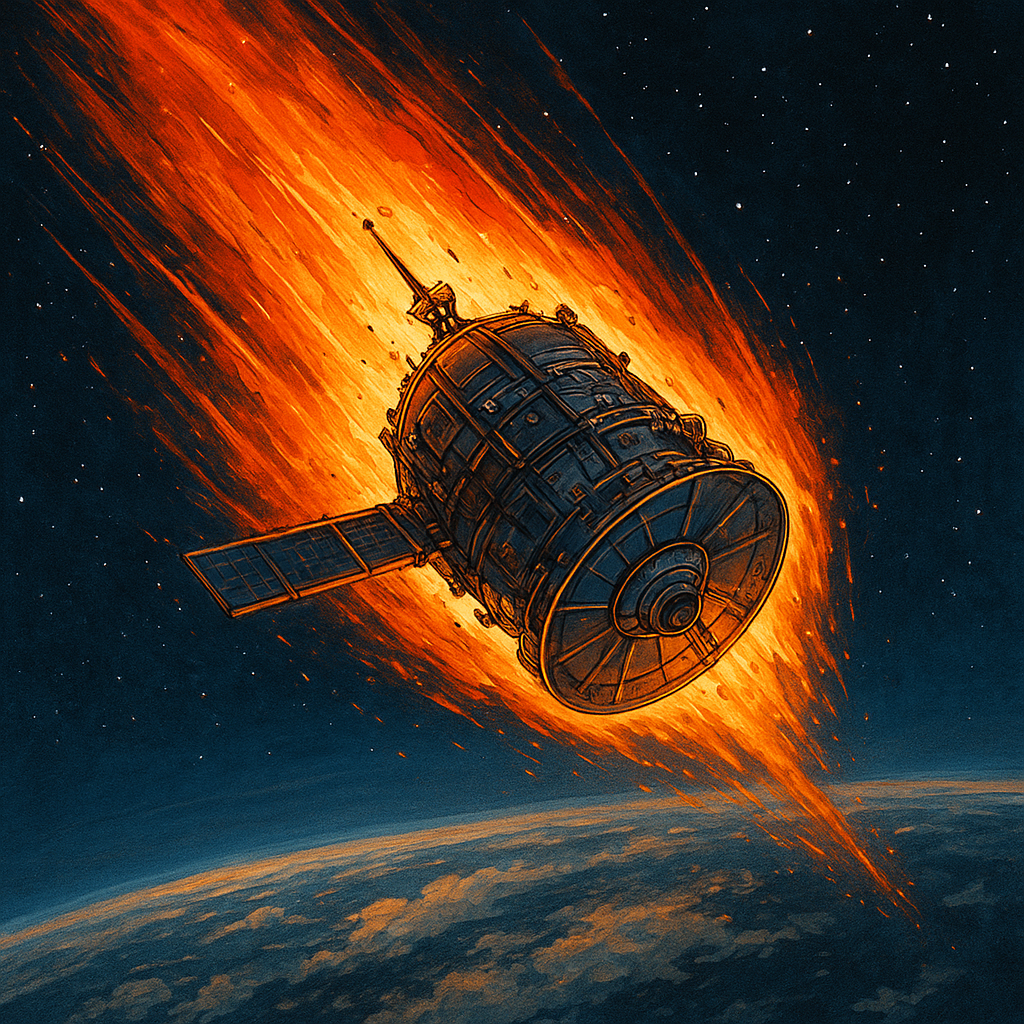
On April 12, 2026, a 1,300-pound NASA probe, known as the Van Allen Probe A, is scheduled for an uncontrolled plunge through Earth’s atmosphere. This event has captured the attention of scientists, space enthusiasts, and the general public alike. High above the planet’s surface, the probe will re-enter at tremendous speed, heating up due to atmospheric friction and disintegrating in a spectacular fiery descent. The probe’s mass and trajectory make this atmospheric re-entry noteworthy—though experts assure that the risk to human life is negligible.
Visualize the probe streaking across the sky in a blaze of light, fragments burning up at altitudes between 80 to 120 kilometers. The probe’s re-entry trajectory crosses over the southern hemisphere, with the most likely impact area predicted to be somewhere in the South Pacific Ocean. NASA’s trajectory tracking and modeling have narrowed the window, but due to the probe’s uncontrolled nature, precise impact coordinates remain uncertain.
“While the probe’s re-entry is uncontrolled, our simulations show that the risk to populated areas is extremely low. Most debris will burn up before reaching the surface,” said Dr. Emily Sanchez, NASA’s Atmospheric Re-entry Specialist, according to Florida Today.
This dramatic event marks the final chapter in a 14-year journey that began when the probe was launched in 2012 to study Earth’s radiation belts. As it re-enters the atmosphere, it offers a rare opportunity to observe the physics of spacecraft burn-up and debris dispersion, while reminding us of the challenges posed by space debris management in the era of expanding space exploration.
The Journey of the Van Allen Probe A: Origins and Mission
The Van Allen Probe A was launched in August 2012 as part of NASA's Radiation Belt Storm Probes mission, designed to investigate the complex dynamics of Earth’s Van Allen radiation belts. These belts, discovered in 1958 by James Van Allen, are zones of charged particles trapped by Earth’s magnetic field. Understanding their behavior is critical for protecting satellites, spacecraft, and astronauts from high-energy particle radiation.
The twin probes, A and B, were equipped with sophisticated instruments to measure particle flux, magnetic fields, and electric fields. Over the course of 14 years, they provided unprecedented insights into the belts’ structure and variations during solar storms. NASA’s data helped improve space weather forecasting, crucial for satellite operators and power grid managers worldwide.
As the mission progressed, the probes exceeded their design lifespans multiple times, a testament to engineering excellence and operational ingenuity. However, as the probes aged and fuel reserves dwindled, they gradually lost orbital altitude. By early 2026, Van Allen Probe A’s orbit had decayed enough to begin its final uncontrolled descent into Earth’s atmosphere.
“The Van Allen Probes transformed our understanding of near-Earth space environment and its hazards,” noted Dr. Marcus Lee, former mission scientist. “Their controlled operations ended years ago, but their legacy continues.”
The uncontrolled re-entry underscores the challenges of satellite end-of-life management, especially for heavy, high-value spacecraft that cannot be safely de-orbited in a controlled manner. NASA and industry partners have since enhanced protocols to mitigate the risks posed by defunct spacecraft, but Van Allen Probe A’s fate was sealed by its propellant exhaustion and orbital decay.
Analyzing the Re-entry: Data, Risks, and Comparisons
The re-entry of a 1,300-pound (approximately 590 kilograms) spacecraft presents a complex interplay of physics and risk assessment. The probe’s mass places it in a category where significant debris can survive atmospheric burn-up and reach Earth's surface, although the majority of the spacecraft is expected to incinerate.
NASA’s trajectory modeling indicates the following:
- Entry speed: Approximately 28,000 km/h (17,400 mph) as it enters the upper atmosphere.
- Deceleration and heating: Intense friction with atmospheric particles causes rapid heating, fragmenting the probe.
- Altitude of breakup: Most breakup occurs between 80 and 120 kilometers altitude.
- Surviving debris: Estimated to be less than 10% of the initial mass.
- Impact area: Predominantly over unpopulated oceanic regions.
Risk assessments reassure that the likelihood of debris causing harm is minimal. According to the AOL report, the odds of any person being injured by falling spacecraft debris are less than 1 in 1,000,000. The probe’s re-entry is similar in scale to other notable space debris events, such as the 2026 fiery return of Northrop Grumman’s Cygnus XL spacecraft, which also burned up over the Pacific with negligible risk to humans.
Compared to debris from larger satellites or defunct space stations, Van Allen Probe A’s mass is moderate but still significant enough to warrant close monitoring. The uncontrolled nature of its descent contrasts with newer spacecraft designed for controlled re-entry and intentional ocean splashdowns to minimize hazards.
NASA’s tracking data and international space agencies’ observations ensure continuous monitoring during re-entry, providing real-time updates on trajectory and fragmentation. This coordination exemplifies the global effort to manage space debris and protect people on Earth.
2026 Developments: Space Debris Management and Industry Innovations
In 2026, the issue of space debris has become more critical than ever, with thousands of active satellites and millions of debris fragments orbiting Earth. The uncontrolled descent of Van Allen Probe A highlights ongoing challenges despite advances in debris mitigation strategies.
Recent innovations focus on designing spacecraft with end-of-life disposal plans, including:
- Propulsive de-orbit systems: Enabling controlled re-entries to reduce risk.
- Materials engineering: Using components that disintegrate more completely during re-entry.
- Active debris removal: Missions deploying nets, harpoons, or lasers to capture or nudge debris toward destruction.
NASA’s partnerships with commercial space companies have accelerated implementation of these technologies. For example, the Cygnus XL spacecraft, operated by Northrop Grumman, demonstrated controlled re-entry capabilities in March 2026, safely disposing of cargo and hardware from the International Space Station, as detailed by Florida Today.
Nevertheless, legacy spacecraft like the Van Allen Probe A, launched before these protocols became standard, remain a concern. NASA and international bodies like the United Nations Committee on the Peaceful Uses of Outer Space (COPUOS) continue to refine guidelines for spacecraft design and end-of-life handling to minimize future risks.
Moreover, improved space situational awareness is critical. Advances in radar, optical tracking, and AI-based orbit prediction enable authorities to forecast re-entry events with greater accuracy. These technologies inform risk communication and emergency preparedness, reassuring the public and policymakers.
For the remote work and productivity sector, these developments indirectly impact global communications infrastructure and satellite-based services crucial for connectivity. Reliable satellite operations mean less disruption to remote collaboration platforms and data services, underscoring the economic importance of effective space debris management.
Expert Insights and the Broader Impact
Industry experts emphasize the lessons learned from the Van Allen Probe A re-entry. Dr. Linda Marquez, a space environment researcher, points out that “each uncontrolled re-entry event underscores the need for proactive design and operational strategies to safeguard both space assets and terrestrial populations.”
“Space debris is not just a technical challenge but a societal one. Responsible stewardship of Earth’s orbital environment benefits all sectors, including remote work infrastructure that depends heavily on satellite networks,” said Dr. Marquez during a recent symposium.
From an economic perspective, the increasing frequency of such events raises insurance costs for satellite operators and compels regulators to enforce stricter compliance. Companies invested in satellite-based internet, navigation, and communication services are pushing for innovations that ensure uninterrupted service despite debris risks.
The academic community also draws parallels between managing physical space debris and digital clutter in remote work environments. Effective organization, timely disposal, and preventive strategies are common themes, as discussed in WriteUpCafe’s article on remote work productivity.
Furthermore, public interest in space missions benefits outreach and education, inspiring the next generation of STEM professionals. Events like the probe’s re-entry serve as teachable moments about orbital mechanics, atmospheric science, and the importance of global cooperation in space governance.
Looking Ahead: What to Watch in Space Safety and Remote Connectivity
As the Van Allen Probe A completes its final descent, attention turns to the future of space safety and the implications for terrestrial technologies dependent on space infrastructure. Key areas to monitor include:
- Enhanced debris tracking: Expansion of global networks to track smaller debris pieces.
- Regulatory evolution: International agreements enforcing end-of-life protocols for all spacecraft.
- Technological innovation: Development of spacecraft with self-deorbit capabilities and safer materials.
- Integration with remote work tech: Ensuring satellite communication resilience amidst orbital hazards.
Moreover, the increasing integration of space-based assets into daily life means that even remote work productivity depends on stable space operations. The lessons from uncontrolled re-entries like Van Allen Probe A's highlight the importance of maintaining orbital safety as a foundation for digital connectivity.
For readers interested in the interplay between space technology and productivity, WriteUpCafe’s explorations into freelancing and digital collaboration underscore how essential uninterrupted satellite services have become for flexible work models.
“The future of work is intertwined with the future of space. Safe, reliable satellite infrastructure is the backbone of global connectivity,” notes technology analyst Sarah Kim.
Ultimately, the controlled management of spacecraft end-of-life and debris will dictate how sustainably humanity can expand its presence beyond Earth while preserving the planet’s safety and digital productivity.





























Sign in to leave a comment.