
If you have ever opened a fresh upsc capf syllabus sheet, you already know the distinct feeling it creates: equal parts purpose and pressure. Unlike standard graduate exams or purely objective screening tests, preparing for the upsc capf ac selection process demands two entirely different mindsets at the same time. In the morning, your brain needs to act like a precision engine firing through 125 tricky multiple-choice questions on science, polity, history, and reasoning under penalty of negative marking. By the afternoon, you need to transition into an articulate analyst, writing cohesive essays, arguments, and précis under strict time constraints.
Six months is ample time to clear the capf exam if you treat your preparation as an integrated system rather than a collection of random study topics. The key isn't studying 14 hours a day until you burn out; it’s building a repeatable routine that balances concept clarity, speed, writing practice, and basic physical readiness.
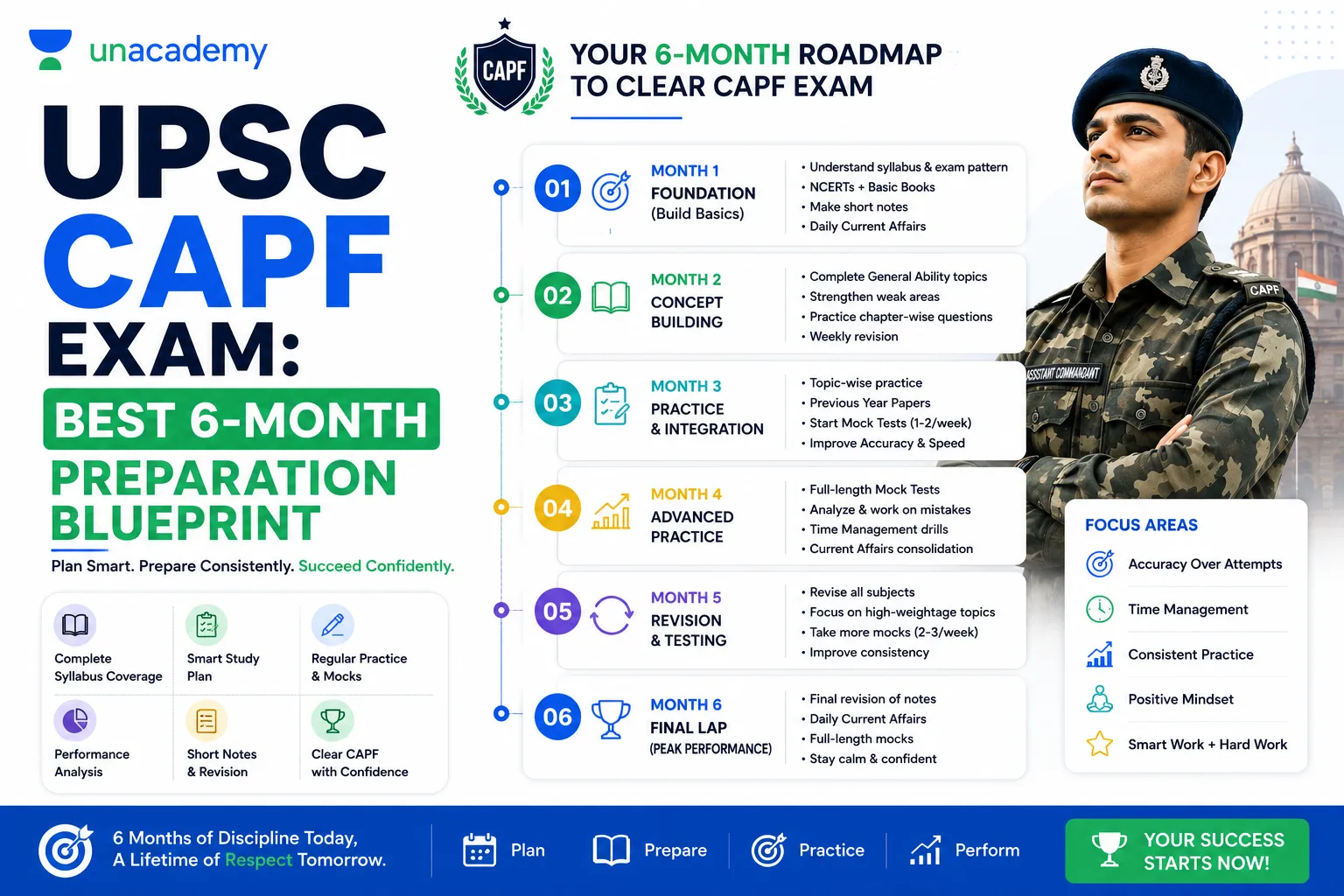
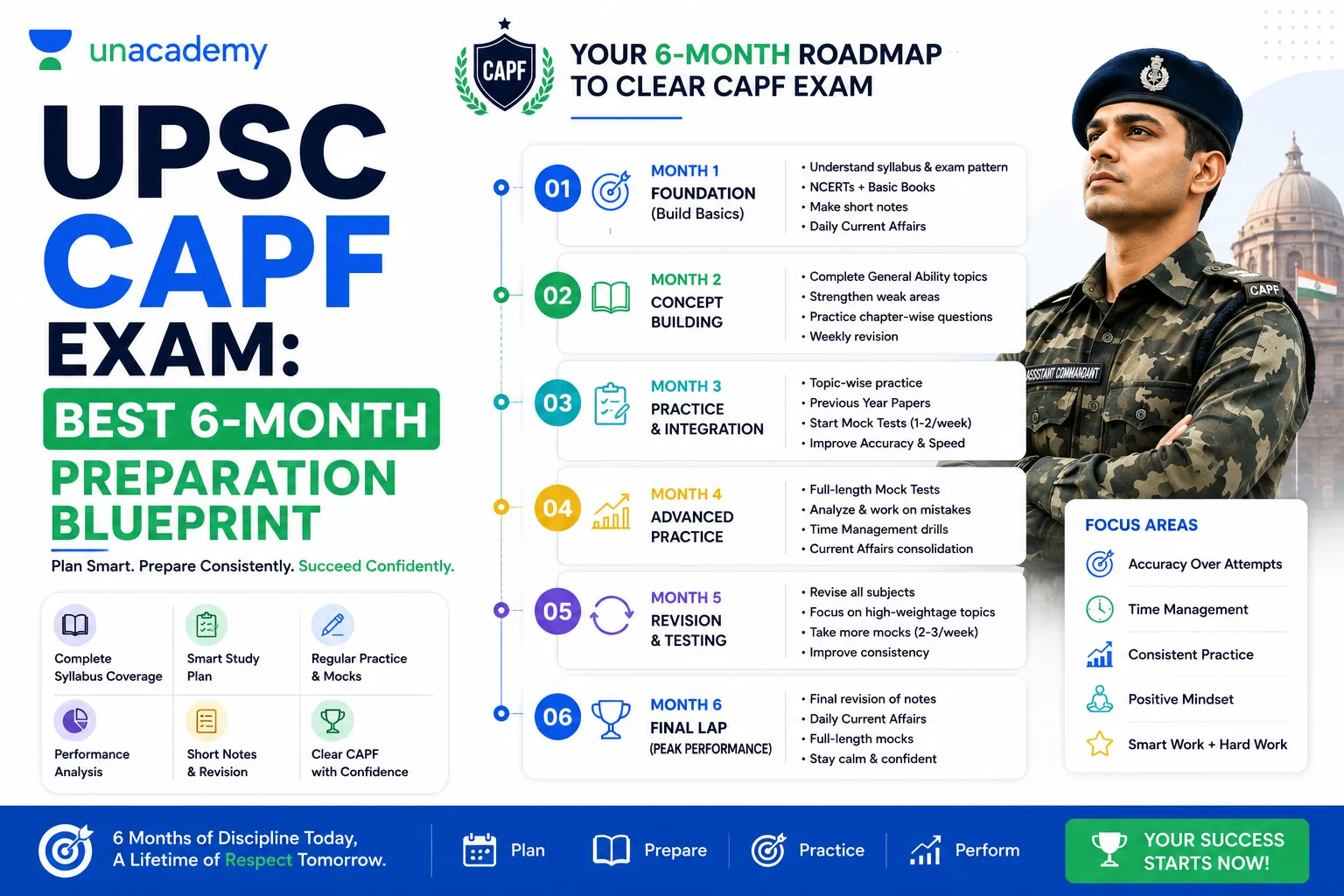
Here is a practical, grounded 6-month blueprint designed to take you from initial preparation to exam day with clarity and confidence.
Decoding the UPSC CAPF Exam Pattern
Before diving into booklists, you need a realistic view of how marks are earned and lost across the two papers.
UPSC CAPF AC Written Exam Breakdown
| Feature | Paper I: General Ability & Intelligence | Paper II: General Studies, Essay & Comprehension |
|---|---|---|
| Exam Format | Objective (MCQs) | Descriptive |
| Number of Questions | 125 Questions | Varies by section (Essays, Arguments, Reports, etc.) |
| Total Marks | 250 Marks | 200 Marks |
| Duration | 2 Hours | 3 Hours |
| Negative Marking | Yes (-0.66 per wrong answer) | No Negative Marking |
| Evaluation Condition | Screening Paper | Evaluated ONLY if Paper I threshold is cleared |
Paper 1: General Ability and Intelligence (250 Marks, 2 Hours)
Paper 1 consists of 125 objective questions covering Indian Polity, Modern History, Geography, General Science, Economics, Current Affairs, and General Mental Ability. Each correct attempt gives you 2 marks, while an incorrect response costs you 0.66 marks. Accuracy matters far more than blind attempts.
Paper 2: General Studies, Essay, and Comprehension (200 Marks, 3 Hours)
Paper 2 is descriptive and evaluates your analytical thinking, language fluency, and structural clarity. It covers four long essays (80 marks), two argument write-ups (40 marks), two report writings (20 marks), précis writing (15 marks), reading comprehension (20 marks), and English grammar (25 marks).
Crucial Rule: Paper 2 is evaluated only if you cross the qualifying cutoff in Paper 1. However, your final written merit list is determined by the combined score of both papers (out of 450 marks). Treating Paper 2 as an afterthought is the single most common reason high-scoring Paper 1 candidates fail to make the final cutoff.
6-Month Preparation Blueprint for UPSC CAPF AC
Months 1–2: Foundation, Core NCERTs, & Mental Ability
Your main objective in the first eight weeks is establishing strong fundamentals across core subjects and building a daily routine.
- Polity: Read M. Laxmikanth thoroughly. Focus heavily on Fundamental Rights, Directive Principles, Executive, Judiciary, Constitutional Bodies, and Emergency Provisions.
- History: Prioritize Modern Indian History (Class 12 NCERT / Bipan Chandra or Spectrum). Pay special attention to the 1857-1947 freedom movement, social reform movements, and major legislative acts.
- Science: Cover Class 9 and 10 NCERT Science books page by page. Science accounts for 20–25 questions in Paper 1, making it one of the highest yield subjects for the upsc capf syllabus.
- General Mental Ability: Spend 45 minutes daily practicing basic quantitative aptitude and logical reasoning (percentages, ratios, series, spatial reasoning, data interpretation).
- Physical Routine: Start brisk walking or light jogging for 20 minutes every evening. Do not skip this; physical conditioning takes time.
Months 3 to 4: Advanced Topics, Paper 2 Writing, & Previous Year Question Papers
Once core concepts are settled, transition into active application and descriptive practice.
- Geography & Environment: Focus on Class 11 and 12 Physical & Human Geography NCERTs. Study mapping (rivers, national parks, mountain passes, international sea trade routes) alongside basic environmental concepts.
- Economy: Stick to macroeconomics basics (inflation, monetary policy, fiscal deficit, budget concepts, and key government schemes).
- Paper 2 Skill Building: Write at least two essays and one argument set every week. Learn the standard structure for argument writing: Introduction → Arguments For → Arguments Against → Balanced Conclusion.
- PYQ Integration: Solve past 10 years of previous year question papers for Paper 1 topic-wise. Analyze why wrong options are incorrect UPSC frequently recycles themes and option logic.
Month 5: Full-Length Mock Tests, Speed, & Current Affairs Consolidation
This month focuses on exam simulation and bridging knowledge gaps.
- Mock Tests: Take at least 8 to 10 full-length Paper 1 mock tests in strict 2-hour timed conditions. Aim for a consistent attempt rate of 90–100 questions with an accuracy above 80%.
- Paper 2 Time Management: Practice solving full Paper 2 papers within 3 hours. Writing continuously for 180 minutes while maintaining coherent handwriting requires physical stamina.
- Current Affairs: Consolidate the last 10–12 months of current events, with particular emphasis on defense exercises, internal security reports, international relations, and major government policies.
Month 6: Revision Cycles, Précis Perfection, & Peak Condition
The final month is strictly for consolidation rather than starting new topics.
- Revision: Re-read self-made concise notes, formula sheets, and highlighted NCERT diagrams.
- Grammar & Précis: Solve grammar exercises daily. English grammar in Paper 2 offers straightforward, high-utility marks if your basics are clean.
- Taper Physicals: Maintain basic agility without risking injuries like ankle sprains or shin splints right before the written exam.
Cracking Paper 2: Why Most Candidates Struggle
Paper 2 in the capf exam is unique because it combines subjective depth with tight time management. You are expected to complete 200 marks of writing in 180 minutes.
| Component | Marks | Suggested Time Allocation | Strategy Focus |
|---|---|---|---|
| 4 Essays | 80 Marks | 60–65 Minutes | Choose topics with solid factual backing. Maintain intro-body-conclusion flow. |
| 2 Arguments | 40 Marks | 35–40 Minutes | Present balanced, point-by-point counterarguments without emotional bias. |
| 2 Reports | 20 Marks | 20 Minutes | Stick strictly to a neutral, factual format (Heading, Place, Date, Body, Impact). |
| Précis Writing | 15 Marks | 20–25 Minutes | Reduce text to one-third length in your own words inside the grid sheet. |
| Comprehension | 20 Marks | 20 Minutes | Answer directly from the passage without adding external assumptions. |
| Grammar | 25 Marks | 15 Minutes | Solve first to secure quick, objective marks. |
Physical Standards and Fitness: Don't Leave It to the Last Minute
Passing the written exam is only the first gateway. Candidates who qualify the written cutoff are summoned for the Physical Efficiency Test (PET) and Medical Standards Test.
CAPF Physical Efficiency Test (PET) Standards
| Physical Test Event | Male Candidates | Female Candidates |
|---|---|---|
| 100 Meters Race | 16 Seconds | 18 Seconds |
| 800 Meters Race | 3 Minutes 45 Seconds | 4 Minutes 45 Seconds |
| Long Jump | 3.5 Meters (3 Chances) | 3.0 Meters (3 Chances) |
| Shot Put (7.26 kg) | 4.5 Meters | N/A |
Building basic running capacity alongside your studies ensures you won't suffer from sudden injuries when the PET notification arrives shortly after results.
Common Mistakes Aspirants Make in the CAPF Exam
- Ignoring Paper 2 Until Post-Exam: Waiting for Paper 1 marks before touching essay or argument writing is a recipe for failure. Writing speed and structural thinking require months of practice.
- Over-calculating in Paper 1: Guessing blindly on 20+ questions when you are unsure leads to heavy negative marks. Calculate your risk carefully.
- Neglecting General Science: Candidates with a humanities background often skip science, losing 40–50 straightforward marks derived directly from basic NCERT textbooks.
- Treating Arguments Like Essays: An argument write-up requires explicit bullet points for both "For" and "Against" perspectives. Paragraph-style essay writing in this section loses marks.
- Ignoring Physical Fitness: Leaving all running practice for after the written results often results in shin splints or failing the 800-meter timing.
Field Notes: Real Reader Experiences
"I cleared Paper 1 comfortably on my first attempt with 138 marks, but missed the overall merit because I panicked during Paper 2. I hadn't timed my essay writing beforehand and left one full essay and a report blank. On my second attempt, I practiced timed full-length writing every Sunday for two months. That single change got me through the upsc capf ac selection list."
— Rohan S., Assistant Commandant (CRPF)
"The biggest myth is that you need dedicated Civil Services optional depth for the upsc capf exam. What you actually need is extreme clarity on NCERTs, quick mental math, and disciplined daily fitness. I ran 2 km every evening after study hours, which kept my mind clear and made the PET stage painless."
— Priya M., Qualified Candidate
Frequently Asked Questions About UPSC CAPF Exam Preparation
1. Is 6 months enough to prepare for the upsc capf exam from scratch?
Yes, 6 months of disciplined, focused study is sufficient if you dedicate 6–8 hours daily. The key is giving balanced attention to Paper 1 concepts, Paper 2 writing practice, and physical conditioning right from the first month.
2. Can I write the Essay component of Paper 2 in Hindi?
Yes, UPSC allows candidates to write the Essay section in either English or Hindi. However, the Précis Writing, Reading Comprehension, and English Grammar components must be answered in English only.
3. What is a safe score in Paper 1 to qualify for Paper 2 evaluation?
While cutoffs fluctuate based on difficulty and vacancy numbers, targeting 130–140+ marks out of 250 in Paper 1 typically provides a safe margin for Paper 2 evaluation and final merit positioning.
4. How should I prepare for the argument writing section in Paper 2?
Practice structuring topics into clear "Arguments For" and "Arguments Against". Use concrete facts, policy references, and logical reasoning rather than emotional assertions. Current internal security, socio-economic, and geopolitical issues form the core of these topics.
5. Are physical tests qualifying or counted in the final merit list?
The Physical Efficiency Test (PET) and Medical Standards Test are strictly qualifying in nature. However, failing any event results in immediate disqualification. Final selection depends entirely on your combined score in the Written Exam (450 marks) and the Personality Test/Interview (150 marks), totaling 600 marks.
Final Thoughts
Clearing the upsc capf exam is less about genius and more about consistency across multiple domains. When you align your daily schedule to cover objective knowledge, clear written expression, and physical endurance, the syllabus becomes manageable. Stay focused on your weekly targets, measure your progress through mock tests, and maintain your physical health throughout the journey.






























Sign in to leave a comment.