
Let's be completely honest: the sheer volume of the Civil Services Examination syllabus is enough to make anyone stare blankly at their study desk at 2:00 AM, wondering if they’ve made a massive mistake. You start your preparation with grand visions of mastering every topic, but within months, you find yourself buried under three different newspapers, standard textbooks, monthly current affairs compilations, and a mountain of loose sheets.
The trap isn't a lack of information; it’s an absolute overload of it.
When you sit down to write answers under intense time pressure in the actual exam, your brain won't recall a 500 page book. It will recall highly condensed, structured, and visually mapped frameworks. If you are struggling to bridge the gap between reading massive amounts of content and writing concise 250 word answers, you don't need to study harder. You need a smarter strategy to handle your upsc mains study material.
Here is how you can stop passively collecting data and start building upsc mains gs notes that actually work for you when the clock is ticking.
Why Traditional Note-Making Fails for the Mains
Most aspirants make notes by essentially rewriting textbooks in their own handwriting. You read a chapter on Scheduled Castes or renewable energy, find every second sentence important, and copy it down. This isn't note making; it's manual printing.
The purpose of your upsc mains notes isn't to store information Google already does that. The purpose is to optimize retrieval when you have only seven to nine minutes per question in the exam hall, your brain needs pre processed, modular data points that can be immediately arranged into an introduction, body, and conclusion.
If your current notes look like endless paragraphs of prose, they won't help you during the frantic revision days between the Prelims and the Mains. You need a radical shift from "subject-wise" compilation to "syllabus-keyword" mapping.
The Theme-Based Blueprint: Structuring Your Notes Around Keywords
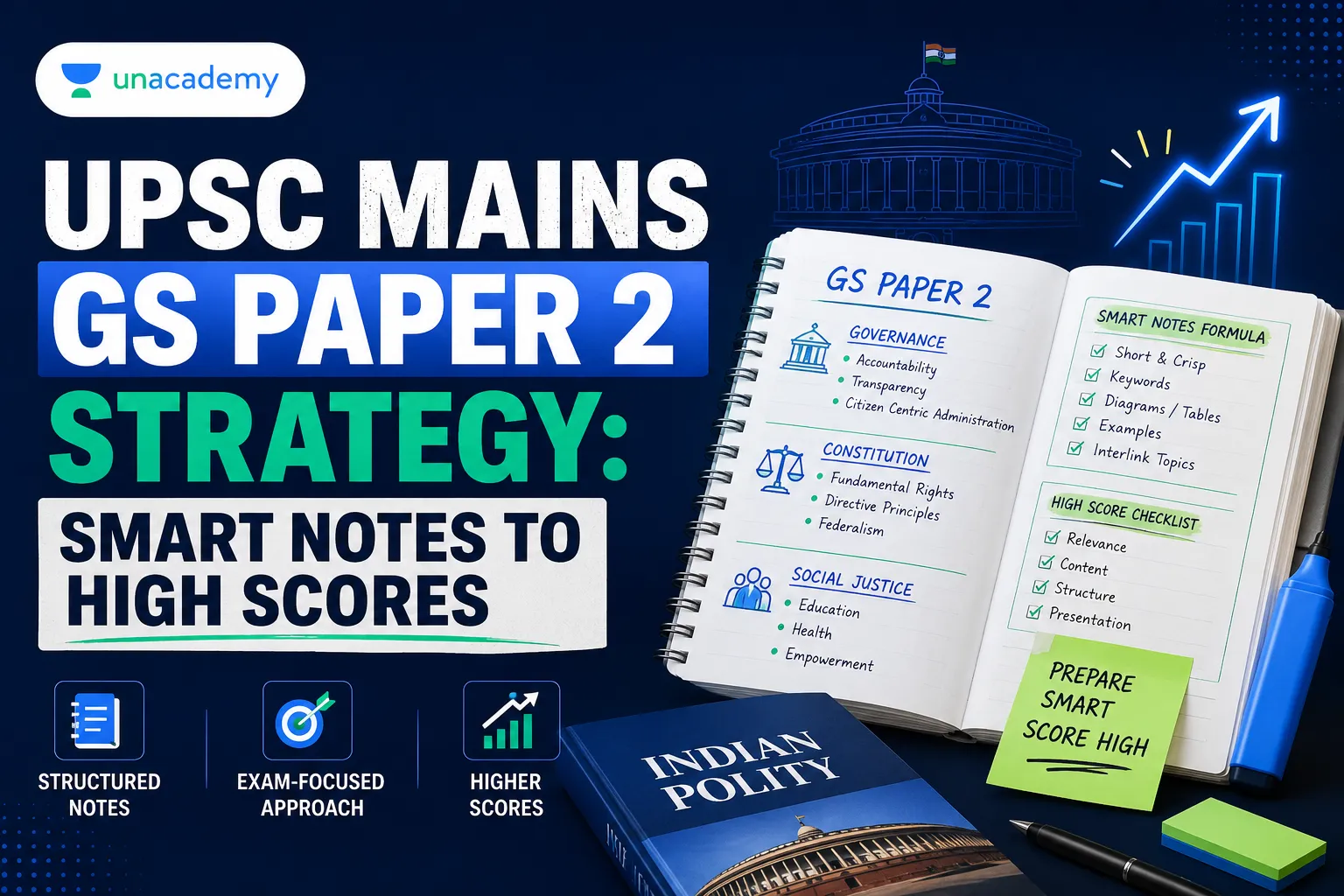
Look at the General Studies (GS) syllabus issued by the UPSC. It is remarkably specific. Instead of studying broad topics like "Economics" or "History," look at explicit line items like “Effects of liberalization on the economy, changes in industrial policy and their effects on industrial growth.”
Every single theme in the syllabus should have a dedicated 2-to-3-page micro-note. No more, no less.
- The Definition: A crisp, authoritative definition of the term (e.g., “What is Food Processing?”), preferably sourced from an official body like the UN, RBI, or a government committee.
- The Core Status/Data: 3–4 baseline statistics that establish the scale of the issue in India (e.g., contribution to GDP, employment percentages, or ranking on global indices).
- The Pros/Drivers: Why is this sector or concept important? What is driving its growth?
- The Cons/Bottlenecks: What are the structural bottlenecks, administrative challenges, or legal loopholes hindering progress?
- Government Initiatives: 2–3 flagship schemes or legislative acts, noting why they succeeded or where they fell short.
- Way Forward/Committee Recommendations: Concrete recommendations from the Second Administrative Reforms Commission (2ARC), Law Commission, NITI Aayog, or expert committees.
By organizing your upsc mains gs notes this way, you are actively practicing answer writing while you study. When a question appears on that specific theme, you won't have to think about how to structure your answer; your notes have already structured your brain.
Micro-Notes vs. Mega-Files: Striking the Perfect Balance
There is a constant debate in the aspirant community about whether to use digital tools or stick to traditional paper. The medium matters far less than the density.
If you prefer physical paper, use loose sheets in ring binders rather than bound registers. The UPSC syllabus is highly dynamic; an issue that is relevant today will have a major Supreme Court judgment or a new government policy attached to it six months from now. If your notes are bound, you cannot update them without ruining the continuity.
If you go digital (using applications like Evernote, OneNote, or Notion), create a strict rule: never copy-paste massive blocks of text from news articles. Summarize the core argument in a single bullet point. Your digital upsc mains notes pdf should be highly scannable, full of bold keywords, flowcharts, and clear structural relationships.
Real Aspirant Experiences: What Worked and What Didn't
Anjali K., Cleared Mains 2025:
"During my first two attempts, I accumulated every popular upsc mains notes pdf I could find online. My room looked like a bookstore, but my mind was completely cluttered. In my third attempt, I threw out the compilations and made my own 2-page micro-notes for every GS3 syllabus topic. When I saw a question on investment models, I didn’t have to recall a whole chapter—I just visualized my 2-page framework. That completely changed my execution speed."
Rahul S., Selected in IRS:
"I used to think that comprehensive study material meant writing down every detail. I realized late that Mains is a game of representation, not just storage. I shifted entirely to digital notes where each GS paper was limited to 100 pages total. If a new point came in, an old, less relevant point had to be deleted. Keeping my upsc mains notes lean was the single biggest reason I could revise the entire syllabus three times between Prelims and Mains."
Common Pitfalls to Avoid in Note Compilation
1. The Current Affairs Over-Indexation
It is remarkably easy to spend four hours a day tracking every minor political debate or editorial back-and-forth. Remember that UPSC rarely asks about transient political controversy; it asks about the underlying structural issue. Don't make separate current affairs notes that exist in a vacuum. Instead, take the new current affairs data point and file it directly under its corresponding static syllabus keyword.
2. Ignoring the Core Analytical Focus of GS2 and GS3
GS Paper 2 and Paper 3 are highly analytical. Simply listing facts will not get you above-average marks. Your upsc mains study material must actively capture linkages. For instance, how does climate change affect food security, and how does that in turn impact distress migration to urban centers? If your notes don't capture these cause-and-effect relationships, your answers will sound superficial.
3. Making Notes Before Understanding the Topic
Never make notes on your very first reading of a book or article. Everything will feel critically important, leading to bloated, unusable notes. Read a topic completely, look at the past five years of previous year questions (PYQs) to understand how UPSC frames questions around it, and only then pick up your pen or open your laptop to summarize it.
How to Effectively Use Topper Notes and Coaching Compilations
You do not have to reinvent the wheel. It is completely fine to download a highly recommended upsc mains notes pdf from a previous year's topper or use standard coaching booklets as a baseline. However, treat them as raw materials, not final products.
A topper’s notes represent how their brain organized information at that specific point in time. If you simply memorize them, your answers will lack an authentic voice. Take their frameworks, integrate them with your baseline textbook understanding, add recent data or examples from your own newspaper reading, and condense it into your personal repository of upsc mains gs notes.
Frequently Asked Questions
Is it absolutely necessary to make personal notes for UPSC Mains?
While a few outliers manage without them, making personal notes is highly recommended for the vast majority of successful candidates. The gap between the Civil Services Prelims and Mains is short, and you will not have the time or mental bandwidth to flip through thousands of textbook pages. Condensed, personal notes are vital for rapid, high-frequency revision.
When is the ideal time to start building my upsc mains notes?
The ideal time is during your integrated phase of preparation, well before the Prelims exam approach. You should ideally have your core framework for GS1, GS2, GS3, and GS4 ready by January or February of your exam year. Post-Prelims, your focus should purely be on value addition, updating current data, and intense answer-writing practice.
How short should my micro-notes actually be?
As a rule of thumb, an entire UPSC General Studies paper (which covers dozens of individual topics) should be condensed into roughly 70 to 100 pages of loose sheets or digital documents. Aim for no more than 1.5 to 2 pages per individual syllabus keyword. If it is longer than that, you haven't synthesized the material well enough yet.
Should I prioritize physical paper or digital platforms for note-making?
Both approaches have yielded excellent results. Choose digital platforms if you prioritize quick editing, searchability, and easy updates for dynamic topics in GS2 and GS3. Choose paper if you find that physical writing improves your long-term memory retention and mirrors the actual exam writing experience. If you choose paper, always use loose sheets in binders rather than bound notebooks.
How do I ensure my upsc mains study material is sufficient for answer writing?
Cross-reference your notes directly against the Previous Year Questions (PYQs). Pick up a random Mains question from the last three years on a topic you have covered. Look at your note for that theme. If your note contains a solid definition, 3 clear analytical points, relevant data, and a valid recommendation to conclude with, your material is perfectly sufficient.
Final Thoughts
At the end of the day, the Civil Services Examination does not reward the person who collected the most PDFs or read the highest number of books. It rewards the person who can present a structured, logical, and evidence-supported argument on a clean sheet of paper in nine minutes.
Stop viewing note-making as an administrative chore or a way to reassure yourself that you've been productive. Treat your upsc mains gs notes as a living, evolving tool designed for a single purpose: to help you write a stellar answer under intense pressure. Keep them lean, keep them structured around the syllabus, and focus heavily on structural utility over sheer volume.























Sign in to leave a comment.