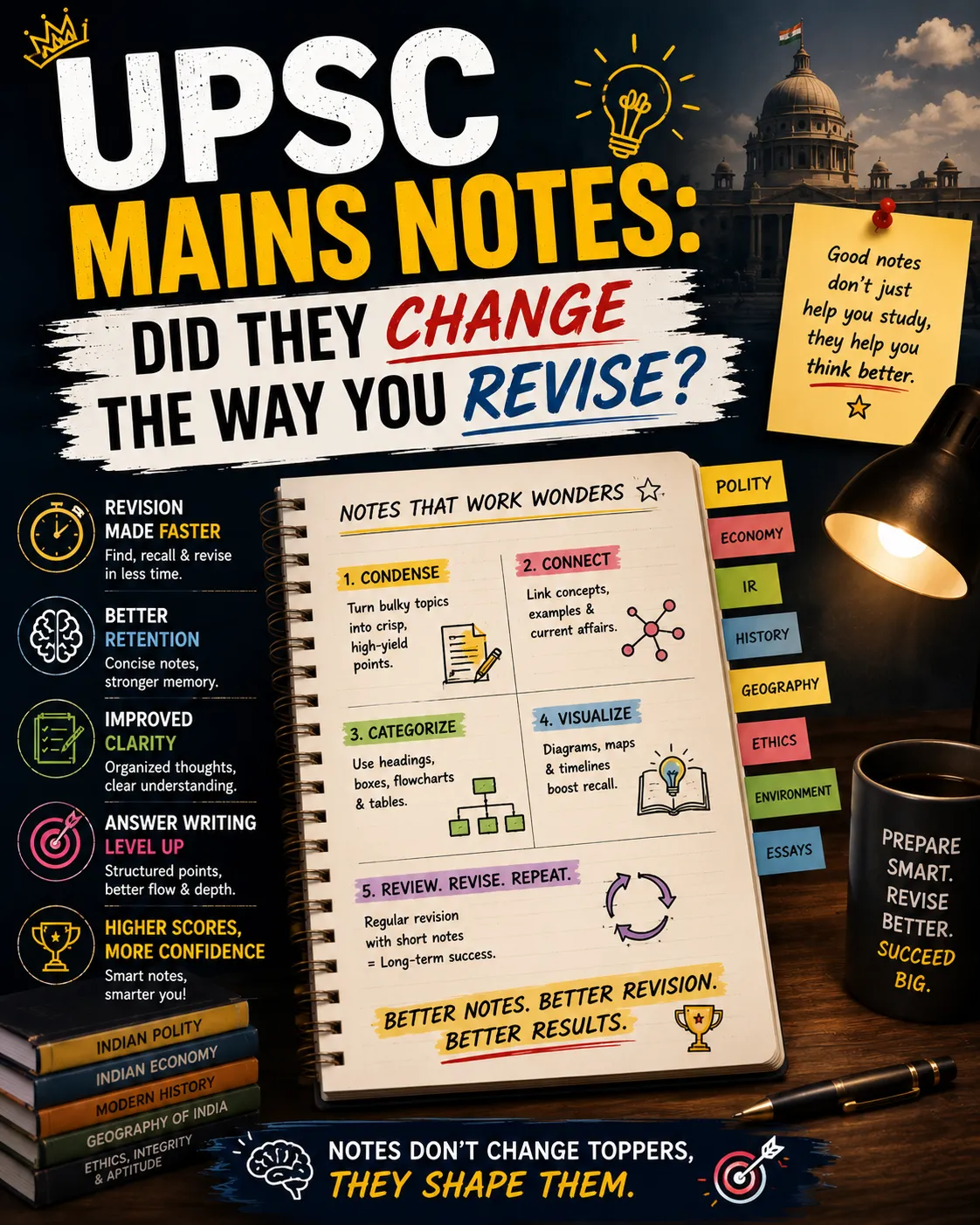

The monsoon in New Delhi usually brings a mix of relief from the heat and a peculiar sense of dread for anyone sitting in a small room in Old Rajinder Nagar or Mukherjee Nagar. If you have ever stared at a three-foot-high stack of color-coded binders as the rain hits the window, you know exactly what that dread feels like.
You spend months highlighting, splitting topics into micro-themes, and downloading every free upsc mains notes pdf that drops on Telegram. You tell yourself that the thicker the binder, the safer your future is. But when you sit down for a mock test, your mind goes blank. You can remember the exact shade of yellow highlighter you used on the page, but you cannot connect the dots well enough to write a coherent 250-word answer on climate finance or federalism in under nine minutes.
The reality is that the exam has quietly shifted under our feet. The days of reproducing static, textbook information are gone. If your upsc mains study material is just a passive collection of definitions and historical timelines, it is probably hindering your progress rather than helping. It is time to look closely at how the nature of the exam has changed, why the traditional approach to making notes is failing, and how you can fundamentally change the way you revise.
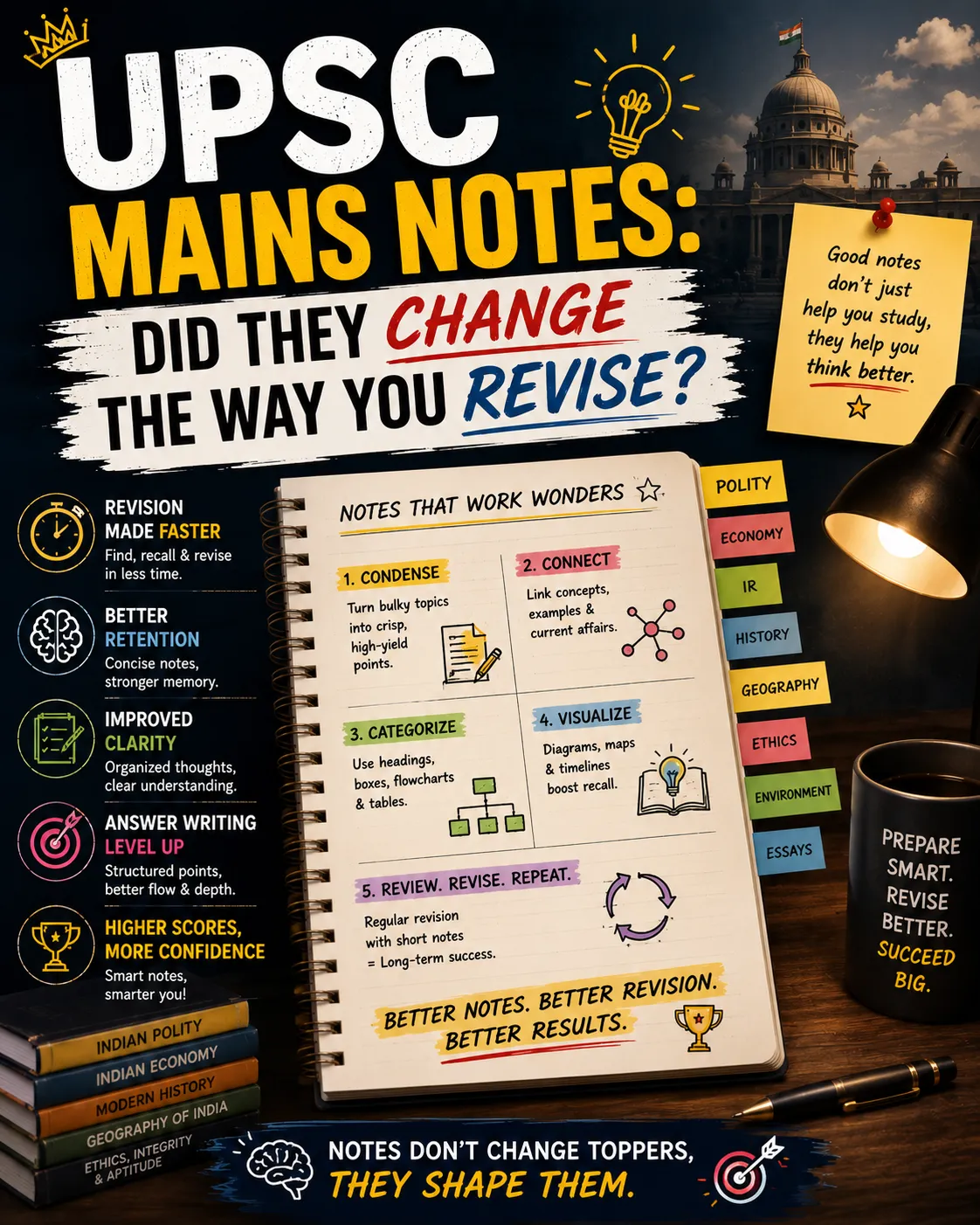
The Shift: Why Static Binders Are No Longer Enough
Look at any recent General Studies paper. The questions do not ask you to simply explain a concept; they force you to evaluate it at the intersection of multiple disciplines. A question on agricultural subsidies is no longer just about economics; it is tied to geopolitics, climate commitments, and state-level voting patterns.
When your upsc mains gs notes are organized like an encyclopedia, your brain learns to store information in silos. You have a folder for GS Paper 1, a separate notebook for GS Paper 2, and a completely different file for GS Paper 3.
But the examiner does not care about your folders. They want to see if you can pull a constitutional provision, an economic data point, and an ethical dilemma into the same page within seconds. If your revision process consists entirely of re-reading these isolated binders from page one to page one hundred, you are training your brain for recognition, not recall. Recognition makes you feel safe because the text looks familiar. Recall is what actually gets you marks when the clock is ticking.
Rethinking Your UPSC Mains Notes: From Storage to Strategy
If you want your notes to actually work for you in the final weeks before the exam, you need to change their purpose. Stop treating them as a storage unit for facts. Treat them as a playground for arguments.
1. The "Theme over Subject" Rule
Instead of creating broad headers like "Polity" or "Environment," organize your upsc mains notes around specific, recurring themes outlined in the syllabus. For instance, instead of a massive section on "Agriculture," create a lean, five-page sheet specifically on "Technology in Aid of Farmers."
On those pages, you should not copy basic definitions that you already know. Instead, map out the current issues:
- The Core Paradox: Why hasn't digital adoption closed the income gap for smallholders?
- Data Points: What percentage of small farmers actually use digital portals like e-NAM?
- Case Studies: A specific district in Telangana or Odisha that successfully implemented drone-based land mapping.
- The Way Forward: Two concrete, actionable recommendations from the NITI Aayog or an international committee.
2. The Functional Value of a UPSC Mains Notes PDF
Digital notes are incredibly useful for the Civil Services Examination, but only if you use them actively. The biggest trap is the endless accumulation of files. Downloading a high-quality upsc mains notes pdf from a trusted source is a great starting point, but it is raw material, not a finished product.
[Downloaded PDF File]
▼ (Passively Reading) -> High Familiarity, Low Recall [Your Active Synthesis]
▼ (Condensing to 1 Page per Theme) [Actionable Exam Notes] -> High Recall under Pressure
If you do use digital files, ensure that for every fifty pages of material you download, you compress it into a single page of your own insights. If you cannot summarize a complex policy down to three bullet points and one critique, you do not understand it well enough to write about it under pressure.
A Practical Framework for the Modern Revision Workflow
How do you actually execute this without getting overwhelmed? You need a system that forces your brain to work hard during revision, rather than just coasting along.
Issue-Based Mapping over Fact Aggregation
Take a critical issue like Cyber Warfare. Instead of writing paragraphs of text, structure your upsc mains study material visually around four distinct quadrants:
| Quadrant | Core Focus | What to Include |
|---|---|---|
| The Vulnerability | Why is India targeted? | Critical infrastructure dependencies, legacy software in public utilities. |
| The Institutional Framework | What do we have? | CERT-In, National Cyber Security Coordinator (NCSC), the 2023 DPDP Act. |
| The Gap | What is missing? | Lack of specialized cyber-warfare commands, weak private-sector collaboration. |
| The Concrete Fix | How do we solve it? | Budgets aligned with international benchmarks, joint cyber drills with strategic allies. |
When you revise this way, your eyes see the entire landscape of an issue in thirty seconds. When you see a question on cyber security in the exam hall, your brain will naturally recreate this grid, giving you an immediate structure for your introduction, body, and conclusion.
Things You Should Know: Common Pitfalls in Note Management
Many candidates spend twelve hours a day working hard but fail to see their mock scores improve. It is rarely a lack of effort; it is usually an optimization error.
- Re-writing the Textbook: If your notes look exactly like a standard reference book but in your handwriting, you have wasted your time. Notes should begin where basic understanding ends.
- The Multicolored Illusion: Using five different highlighters creates a false sense of productivity. It makes the page look visually distinct, but it keeps your brain passive.
- Ignoring the Syllabus Keywords: Every heading in your upsc mains gs notes should match a specific phrase from the official UPSC syllabus. If your notes are on a topic that cannot be mapped back to a specific syllabus line, question why you are keeping them.
- Chasing Novelty over Consistency: Replacing your core revision material three months before the exam because a new, shiny upsc mains notes pdf appeared online is a dangerous mistake. Stick to your core materials and update them with fresh data, rather than changing the entire foundation.
Real Perspectives: How Changing the Approach Fixed the Process
To understand how this looks in practice, read through these observations from people who had to rethink their strategy after facing roadblocks.
Siddharth M., Rank 142 (After 2 Mains Attempts):
"In my first two attempts, my room looked like a library. I had every single piece of upsc mains study material you could buy. I could talk about topics for an hour, but my answers were average because I was trying to remember everything. For my third attempt, I threw out four big binders and compressed all of GS Paper 2 and 3 into two slim notebooks. I focused on making sure I had exactly three arguments for and three arguments against every major theme. My revision time dropped from three weeks to three days, and my scores went up significantly."
Priyanka K., Selected in State Services & UPSC Aspirant:
"I used to think that finding the perfect upsc mains notes pdf online was the secret. I spent more time organizing my cloud storage than actually reading. I changed my approach when I realized I couldn't remember a single case study during a timed test. I started making tiny cue cards for data points and judicial precedents. Changing how I revised—moving from passive reading to active blurt-testing from memory—completely altered my confidence level."
Frequently Asked Questions
1. Should I make separate notes for Prelims and Mains?
No, your foundation should be integrated. However, your upsc mains notes require a distinct structural focus. While Prelims preparation requires recognizing specific facts and elimination strategies, Mains preparation demands understanding cause-and-effect relationships, institutional challenges, and policy formulations. Once Prelims is over, your focus must shift entirely toward structuring those facts into clear arguments.
2. How short should my upsc mains gs notes actually be?
A good rule of thumb is the 1:10 rule. If a topic spans ten pages in a textbook, it should occupy no more than one page in your revision files. Ideally, your notes for the entire General Studies syllabus should fit into a few lean notebooks or a well-curated digital workspace that you can review comfortably in the short gap between papers.
3. Can I rely entirely on a downloaded upsc mains notes pdf for my preparation?
You can certainly use a professional compilation as your baseline framework to save time on basic research. However, relying on it blindly is risky. You must customize that material. Add your own structural diagrams, introduce fresh data points from your daily newspaper reading, and rephrase arguments in your own voice so that your answers do not look exactly like thousands of other candidates using the same source.
4. When is the right time to stop adding new content to my upsc mains study material?
You should stop adding major new themes at least two to three months before the examination. The final phase of your preparation should be reserved exclusively for streamlining, updating current data or recent Supreme Court judgments, and practicing writing answers under strict time constraints. Introducing entirely new source materials late in the cycle usually leads to anxiety and poor retention.
5. How do I incorporate current affairs smoothly into my existing notes?
Avoid creating a separate, massive current affairs file. Instead, leave wide margins on your theme-based pages or use a flexible digital tool. When you find a relevant statistic, a committee recommendation, or a useful case study in the daily news, add it directly to the corresponding theme page. This keeps your contextual arguments and your fresh supporting evidence in one single place.
Conclusion
At the end of the day, the examination hall is a high-stress environment where you only have time to think clearly for a minute or two before your pen has to start moving. If your revision process leaves you struggling to parse through vast amounts of text in your head, the system is broken.
The goal of your upsc mains notes is not to show how much you have read over the past year. Their only purpose is to give your brain a clear, structured, and rapid path to the insights you need when you are exhausted, short on time, and facing an unpredictable question paper. Streamline your materials, focus heavily on core themes, and build your revision workflow around active recall. Your future self, sitting in that exam hall with a ticking clock, will thank you for it.




























Sign in to leave a comment.