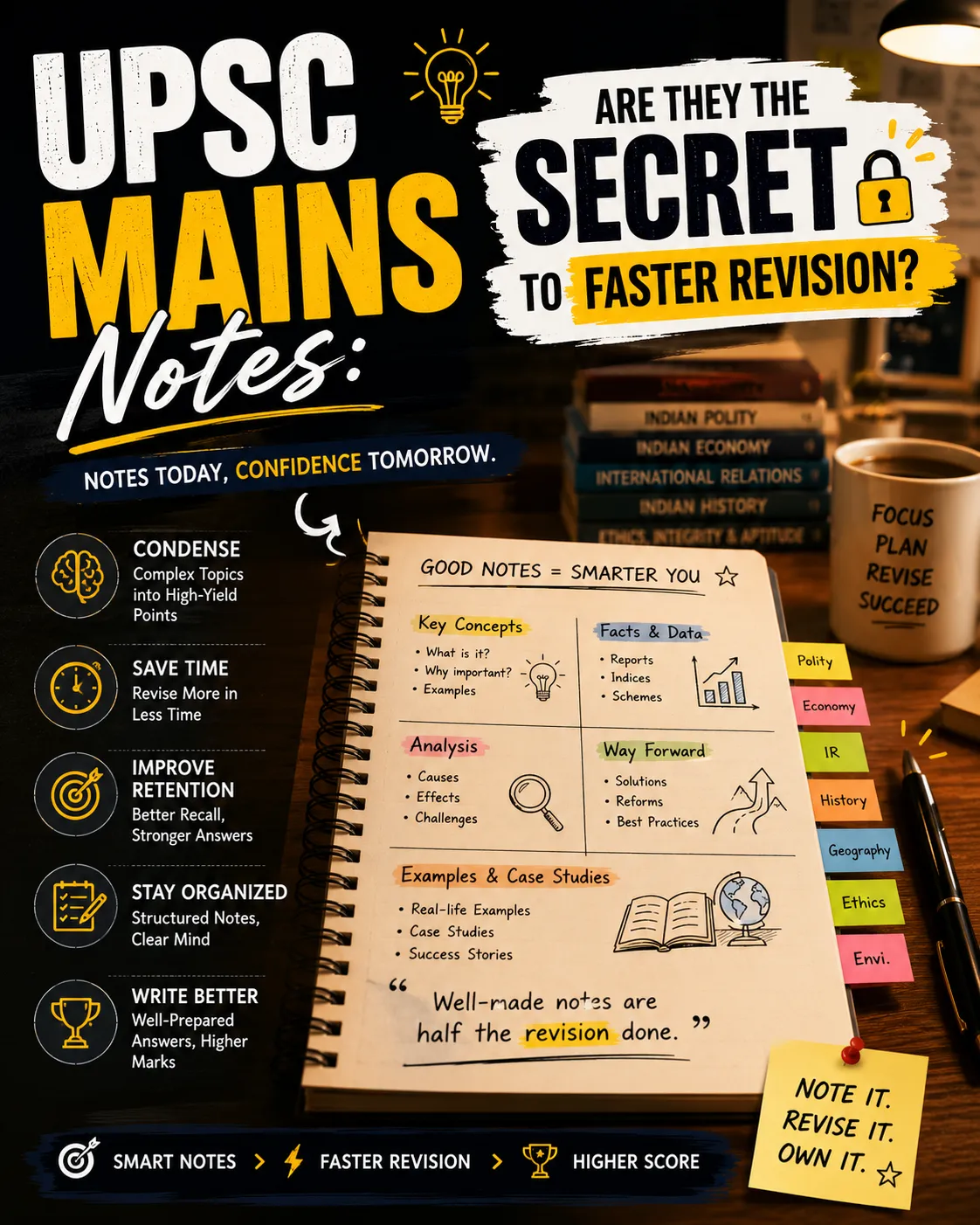

Struggling to revise the massive UPSC syllabus? Discover how high-quality upsc mains notes change your prep and how to build or choose them.
You are staring at a stack of books that stands nearly two feet high on your study table. Laxmikanth, Nitin Singhania, Spectrum, monthly current affairs compilations, and half-filled spirals of newspaper clippings.
The exam is a few months away. You know the material is in those pages, but the sheer panic of how you will flip through thousands of pages in the one-week gap between the Prelims and Mains papers is keeping you up at 2:00 AM.
Every aspirant goes through this exact moment of reckoning. The standard textbook strategy works perfectly fine when you have a year ahead of you. But when you are staring down the clock, thick reference books become an absolute liability.
This brings us to a critical question that dominates online forums and tea-stall discussions alike are dedicated upsc mains notes actually the hidden shortcut to faster revision, or are they just another digital asset gathering dust in your hard drive? Let’s look past the coaching hype and break down what actually works when your exam rank is on the line.
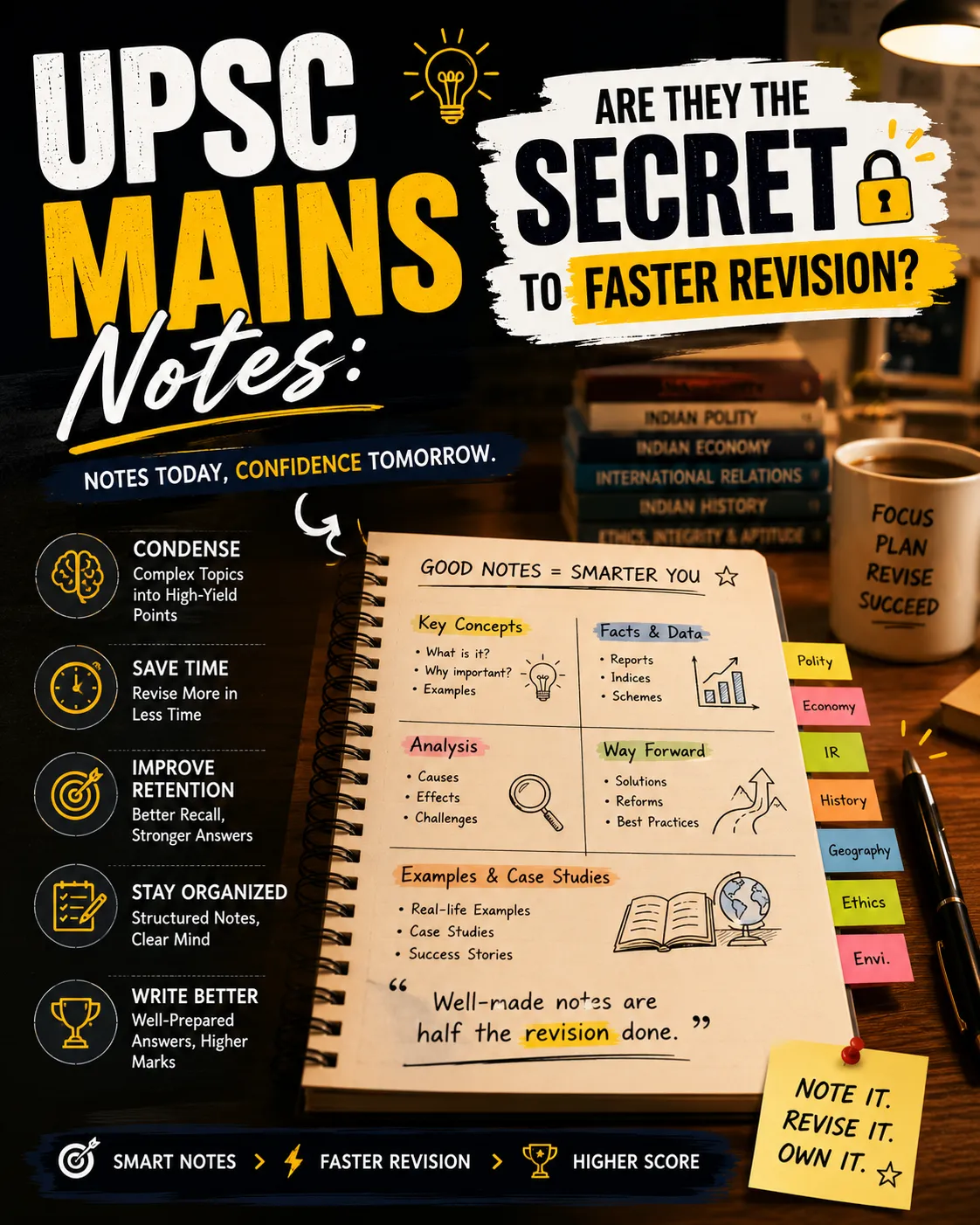
Why Standard Textbooks Fail You in the Final Month
The core issue with relying entirely on standard reference books during your final revision phase is that textbooks are written to explain concepts, not to answer 15-mark questions.
When you open a standard book on Indian polity or history, the information is narrative. In the Mains exam hall, you have exactly seven to nine minutes to structure an answer, present arguments, add relevant data, and write a balanced conclusion. If your brain has to filter out 80% of a textbook chapter to find the three core arguments while the clock is ticking, you are already losing the race.
This is exactly where specialized upsc mains gs notes fit into your routine. They act as a pre-processed version of the syllabus. Instead of a 30-page chapter on the non-cooperation movement, a solid set of notes gives you the causes, the regional variations, the reasons for withdrawal, and the long-term impact all structured in neat bullet points. You are no longer reading to understand; you are reading to reproduce.
The Anatomy of an Effective Revision Tool
Not all notes are created equal. In fact, bad notes are arguably worse than no notes at all, because they give you a false sense of security while leaving massive structural gaps in your preparation.
If you are looking at a upsc mains notes pdf you downloaded online, or if you are sitting down to write your own, it needs to be highly structured. As shown in the workflow diagram i, a perfect revision note branches directly from a single core syllabus keyword into two distinct, balanced columns: the foundational static theme and the dynamic real-world context.
Here is how that framework translates into a simple, easy-to-scan table layout for your study sheets:
| Syllabus Keyword | Core Theme / Issue (Static) | Current Context (Dynamic) |
|---|---|---|
| Micro-Topic Focus | • Definition & Origin: Brief 1-2 line intro.
• 3-4 Structural Causes: Why the issue persists.
• 3-4 Major Impacts: Socio-economic consequences.
• Way Forward: Actionable solutions & recommendations. | • Recent Reports/Indices: Data from NITI Aayog, WB, etc.
• Supreme Court Judgments: Landmark legal precedents.
• Government Schemes: Active flagship programs. |
1. Tight Alignment with the Syllabus Keywords
Look at GS Paper 3. It mentions words like “Land reforms in India” or “Investment models.” Your study material shouldn't be a generic essay on agriculture. It needs to address those exact words. A great set of upsc mains study material organizes content strictly by the official syllabus sub-headings so that you can mentally map every single fact to a potential question.
2. The 80-20 Rule of Data and Examples
You do not need fifty case studies; you need three highly versatile ones that you can deploy across multiple answers. An effective revision sheet includes:
- One key statistic from a reputable body (like NITI Aayog or the World Bank).
- One relevant Article of the Constitution or a landmark Supreme Court judgment.
- A single committee recommendation (like the Law Commission or Sarkaria Commission).
3. Visual Scannability
If your personal notes look like a wall of continuous text, you haven't made notes—you have just re-written the textbook in your own handwriting. True revision notes utilize flowcharts, hub-and-spoke diagrams, and explicit underlines. When you look at a page for five seconds, your eyes should immediately catch the core arguments.
Making vs. Buying: The Ultimate Prep Dilemma
Should you spend months painstakingly compiling your own sheets, or should you download a curated upsc mains notes pdf from an established ranker or institute? There is no single correct answer, but the trade-offs are incredibly clear.
| Approach | Pros | Cons |
|---|---|---|
| Making Your Own | • Unmatched conceptual clarity
• High active recall during writing
• Highly personalized to your weak areas | • Incredibly time-consuming
• Risk of getting bogged down in trivial details
• Hard to balance with daily current affairs |
| Using Ready-Made Material | • Saves hundreds of hours
• Professional structuring and formatting
• Covers obscure syllabus parts quickly | • Lack of emotional connection to the text
• Can feel like mindless rote learning
• Requires extra effort to internalize |
A balanced, practical approach that many successful candidates use is a hybrid model. You don't need to reinvent the wheel for static portions like World History or Geography relying on high-quality, pre-existing upsc mains study material saves immense time here. However, for dynamic and highly analytical areas like Internal Security, Governance, or Indian Economy, adding your own specific case studies, recent data points, and personal structural frameworks makes your answers stand out from the crowd.
Common Mistakes: Why Good Notes Fail to Deliver Marks
Many candidates accumulate gigabytes of pristine, beautifully color-coded digital documents but still struggle to clear the cutoff. Having access to excellent material is only half the battle; avoiding structural pitfalls in how you handle that material is what determines your final score.
- Treating Note-Taking as an Art Project: If you find yourself changing highlighters four times and worrying about the aesthetic appeal of your digital tablet layout, you are wasting valuable cognitive energy. Your revision tools are functional, disposable templates meant for memory retention, not publication.
- The Hoarding Habit: Downloading every single upsc mains gs notes document shared across Telegram channels creates decision paralysis. Stick to one foundational source for each GS paper and completely block out the external noise.
- Ignoring the Static-Dynamic Integration: If your notes on Environmental Degradation don't leave blank spaces or margins to add the latest COP decisions or national climate reports, they will become obsolete within six months.
Real Experiences: Perspectives from the Study Room
"During my first attempt, I tried revising straight from my standard reference books. I remember sitting in the exam hall during GS 2, knowing I had read about the specific committee on federalism, but I couldn't recall the three core bullet points in time. For my second attempt, I consolidated everything into short, 2-page summaries per syllabus topic. The difference was night and day my fingers just knew what to write because the visual map was etched in my head."
— Ananya R., Cleared Mains 2024
"I used to think downloading a massive, comprehensive upsc mains notes pdf bundle would solve my revision issues. It didn't. I realized that unless you actively compress that data, annotate it, and scribble your own keywords in the margins, ready-made material remains alien to your brain during high-stress hours."
— Siddharth K., Selected in Corporate Law, UPSC Aspirant
Frequently Asked Questions
1. When is the ideal time to start preparing upsc mains notes?
The best time to start compiling your core material is during your integrated phase of preparation, ideally before you enter the dedicated pre-Prelims window. Attempting to make comprehensive sheets between the Prelims and Mains exams is highly risky because that limited time must be strictly reserved for writing mock tests, practicing essay structures, and doing rapid visual revisions.
2. Can I rely entirely on a downloaded upsc mains notes pdf for my GS preparation?
You can absolutely use them as your primary informational foundation to save time on static topics. However, to score above average, you must personalize that downloaded material. Add fresh current affairs context, incorporate specific data points you tracked yourself, and practice converting those static points into active answers during test series.
3. How short should ideal upsc mains gs notes actually be?
A practical rule of thumb is the 1:10 rule. If a textbook topic or a policy issue takes up ten pages of dense reading, your final revision summary should fit comfortably onto a single page or both sides of an A4 sheet. If your notes are nearly as long as the source material, they will fail to provide the speed you need during the final week.
4. How do I effectively integrate current affairs into my static upsc mains study material?
The most reliable method is to use loose A4 sheets or highly flexible digital note-taking applications. Organize your folders strictly by syllabus keywords. When you find an insightful editorial, an official ministry report, or a critical data point in the daily newspaper, simply slide that single point or statistic into the dedicated margin of that specific syllabus topic.
5. Should I prioritize making digital notes or paper-based notes for the Mains exam?
Both mediums have distinct advantages. Digital tools allow for effortless editing, instant keyword searches, and quick copy pasting of current events. On the other hand, paper-based sheets mirror the physical reality of the actual handwritten exam. Choose whichever method fits your natural workflow, but ensure that your digital documents remain backed up and easily printable for offline review sessions.
Summary: The Final Verdict
High-quality revision summaries are not a magic shortcut that replaces hard work, nor are they an optional luxury. They are a necessary piece of administrative infrastructure for your brain. The UPSC Civil Services Examination does not merely test how much information you can absorb over a two year period; it ruthlessly evaluates how effectively you can recall, structure, and articulate that knowledge under extreme time pressure.
Whether you decide to build your own system from scratch or use high-quality, pre-compiled upsc mains study material as your base, remember that the value of any note lies entirely in its ability to be revised four times in a row. Focus on clarity, keep your structures highly scannable, and build a system that serves your future self when you are sitting in that exam hall with a ticking clock.




























Sign in to leave a comment.