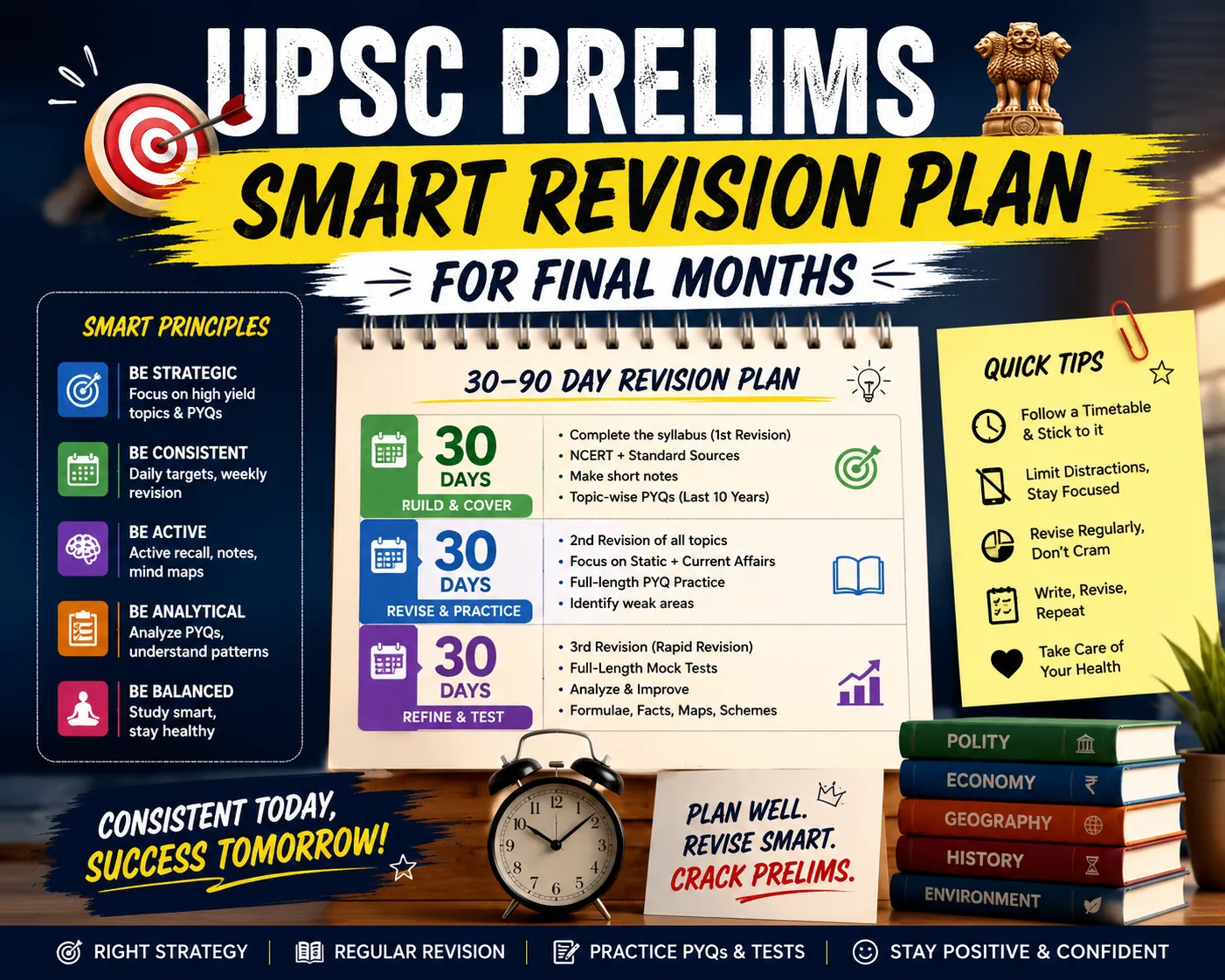

Cracking the upsc prelims requires a strategic revision plan. Discover actionable tips, mock strategies, and CSAT fixes to optimize your final months.
The final stretch before the upsc prelims is notoriously overwhelming. One day you feel like you have everything under control, and the next, a single tricky mock question makes you feel like you have forgotten the entire Indian Constitution. If your desk is buried under a mountain of standard textbooks, current affairs compilations, and half-marked OMR sheets, you are not alone.
When the official upsc prelims date 2026 approaches, the temptation to read new material is incredibly strong. However, clearing the upsc prelims exam isn’t about how much new information you can force into your brain in the final days; it is about how effectively you can recall what you have already studied.
This guide provides a practical, stress-tested revision plan designed to help you cut through the noise, stabilize your mock scores, and approach the exam with quiet confidence.
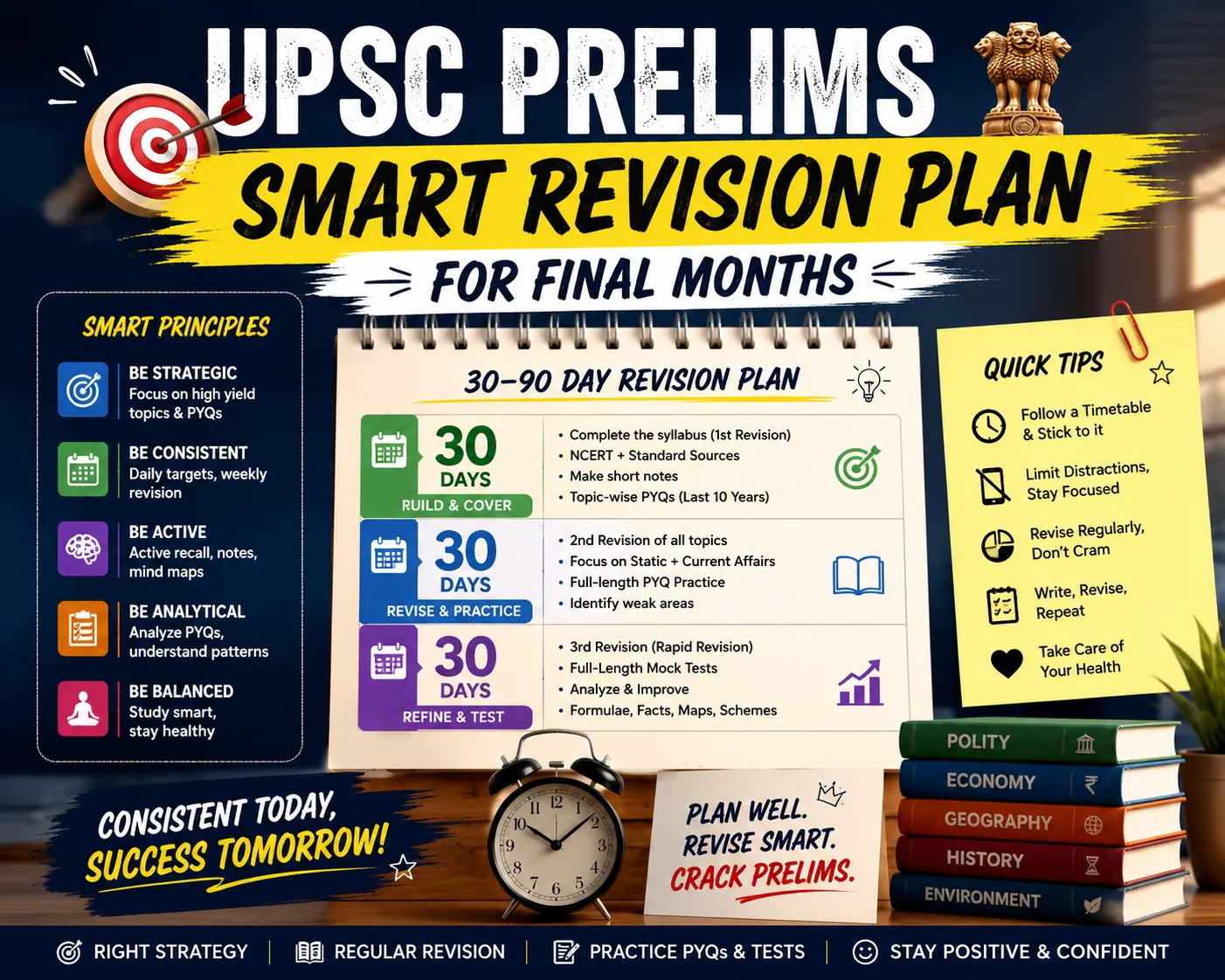
The Core Pillars of Final Month Revision
Success in the final months comes down to aggressive prioritization. You cannot revise all 10,000 pages of your initial study material with equal depth. Instead, you need to channel your energy into high-yield areas where structural clarity translates directly into marks.
1. Tightening Your Grip on Static Core Subjects
The static syllabus is your safety net. While current affairs can be unpredictable, the core concepts of Polity, Modern History, Economy, and Geography remain relatively stable.
- Polity: Focus deeply on Constitutional Bodies, Fundamental Rights, Directive Principles, and the functional mechanics of Parliament. Do not just memorize articles; understand the underlying principles of federalism and judicial review.
- Economy: Prioritize conceptual clarity over raw data. Ensure you thoroughly understand banking concepts, monetary policy tools, inflation mechanics, and balance of payments.
- Modern History: Move away from isolated facts and focus on chronological timelines, the evolution of administrative policies, and the specific ideological shifts within the freedom movement.
2. High-Yield Themes: Where UPSC Consistently Focuses
Every year, certain sub-themes yield a disproportionate number of questions. If you are short on time, ensure these areas are thoroughly covered:
| Subject | High-Yield Revision Themes | Focus Areas |
|---|---|---|
| Environment | National Parks, Wildlife Sanctuaries, International Conventions | Focus on mapping locations and the legal protections of endangered species. |
| Science & Tech | Emerging Tech, Biotechnology, Space Missions | Prioritize real-world applications of technology over theoretical physics. |
| Art & Culture | Buddhism, Jainism, Bhakti Movement, Major Architecture | Understand the philosophical lineages and patronage of classical arts. |
| Geography | Mapping (Indian and International), River Systems, Climate Zones | Trace active conflict zones and critical trade routes globally. |
Rethinking Your Mock Test Strategy
A common trap many aspirants encounter during upsc prelims 2026 preparation is treating mock tests like a counting game. Scoring well in a mock is useless if you do not analyze why you got specific questions wrong. Mocks are diagnostic tools, not a definitive preview of your final score.
Transitioning from Sectional to Full-Length Tests
While sectional tests are excellent for fixing specific gaps in your knowledge, the actual upsc prelims exam demands rapid mental shifting between completely unrelated topics.
Spend the final weeks focused on full-length tests (FLTs). Sit down precisely from 9:30 AM to 11:30 AM to train your brain to operate at peak cognitive capacity during those exact hours.
The Anatomy of an Intelligent Mock Analysis
When reviewing your tests, categorize your incorrect answers into three distinct groups:
- Conceptual Blindspots: You genuinely did not understand the topic. Fix: Spend 15 minutes reviewing the foundational text.
- Silly Misreads: You missed words like "not," "incorrect," or "only." Fix: Slow down your reading pace and physically underline qualifiers during the test.
- Calculated Guesswork Failures: Your intuition was off when eliminating options. Fix: Review your elimination logic to see if you are falling for classic trap options.
Fixing the CSAT Vulnerability Early
It is dangerously easy to neglect Paper II, assuming your basic aptitude will carry you through. However, CSAT has become a major bottleneck for many excellent candidates in recent years. Leaving it to chance is an unnecessary risk.
Dedicating Predictable Windows to Paper II
If you find yourself struggling with CSAT, commit to a disciplined routine:
- Allocate a dedicated 90-minute slot every alternate afternoon when your energy naturally dips.
- Focus on mastering 4–5 core mathematical topics that appear every year, such as Percentages, Permutations & Combinations, Number Systems, and Ratio & Proportion.
- Practice reading comprehension with a focus on identifying the author's core assumptions and implications, rather than letting your personal biases dictate the answer.
Real Aspirant Insights
"During my previous attempt, I spent the final three weeks frantically reading every current affairs compilation I could find. I panicked, abandoned my static revision, and missed the cutoff by two marks. This time, I kept my resources minimal and spent my mornings re-reading standard texts. It made a massive difference in my conceptual confidence."
— Ananya R., Delhi
"I used to consistently score around 85 in my full-length mocks because I was terrified of negative marking and left too many questions blank. Once I started systematically practicing option elimination and pushed my attempts up to 85–90 questions, my scores stabilized well above the safety margin."
— Karthik M., Bengaluru
Common Mistakes to Avoid in the Final Stretch
- Chasing Novelty: Do not buy a new booklet just because someone in a study group claims it contains predicted questions. Trust your primary sources.
- Ignoring Past Papers: Mock tests are written by coaching institutes; the actual papers are set by the Commission. Spend time analyzing the phrasing and logic of official papers from the last ten years to understand how options are constructed.
- Neglecting Sleep and Physical Health: A fatigued mind cannot effectively eliminate options under pressure. Prioritize a consistent sleep cycle well before the upsc prelims date 2026 arrives.
Frequently Asked Questions
1. How many questions should I ideally attempt in the upsc prelims General Studies paper?
There is no universal number, but for most successful candidates, the sweet spot lies between 82 and 90 questions. Attempting too few requires an unsustainably high accuracy rate while attempting too many can lead to heavy losses from negative marking. Use your final mock tests to find the balance where your net score peaks.
2. How should I balance current affairs with static subjects in the final months?
The static portion forms the foundation of your score. Allocate roughly 70% of your revision time to solidifying your core static subjects and 30% to updating your current affairs knowledge. Most current affairs questions can be answered easily if your static fundamentals are secure.
3. I am consistently scoring 80–90 in full-length mocks. How can I push this past 100?
Analyze your errors carefully. If your scores are plateauing, it is usually because you are losing marks to avoidable errors in your core subjects or making poor decisions during your second round of option elimination. Focus on minimizing negative marks from simple questions.
4. How far back should current affairs cover for the upsc prelims 2026?
Focus intensely on the previous 12 to 15 months of news. However, prioritize the quality of your understanding over raw timelines. UPSC often highlights issues that have seen continuous developments over two to three years, rather than isolated events from a single month.
5. Should I stop solving mock tests a week before the upsc prelims exam?
Yes, it is generally wise to stop solving fresh full-length mocks roughly 5 to 7 days before the exam. Use that final week to quietly review your personal notes, flip through your collection of incorrect mock questions, and look over past papers to keep your mind calm and focused.
Final Thoughts
The final phase of preparation for the upsc prelims is less about gathering new facts and more about managing your mindset and refining your execution. The exam does not require you to know everything under the sun; it requires you to be clear, composed, and analytical under pressure.
Keep your resources limited, trust the depth of your prior preparation, and approach your revision with structure. Every focused hour you put in now brings more clarity when you open the question booklet on exam day.




























Sign in to leave a comment.