
If you have ever opened the General Studies Paper 2 syllabus, stared at terms like "Representations of People Act," "statutory bodies," or "India and its neighborhood," and felt an immediate sense of quiet panic, you are far from alone.
GS Paper 2 covering Governance, Constitution, Polity, Social Justice, and International Relations is notorious for a specific kind of frustration unlike GS Paper 1, which often relies on factual retention, or GS Paper 3, which leans heavily on contemporary economics and environment, GS 2 demands a delicate balance: core static knowledge wrapped in real-time dynamic analysis. Many aspirants spend months reading M. Laxmikanth cover to cover, keeping up with daily editorials, and taking pages of handwritten notes, only to see their marks stall somewhere in the 70–80 range.
Why does this happen? Because GS 2 isn't tested on what you know. It tests whether you can think like an administrator while writing like a constitutional expert.
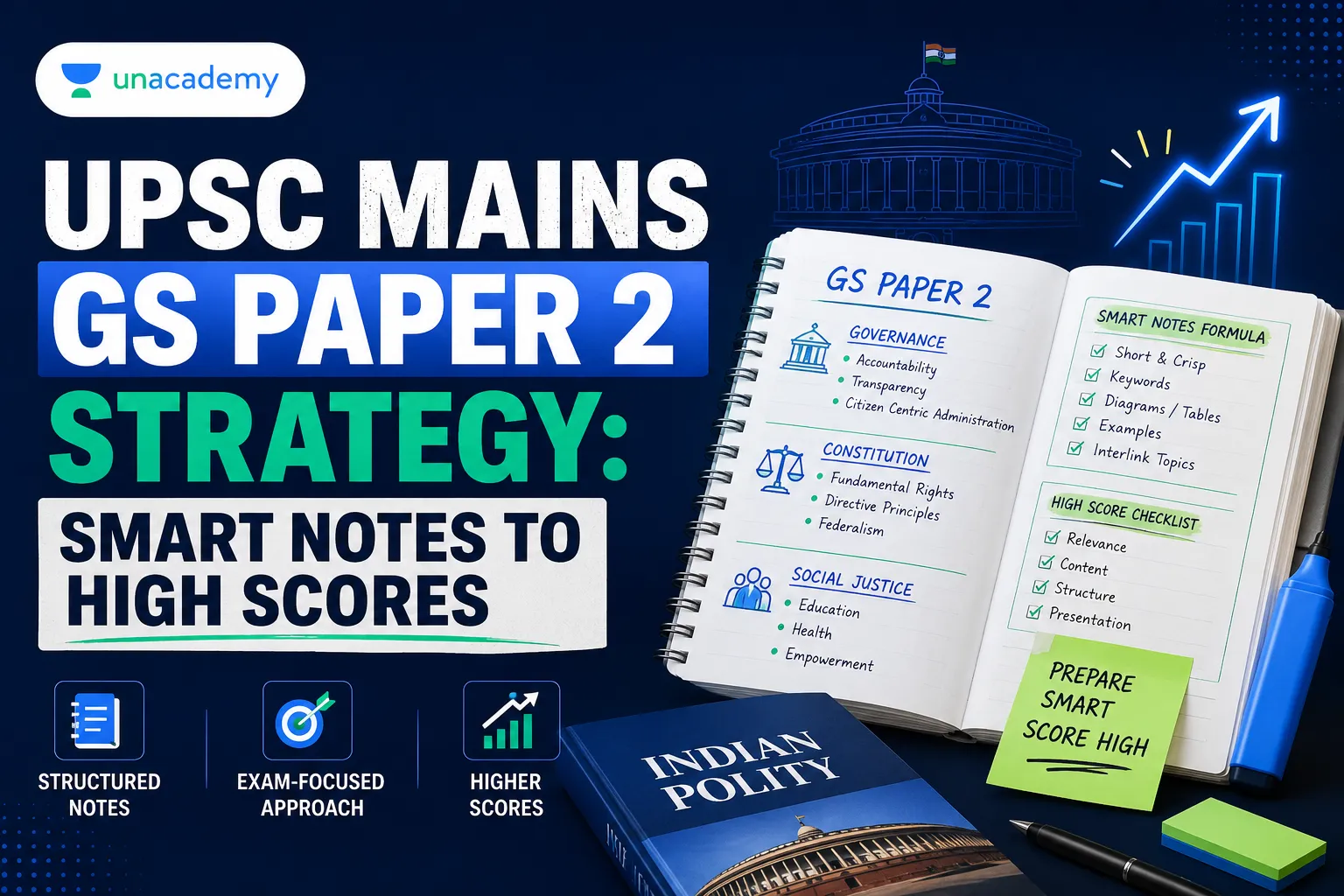
Here is a practical, ground-level upsc mains gs paper 2 strategy designed to transform passive reading into concise notes and high-scoring answer scripts.
1. Decode the Syllabus Before Touching the Books
The biggest mistake aspirants make in their upsc gs 2 preparation strategy is treating the syllabus as an index page. It is actually a blueprinted roadmap.
GS 2 breaks down into four core pillars:
- Polity & Constitution: Fundamental rights, federalism, judicial review, constitutional bodies, separation of powers.
- Governance: E-governance, citizen charters, role of civil services, transparency, accountability.
- Social Justice: Vulnerable sections, health, education, poverty, human resource development.
- International Relations (IR): Bilateral relationships, global groupings, regional dynamics, diaspora.
How to use this breakdown:
Instead of writing broad notes on "Poverty," create a targeted 1-page sheet addressing specific syllabus triggers:
- What is the current measurement framework?
- Which government schemes address it (e.g., DAY-NRLM)?
- What are the core implementation bottlenecks?
- What did NITI Aayog or recent parliamentary committees recommend?
When your notes directly address these syllabus-level sub-points, your answers automatically align with what UPSC evaluators look for.
2. Note-Making for GS 2: Moving from Summaries to Frameworks
If your notes look like a verbatim summary of a textbook, they will not help you in the 3-hour exam pressure cooker. You need actionable notes that convert directly into answer structures.
A solid gs paper 2 strategy for upsc mains relies on three specific note-making frameworks:
A. The "Polity Template" (1 Page Per Keyword)
For core polity topics (such as the Office of the Governor, Electoral Reforms, or Parliamentary Committees), your notes should contain:
- Constitutional Provision / Articles: (e.g., Article 156, Article 200)
- Key Issue / Friction Point: (e.g., Discretionary powers, delayed assent to bills)
- Landmark Supreme Court Judgments: (e.g., S.R. Bommai, Nabam Rebia)
- Commission Recommendations: (e.g., Sarkaria Commission, Punchhi Commission, Law Commission reports)
- Way Forward: 2–3 structured policy recommendations.
B. The "Social Justice Template"
For topics involving vulnerable groups (women, children, elderly, informal workers):
- Data & Statistics: Current indicators from NFHS-5, Periodic Labour Force Survey (PLFS), or UN reports.
- Constitutional Safeguards: Relevant articles (e.g., Article 15(3), Article 39A).
- Key Schemes & Institutional Mechanisms: Primary initiatives and oversight bodies (e.g., NCW, NCPCR).
- Structural Challenges: Issues in design, funding, or execution.
- Actionable Steps: Best practices, international models, or civil society interventions.
3. Mastering International Relations (IR) Without Getting Lost in Daily News
IR questions in GS 2 can feel unpredictable. One year the paper focuses heavily on neighbourhood diplomacy; the next, it asks about international trade agreements or multilateral reform.
To streamline your upsc mains gs 2 strategy for International Relations:
- Categorize by Geography & Function: Group your coverage into India’s Immediate Neighbourhood, Major Powers (US, China, Russia), Regional Groupings (QUAD, BRICS, ASEAN, SCO), and Global Institutions (UN, WTO, IMF).
- Focus on Strategic Themes: For any bilateral relationship, track five consistent dimensions:
- Strategic & Defense ties
- Economic & Trade relations
- Energy & Connectivity cooperation
- Diaspora & Cultural connections
- Areas of divergence or conflict
- Avoid Writing Event Histories: UPSC rarely asks about a specific news event from yesterday. They ask about structural shifts, long-term strategic interests, and policy impacts.
4. The Answer Writing Architecture: What Elevates Your Score
Knowing the material is only half the battle. Presenting it under tight time limits determines your score. Here is how top scorers structure GS 2 responses:
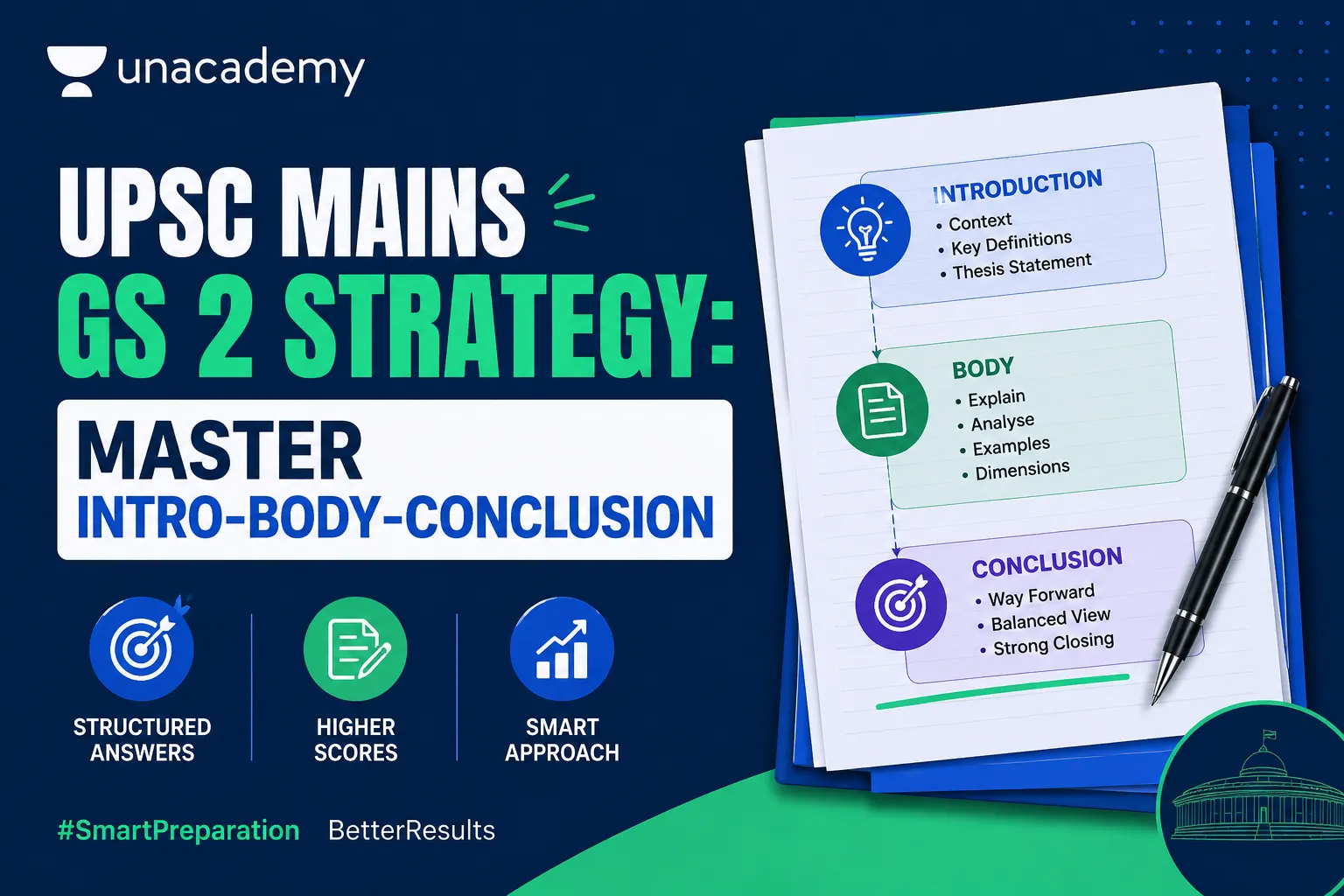
Introductions
Start with a precise hook rather than a vague statement.
- Standard Intro: "Federalism is a basic structure of the Indian Constitution where power is divided between the Centre and States."
- GS 2 High-Scoring Intro: "Federalism in India reflects a 'cooperative' yet 'asymmetric' framework under Article 1. Recent debates around GST compensation and Governor powers highlight ongoing friction between central coordination and state autonomy."
Body Paragraphs: Use Context-Specific Subheadings
Avoid generic headers like "Pros" and "Cons." Instead, use headers that reflect the core topic:
- Instead of "Issues": Use "Structural Constraints in E-Governance Delivery"
- Instead of "Solutions": Use "Administrative Reforms Recommended by 2nd ARC"
Conclusions
End with a forward-looking, constructive closure. Cite recommendations from bodies like NITI Aayog, the 2nd ARC, or landmark SC rulings to give your conclusion administrative authority.
Common Mistakes to Avoid in GS Paper 2
1. Writing GS 2 Answers Like Political Essays
GS 2 is an administrative and legal paper, not an opinion column. Avoid vague political commentary. Ground your arguments in articles, committees, acts, and statistics.
2. Ignoring Governance and Social Justice
Many aspirants spend 70% of their preparation time on Polity and IR, treating Governance and Social Justice as secondary. In reality, Governance and Social Justice account for a significant portion of the marks and are often easier to score in with structured preparation.
3. Over-Relying on Current Affairs Without Static Roots
Citing a recent news event without linking it to underlying constitutional principles, relevant articles, or historical context leaves your answer feeling shallow.
4. Collecting Endless Materials
Hoarding compilations from multiple coaching institutes leads to cognitive overload. Stick to one standard source per topic, complement it with regular newspaper reading, and focus heavily on consolidation.
Real Aspirant Insights
"I scored 74 in GS 2 during my first Mains attempt because my answers were too generic. I knew the facts, but I wasn't citing articles or judicial precedents properly. Rebuilding my notes around specific committees and Supreme Court cases brought my score up to 108 in my next attempt."
— Rohan V., Civil Services Ranker
"Governance felt abstract until I broke it down using the 2nd ARC report framework. Organizing my notes into specific 1-pagers for citizen charters, e-governance, and civil services reform made answer writing significantly faster during the exam."
— Ananya S., UPSC Mains Candidate
Frequently Asked Questions
1. What is the ideal timeline to complete the upsc mains gs paper 2 strategy preparation?
Ideally, cover the core static portion of GS 2 alongside early Mains preparation (June to October pre-Prelims). Use the period between Prelims and Mains to update your notes with current statistics, recent judgments, and targeted answer writing practice.
2. How many Supreme Court cases should I include in my answers?
Quality matters more than sheer quantity. Aim to include 1–2 highly relevant landmark cases (e.g., Kesavananda Bharati, K.S. Puttaswamy, SR Bommai) for constitutional and polity questions where applicable. Avoid force-fitting cases into questions that don't call for legal analysis.
3. Are the 2nd ARC reports still relevant for GS 2 Governance?
Yes. While some policy details have evolved, the core structural analyses especially from Report 1 (Right to Information), Report 4 (Ethics in Governance), and Report 12 (Citizen Centric Administration) remain foundational for governance answers.
4. How do I balance dynamic news updates with static notes in my upsc gs 2 preparation strategy?
Keep your static notes in a loose-leaf folder or digital file (like Notion or OneNote). As major developments occur (such as a new Law Commission report or a key constitutional amendment bill), add a brief bullet point under the relevant topic heading in your existing notes.
5. What is the best way to handle International Relations questions if I don't have a PSIR optional background?
GS 2 IR does not require deep academic theory. Focus on understanding core national interests, trade dynamics, security concerns, regional cooperation, and the strategic role of the Indian diaspora. Standard news coverage and annual compilations provide sufficient depth for GS-level questions.
Final Thoughts
Succeeding in GS Paper 2 isn't about memorizing every line of the Constitution or reading every editorial published over the past year. It is about building clear, organized notes that connect core principles with contemporary realities and presenting those connections cleanly under time pressure.
Keep your preparation focused, keep your notes organized by topic, and approach every question from the perspective of an insightful, well-informed administrator.

























Sign in to leave a comment.