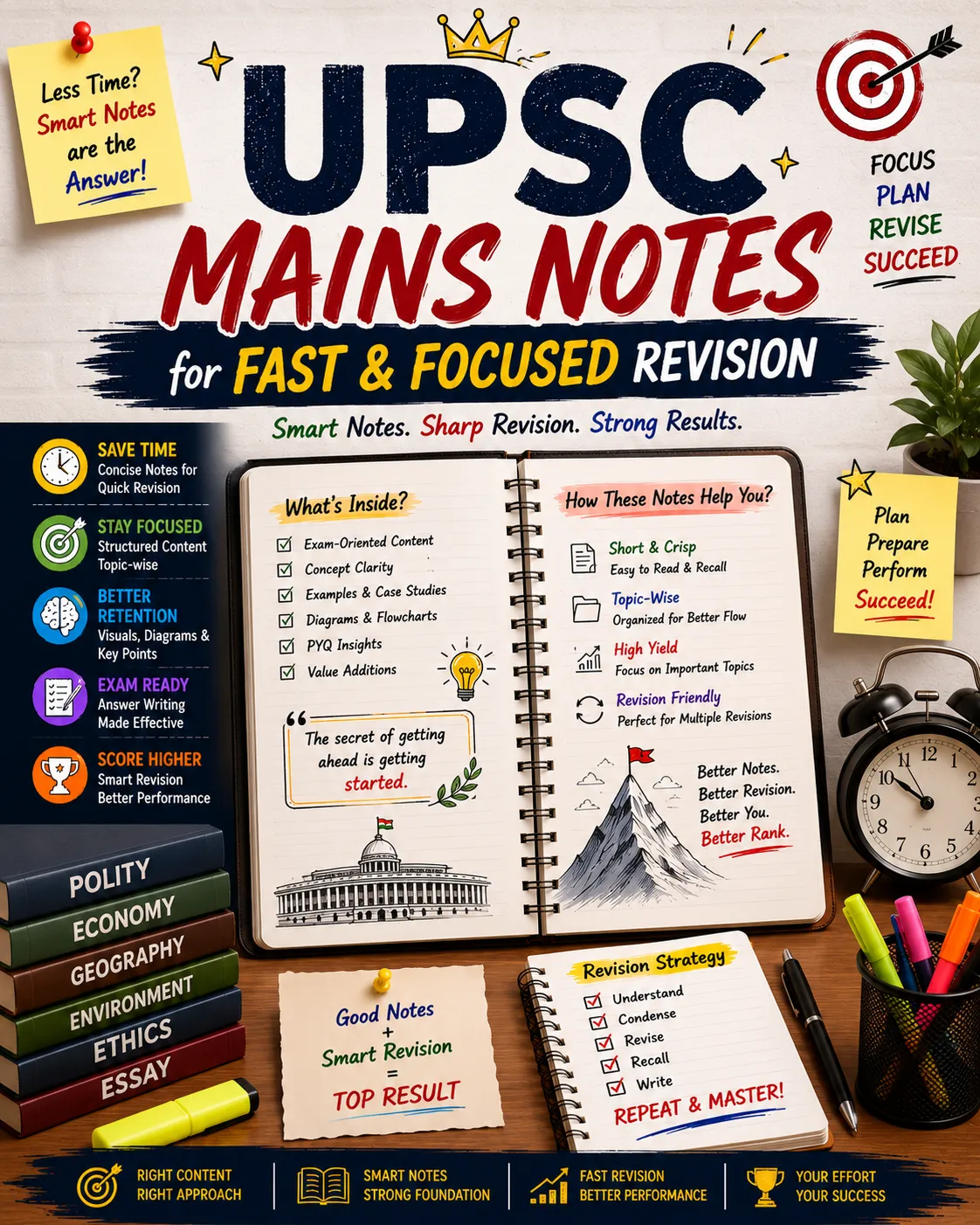

The sheer volume of the UPSC Civil Services Examination syllabus has a unique way of creeping up on you. One day you are confidently finishing a standard textbook, and the next, you are staring at a towering stack of loose sheets, newspapers, and monthly current affairs compilations, wondering how on earth you will revise all of this in the nerve-wracking five-day window of the Mains exam.
If you have ever felt the sudden pang of panic looking at your study room, you are not alone. The real challenge of the Civil Services Examination isn't just absorbing information; it is the brutal logistics of retrieval. When you are sitting in the exam hall with your wrist aching after writing for hours, your brain doesn't need an endless library. It needs sharp, highly condensed, and instantly retrievable data points.
That is where a highly deliberate strategy for upsc mains notes comes into play. Let’s break down how to stop collecting data and start building an actual execution toolkit that works when the pressure is at its peak.
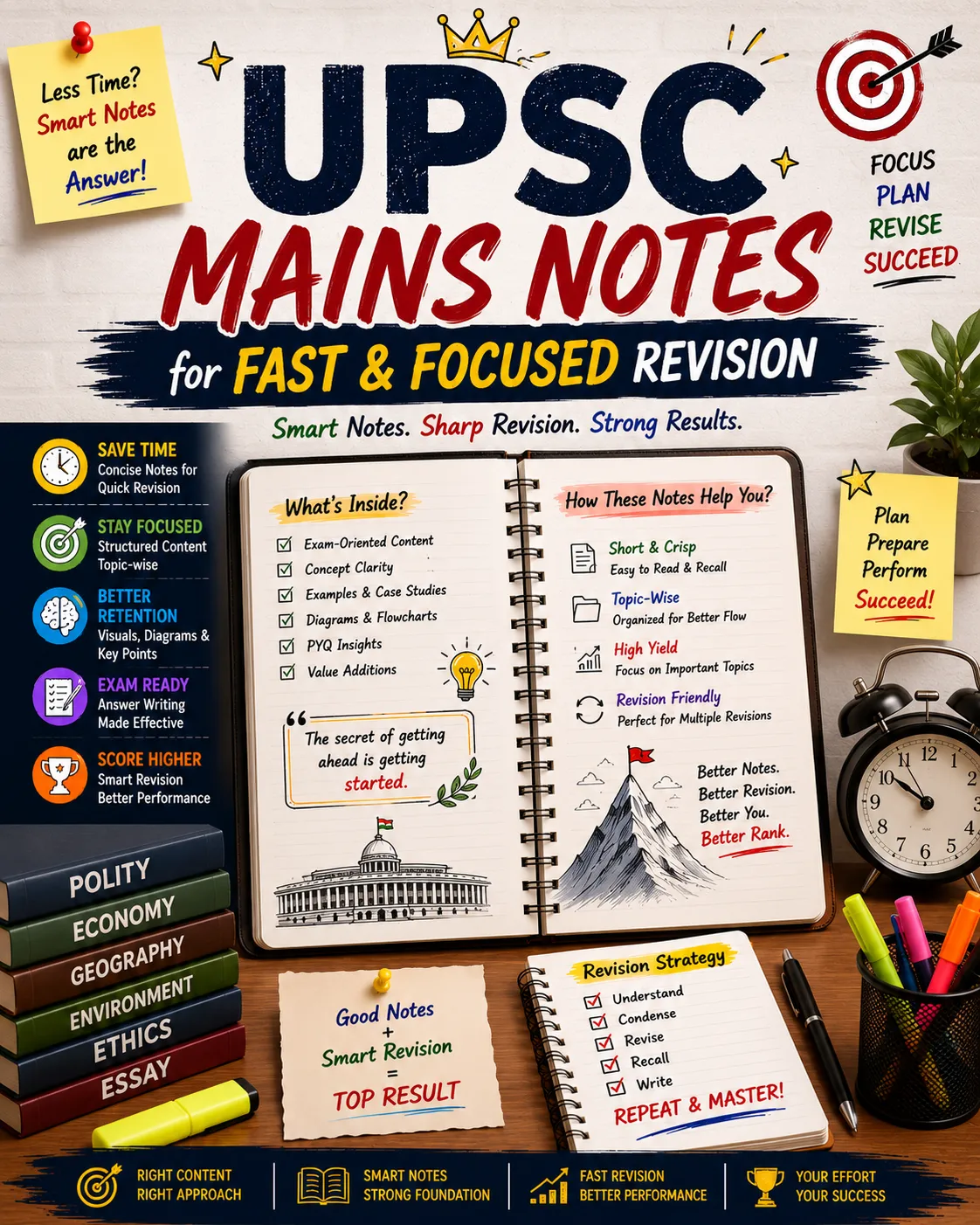
The Core Problem: Why Standard Material Fails You in Mains
Most aspirants treat note-making like a transcription job. You open a standard textbook, change a few words, and copy it into a spiral notebook.
The harsh truth? You’ve just rewritten a slightly worse version of a book that was already well-edited.
Standard upsc mains study material is designed to give you a broad, comprehensive understanding of a topic. It builds context. But when you are writing an 150-word answer on semiconductor manufacturing or the cooperative movement in India, you don't have room for paragraphs of context. You need:
- A crisp, authoritative definition or opening line.
- Hard statistics or data points from verified reports (like NITI Aayog or the Economic Survey).
- The exact constitutional articles, legal provisions, or committee recommendations involved.
- Three core challenges and three practical, actionable solutions.
If your current notes cannot give you those four elements within a thirty-second glance, they will not serve you during the intense revision period between the Prelims and Mains exams.
Architectural Blueprint for Effective UPSC Mains GS Notes
To make your upsc mains gs notes truly effective, you need to shift from a "topic-wise" mindset to a "syllabus-keyword" mindset. The UPSC syllabus is highly structured. Your files should mirror that exact structure.
1. The Micro-Sheet Strategy
For every single sub-topic listed explicitly in the GS 1, 2, 3, and 4 syllabus, restrict yourself to a maximum of two pages. If a topic spans ten pages in your binder, it is no longer a revision note it is a manuscript. If you are looking at "Disaster Management," you should have a single sheet on floods, one on earthquakes, one on landslides, and one on institutional frameworks. When you condense information this aggressively, you force your brain to prioritize high-value arguments over filler text.
2. The Multi-Layered Revision Framework
An ideal note shouldn't look like a block of prose. It should be layered visually so your eyes can skim it effectively 48 hours before the paper.
- Layer 1 (The Hook): A striking quote, a recent news event, or a core metric that can form your introduction.
- Layer 2 (The Structural Spine): Bullet points detailing the structural causes of an issue. Use diagrams, flowcharts, or hub-and-spoke models here to visually map relationships.
- Layer 3 (The Punchline): Specific committee names (e.g., Sarkaria Commission for center-state relations, or the Kelkar Committee for PPP models). Mentioning these explicitly is what separates an average answer from a high-scoring one.
Digital vs. Paper: Choosing Your Weapon Authentically
As shown in the ASCII breakdown from image_d7febe.png, there is a running debate in the aspirant community about whether to go digital or stick to physical paper. Below is a clean, formatted breakdown of those exact comparisons to help you choose your workflow:
| Feature | Digital Notes (OneNote, Notion, Evernote) | Physical Notes (Loose Sheets, Registers) |
|---|---|---|
| Updatability | Effortless. Insert links, new data, and dynamic facts inline. | Difficult. Requires sticky notes, margins, or completely rewriting pages. |
| Searchability | Instant search for any keyword across thousands of pages. | Requires manual flipping and disciplined physical indexing systems. |
| Exam Simulation | Poor. Doesn't mimic the physical pen-and-paper reality of the actual mains hall. | Excellent. Builds muscle memory and matches the actual writing environment. |
| Retention Style | Tends to encourage hoarding of web links and copy-pasting behavior. | Forces active summary and physical condensation due to space limits. |
If you prefer a digital workflow, make sure you actively convert your typed thoughts into handwritten structures during mock tests. If you prefer paper, use loose A4 sheets instead of thick bound registers. Loose sheets allow you to insert a newly released government report directly into your existing dynamic file without ruining your entire sequence.
Real Aspirant Insights: What Works in the Trenches
"In my first attempt, I had massive, beautiful registers for every GS paper. But during the actual Mains week, I realized I couldn't carry fifteen heavy books to the exam center, let alone flip through them during the lunch break. For my next attempt, I condensed all of GS 3 into just 40 loose pages. I memorized only the core arguments, data points, and committee recommendations. My score jumped by 22 marks in that paper alone because my answers were precise, not rambling."
— Siddharth M., Selected Candidate
"I spent months downloading every curated upsc mains notes pdf I could find online. I thought I was being productive. When I sat for my first full-length sectional mock, my mind went totally blank. That is when I realized that downloaded material belongs to the person who compiled it, not to you. You have to process the information yourself, run it through your own logic, and write it out by hand if you want to remember it under pressure."
— Ananya R., Senior Aspirant
Common Note-Making Pitfalls You Must Avoid
When you are deep in the cycle of daily news analysis, it is very easy to fall into traps that waste your energy and bloat your files.
- The Current Affairs Black Hole: Do not make fresh daily entries for ongoing issues. If there is a dispute regarding federalism, do not write a new page every time a politician makes a speech or an op-ed drops. Wait for the core issue to settle, then update your single master sheet on "Center-State Relations" with the definitive core arguments.
- The Copy-Paste Illusion: Highlighting everything in a PDF or copying whole paragraphs into your digital notebook gives you a false sense of accomplishment. True note-making is an active intellectual exercise. Read a section, close the source, process what matters, and write down the absolute essence from memory.
- Ignoring the Syllabus Vocabulary: If your notes use generic headings like "Environment Problems," you are missing a trick. Use the exact wording of the UPSC syllabus, such as "Environmental Pollution and Degradation" or "Investment Models." This trains your brain to recognize exam questions instantly and map your prepared material directly onto the answer sheet.
Finding Balance: Integrating Static and Dynamic Content
Your static conceptual understanding (from foundational textbooks) and dynamic updates (from newspapers and policy forums) must live together. They should not exist in isolated silos.
If you are creating a note on "Subsidies," your static portion should cover the economic definitions, the explicit objectives, and the historical issues with the Public Distribution System (PDS).
The dynamic layer must be woven right alongside it: the latest budgetary allocations, recent challenges highlighted by the Comptroller and Auditor General (CAG), and technology-driven interventions like direct benefit transfers or biometric verification issues. This integration ensures that when you write an answer, your foundation is economically sound and your examples are completely current.
Frequently Asked Questions
Is it necessary to prepare individual notes for every single topic in the syllabus?
It is highly recommended for the core, high-yield topics. For areas where the syllabus is very explicit but resources are scattered (like GS 2 and GS 3 governance or security challenges), having your own crisp summaries is crucial. For very generic topics, you can rely on a solid, well-underlined base resource, supplemented with small margin notes.
When is the ideal time to start making your own upsc mains notes?
Do not start making notes on your very first reading of a subject. Your first pass should be focused purely on understanding the landscape and context. Start your structured note-making during your second or third reading, ideally after you have analyzed at least five to ten years of previous years' question papers to understand exactly what kind of details the exam demands.
Can I completely rely on a pre-made upsc mains notes pdf from coaching institutes?
A compiled upsc mains notes pdf from a reputable source is excellent as a base reference or to fill gaps in your preparation. However, relying on them completely without personal processing is risky. You need to personalize that information, condense it further, and practice reproducing it in your own words to perform effectively under exam conditions.
How do I compress massive current affairs topics into short revision sheets?
Focus strictly on the core structural framework of the issue: Why is it in the news? What is the underlying structural cause? What are the arguments for and against? What are the official institutional recommendations? Strip away all the narrative prose, journalistic descriptions, and repetitive commentary.
How often should I update my upsc mains study material with new statistics?
Do not obsess over changing your data points every single week. Update your master data matrices twice a year ideally when the Economic Survey and Union Budget are released, and once more just before the Mains exam to capture any major national or international indices and reports.
The Path Forward
At the end of the day, your preparation material should serve as a functional launchpad for high-quality answer writing, not a library archiving every piece of information under the sun. The quality of your preparation is determined by what you can successfully remember and clearly express on a blank sheet of paper in nine minutes flat. Keep your files lean, focus on the structural clarity of your arguments, and ruthlessly cut out the fluff.



















Sign in to leave a comment.