

The dust from the preliminary exam has barely settled. If you recently sat in that exam hall, managing your time between a dense General Studies paper and a demanding CSAT session, you know exactly how exhausting the process is. For a few days, your entire routine probably revolved around refreshing portals, tracking down the upsc prelims answer key, and matching your responses set by set.
Checking the upsc prelims answer key 2026 is an emotional roller coaster. Whether you are comfortably clearing the estimated cutoff or sitting right on the fence, a shifting realization takes over: the true battle of the Civil Services Examination is fought in the descriptive arenas of the Mains.
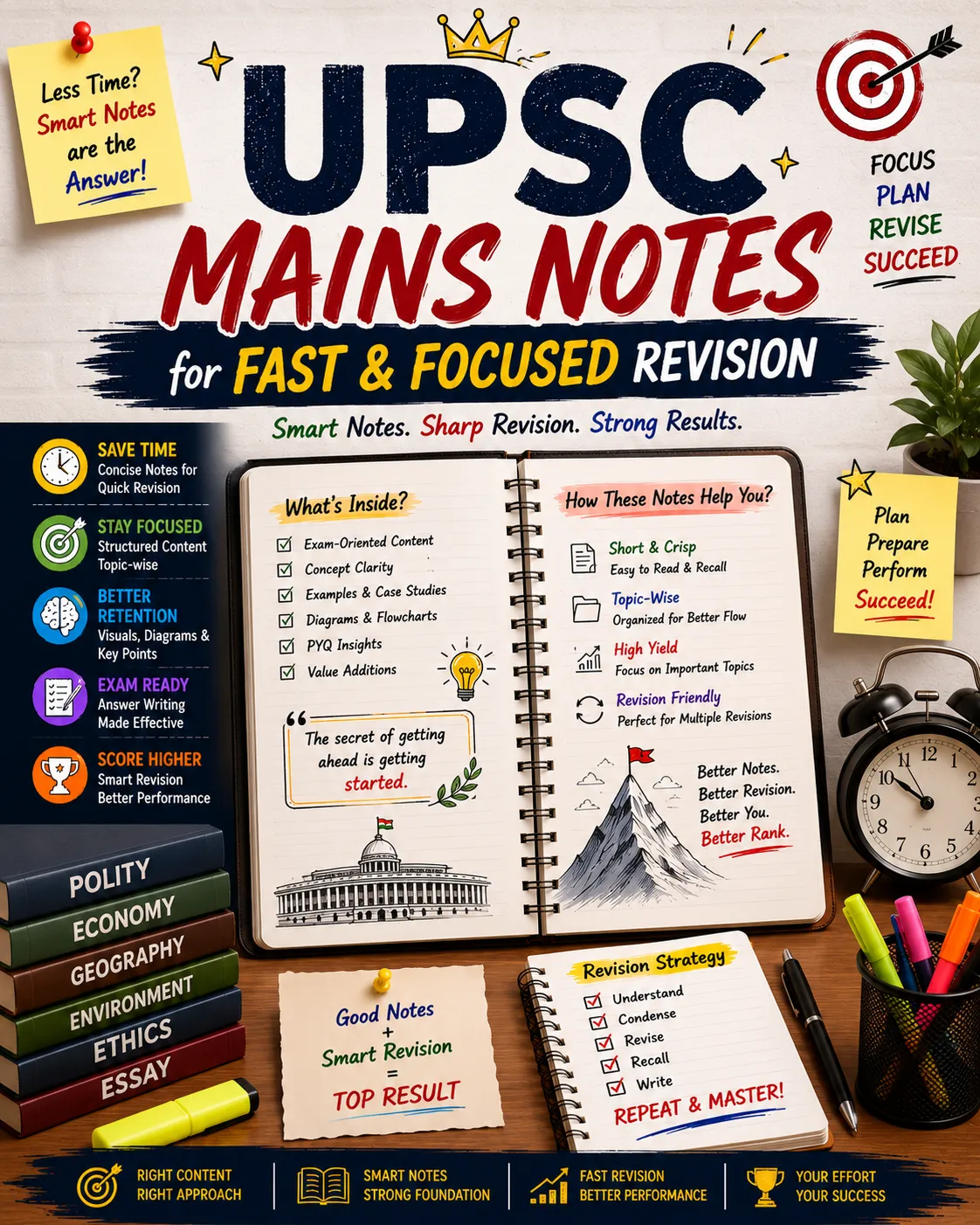
When you transition to writing nine comprehensive, analytical papers, your biggest challenge is no longer a lack of information it is an overload of it. You cannot revise thousands of pages of textbook content in the short window before the exam. To survive and excel, you need notes that act as an active strategy for your revision, transforming raw knowledge into sharp, structured answers under tight time constraints.

The Core Problem with Standard Mains Prep
Most aspirants treat Mains note-making as a passive exercise in rewriting textbooks. You buy thick markers, open a standard reference book, and essentially create a slightly shorter, handwritten version of the exact same book.
When revision time arrives, you are left with massive registers that are just as intimidating as the original sources.
Real, effective preparation requires you to build analytical frameworks. The Civil Services Main Examination does not test your ability to recall isolated facts; it tests your capacity to connect a historical precedent to a current constitutional issue, or link an economic policy to a grassroots social problem.
Your notes must be structured to match how your brain works under pressure packaged into clear arguments, concise data points, and flexible case studies.
Shifting Focus from Screening to Selection
The moment you download the upsc answer key prelims, your processing mindset has to evolve. Evaluating your performance using the upsc prelims answer key pdf helps you assess your factual accuracy, but the Mains demand structural depth and clarity.
In the preliminary stage, the answer is always right there on the page; your job is simply to recognize it. In the Mains, you face a blank sheet of paper and a ticking clock. Your notes must bridge that gap, serving as a repository of structured arguments rather than a laundry list of facts.
How to Build High-Yield Notes
To create notes that give you a genuine advantage during revision, consider structuring your study materials around the following four pillars:
1. The Micro-Topic Approach
Do not organize your registers by broad subjects like "Polity" or "Economics." Instead, align them directly with the specific micro-topics listed in the official syllabus. If the syllabus mentions "Issues relating to development and management of Social Sector/Services relating to Health,” your notebook should have a dedicated section with that exact title.
When you organize your materials this way, you can easily spot gaps in your preparation and ensure that every hour of study directly addresses potential exam questions.
2. The 1-Page Framework
For every single micro-topic, challenge yourself to condense your material down to a single page should prioritize a concise definition or current context, essential statistics, primary structural challenges, institutional mechanisms, and expert committee recommendations for the way forward.
3. Data Hubs and Case Studies
Do not scatter your statistics across hundreds of pages. Maintain a dedicated section at the back of your notes specifically for high-impact data, supreme court judgments, and real-world case studies.
Knowing the exact percentage of female labor force participation or a specific pilot project that successfully tackled urban water scarcity can help you back up general arguments with concrete evidence.
4. Intentional Structural Integration
Your preparation should never exist in silos. As you analyze current affairs, use your foundational knowledge to contextualize changing trends. For example, if a major legislative amendment is being debated, tie it directly back to your core constitutional notes.
Common Mistakes to Avoid
- Over-complicating Digital Tools: Spending more time adjusting font styles, organizational tags, and complex folder structures on digital note-taking apps than actually engaging with the material.
- The Infinite Collection Loop: Hoarding PDFs, saving bookmarked links, and buying every new compilation booklet without ever synthesizing the information into your own words.
- Ignoring the Structural Core: Failing to link current events back to fundamental institutional frameworks. Isolated news stories rarely form a complete answer without their underlying legal or historical context.
- Neglecting Your Optional Subject: Getting so caught up in General Studies that you put off organizing your optional subject notes. Your optional subject plays a massive role in your final score and requires deeply specialized preparation.
Voices from the Field: Real Aspirant Experiences
Rohan’s Transition Strategy
"After checking the upsc prelims answer key last year, I realized I was right on the edge of the cutoff. I spent three weeks worrying instead of studying. When the results came out and I made the cut, I panicked because my Mains notes were completely unorganized. I had to learn the hard way that your preparation for the next stage has to start the moment the prelims end, regardless of your score anxiety."
Anjali’s Consolidation Realization
"I used to write down pages of information for every current affairs topic. By August, I couldn't revise any of it. I changed my strategy entirely: I forced myself to fit every single topic whether it was self-help groups or cooperative federalism onto a single page. That constraint completely changed my revision pace and helped me feel far more prepared."
Frequently Asked Questions
How soon after checking the upsc prelims answer key should I start Mains preparation?
You should begin your Mains preparation immediately. Waiting for the official results to be declared wastes valuable weeks. Use the upsc prelims answer key 2026 to get a general sense of your performance, and then transition your daily routine toward answer writing and note consolidation.
Should I make my Mains notes digital or handwritten?
Both methods work well, so choose the one that fits your workflow. Digital notes make it easy to update current affairs and search for specific terms. However, handwritten notes help build muscle memory for the actual exam, where you will be writing continuously for hours. Many aspirants use a hybrid approach: digital tools for organizing information, and paper for practicing answers.
How do I integrate current affairs into my static syllabus notes?
Avoid keeping separate registers for current affairs. Instead, insert updates directly into the corresponding section of your static syllabus notes. If a new report on judicial pendency comes out, add that data point straight to your "Judiciary" page so you have all your relevant material in one place when you revise.
Can I rely entirely on coaching market compilations for my notes?
Market compilations are excellent for saving time on basic research, but they should not completely replace your own note-making. Personalizing your materials forces you to process the information deeply. Rewriting insights in your own words helps you internalize arguments so you can recall them quickly during the exam.
How do I compress massive subjects like History or Geography for revision?
Focus on trends, causes, consequences, and geographical maps rather than trying to memorize every minor detail. For History, organize your material around the underlying factors behind major movements. For Geography, focus on structural diagrams and conceptual frameworks that you can quickly sketch out during the exam.
Conclusion
At its core, clearing the Civil Services Examination is an exercise in effective communication under pressure. High-quality revision notes act as a bridge between your months of deep study and the blank spaces on your answer sheet.
Once you finish analyzing your performance with the upsc answer key prelims and download the official upsc prelims answer key pdf, shift your focus entirely to organizing your study materials. Consolidating your knowledge into clear, actionable frameworks ensures that when you walk into the exam hall, you can focus on building strong arguments instead of struggling to remember basic facts.
























Sign in to leave a comment.