
The dust has settled, the OMR sheets are locked away, and the intense, collective sigh of relief from lakhs of aspirants has filled the air. If you just walked out of the exam hall, your mind is probably a chaotic mix of second-guessing, mental math, and the inevitable urge to scroll through Telegram channels checking unofficial answer keys.
That post-exam anxiety is completely normal, but it can also be incredibly paralyzing.
This isn't your typical coaching institute analysis designed to panic you into buying a Mains course. Instead, let's take a calm, objective, and deeply realistic look at how the papers actually unfolded and what the realistic upsc prelims 2026 expected cutoff might look like based on historical data and early student feedback.
The Reality of the Papers: A Ground-Level Breakdown
Every year, the immediate reaction on social media follows a predictable script: half the internet claims it was the easiest paper ever, while the other half labels it an absolute disaster. The truth always lies somewhere in the messy middle.
Let's break down the actual substance of the day through a realistic upsc prelims paper analysis.
GS Paper 1: The Return of Conceptual Depth
The morning session wasn't a straightforward walk through basic facts. If you relied solely on surface-level factual monthly compilations, you likely found yourself in a tight spot. Our upsc prelims analysis shows a heavily balanced distribution that heavily rewarded conceptual clarity over blind memorization.
- Polity & Constitution: While the questions felt familiar, the options were tightly wound. Conceptual clarity regarding constitutional morality, federalism, and the finer nuances of parliamentary procedures separated the serious candidates from the rest.
- Economy: Moving away from dry definitions, the focus remained sharp on applied macroeconomics, banking sector regulations, and supply chain disruptions.
- Environment & Science: This section continues to be the wild card. The trend of blending core ecology with current dynamic updates was on full display, testing your ability to eliminate options under immense time pressure.
- History & Culture: A mix of predictable chronological questions paired with highly obscure ancient terms that left many scratching their heads.
Ultimately, a comprehensive upsc prelims gs paper analysis reveals that the paper was lengthy and moderately challenging. It successfully penalized reckless guessing while rewarding structurally disciplined revision.
The CSAT Factor: Still the Ultimate Gatekeeper
If Paper 1 tested your endurance, Paper 2 tested your nerves. A thorough upsc prelims csat analysis reveals that UPSC has maintained its demanding standards for the aptitude paper, ensuring it remains a massive roadblock for many.
The Quant section did not pull any punches. Number systems, permutations, and combinatorics dominated the landscape. Even for those with strong engineering or mathematical backgrounds, the sheer length of the questions meant that time management was a brutal challenge.
The Reading Comprehension passages, while moderate in length, featured highly subjective options where two answers felt equally valid. If you felt squeezed for time or had to pivot your strategy halfway through the afternoon, you are absolutely not alone. This difficulty curve means that a significant portion of high GS scorers will unfortunately be held back by CSAT, which directly depresses the overall cutoff baseline.
Historic Trends vs. 2026 Realities
To understand where you stand, you have to look at the historical trajectory. UPSC cutoffs are never static; they are highly dynamic reactions to paper difficulty, candidate preparation levels, and the total number of vacancies.
| Exam Year | General Cutoff | Vacancies | Paper Difficulty & Character |
|---|---|---|---|
| 2023 | 75.41 | 1,105 | Extreme difficulty anomaly; unpredictable option formats. |
| 2024 | 87.98 | 1,056 | Balanced recovery year; pairing elimination challenges. |
| 2025 | 92.66 | 979 | Moderate difficulty; high competition and shrinking seats. |
| 2026 (Est.) | 90 – 95 | ~933 | Lengthy GS Paper 1; highly challenging CSAT. |
With approximately 933 vacancies for this cycle, the competition for each seat has intensified slightly compared to previous years. However, because both the morning and afternoon sessions trended on the challenging side, the cutoff is highly unlikely to skyrocket beyond the mid-90s.
The Expected Cutoff and the "Safe Score"
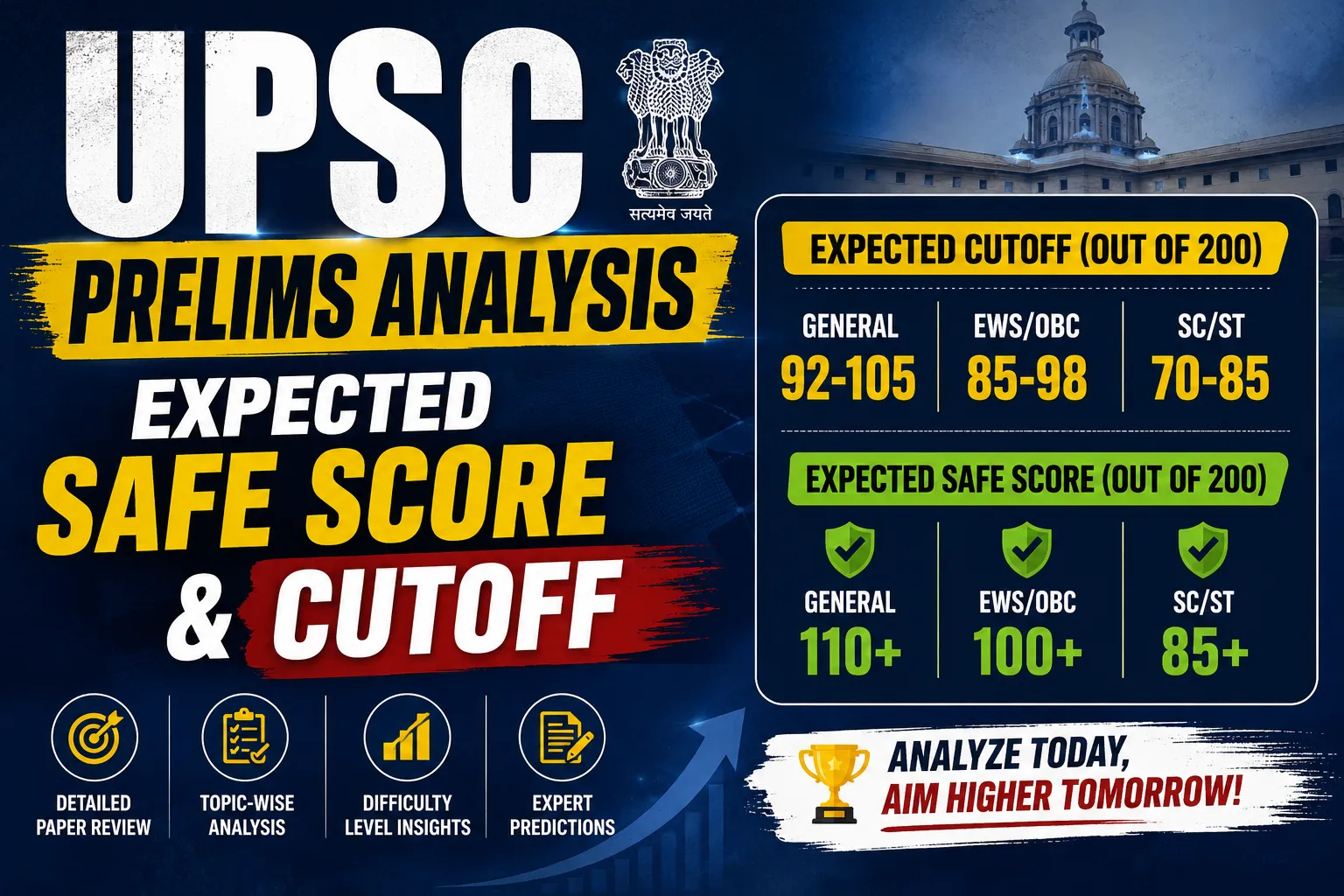
Let’s talk concrete numbers. Based on early feedback, difficulty metrics, and vacancy ratios, here is the projected category-wise breakdown for the upsc prelims 2026 expected cutoff:
- General: 90 – 95 Marks
- EWS: 87 – 92 Marks
- OBC: 89 – 94 Marks
- SC: 78 – 83 Marks
- ST: 74 – 79 Marks
Mapping Your Score Zone
Instead of obsessing over a single digit, calculate your score across 2–3 reliable answer keys and see where you fall on this spectrum:
The Safe Zone (95+ Marks): If your score is consistently clearing 95 marks after factoring in negative marking, do not waste another second. Take a 48-hour break to rest your mind, and then dive headfirst into your Mains preparation. The competition for Mains is fierce, and every day you spend checking cutoff videos is a day lost to your competitors.
The Grey Zone (85 – 95 Marks): This is where the vast majority of serious aspirants find themselves. It is an incredibly uncomfortable space to be in, but the worst thing you can do is freeze. Act as if you are clearing it. The preparation you do over the next month covers core overlapping topics (Polity, Economy, Ethics, International Relations) that will form the backbone of your prep regardless of the outcome.
The High-Risk Zone (Below 85 Marks): If your score is safely below the competitive threshold, allow yourself to feel the disappointment, but don't let it turn into despair. Take a week off to fully detach, then conduct an honest post-mortem of your paper. Was it a lack of conceptual depth? Did CSAT sink your paper? Did panic lead to silly mistakes? Identify the root cause and rebuild your strategy systematically.
Authentic Aspirant Experiences
To get a true sense of the room, here is what fellow aspirants are experiencing on the ground:
Testimonial 1: The Veteran's Perspective
"This was my third attempt, and it felt like a marathon. GS Paper 1 wasn't impossible, but it was incredibly lengthy. I found myself reading the options twice just to make sure I wasn't falling into a trap. CSAT felt just as brutal as 2023. I'm sitting right around 92 on most keys, and the anxiety is real, but I'm forcing myself to start answer writing next week anyway."
— Ananya R., Delhi
Testimonial 2: The First-Timer's Reality Check
"Nothing quite prepares you for the pressure of the actual exam hall. Mock tests gave me a false sense of security with direct questions. Today, the applied nature of the Economy and Environment sections forced me to rely completely on first-principle logic. I messed up my time management in CSAT and only attempted 42 questions. It's going to be a very tight race."
— Rahul M., Bengaluru
Common Post-Exam Pitfalls to Avoid
- The Answer Key Obsession: Checking seven different coaching keys to find the one that gives you the highest score is a form of productive procrastination. Accept that keys will differ on 4–5 highly ambiguous questions, give yourself a realistic margin of error, and move on.
- Waiting for the Official Result: Waiting 20–25 days for the official UPSC results before touching your Mains syllabus is a massive strategic mistake. If you qualify, you will face an insurmountable backlog of syllabus copy, optional prep, and answer writing.
- Ignoring CSAT Failures: If you scored 105 in GS but are hovering at 64 in CSAT, don't brush it off as bad luck. Treat it as a structural flaw in your preparation that requires dedicated, year-long attention.
Frequently Asked Questions (FAQs)
1. Does the difficulty of CSAT affect the final GS Paper 1 cutoff?
Yes, heavily. Because CSAT is a mandatory qualifying paper (requiring a minimum of 33% or 66.67 marks), any increase in its difficulty disqualifies a large pool of candidates who scored exceptional marks in GS Paper 1. This naturally prevents the final cutoff from rising too high.
2. When will UPSC release the official answer key for Prelims 2026?
In a major institutional shift, UPSC has implemented new reforms to release the provisional answer key shortly after the conclusion of the Preliminary Examination. This allows candidates to raise objections through the Question Paper Representation Portal (QPRep) almost immediately, drastically increasing transparency.
3. How many questions should ideally be attempted in a moderate-to-tough GS paper?
There is no golden number, as it depends entirely on your personal accuracy levels. However, given the length and complexity of recent patterns, an attempt count between 75 and 85 questions is generally seen as balanced, allowing candidates to maximize potential scores without succumbing to excessive negative marking.
4. What should my immediate strategy be if I find myself in the 'Grey Zone'?
Focus entirely on core Mains topics that overlap with GS preparation, such as modern history, polity, and economy. Dedicate time to your Optional subject and Ethics (GS Paper 4). Even if you miss the cutoff by a margin, this structural foundation will ensure you are a top contender for the next cycle.
5. Are marks from the mock test series a reliable indicator of actual Prelims performance?
Not entirely. Mock tests are exceptional tools for mastering time management, building an elimination rhythm, and identifying blank spots in your syllabus. However, coaching institutes often over-index on obscure facts or hyper-specific current affairs, whereas UPSC prioritizes deep conceptual understanding and multi-disciplinary logic.
Conclusion
At the end of the day, the Civil Services Examination is an endurance test as much as an intellectual one. This single exam paper does not define your capabilities, your intelligence, or your worth.
If you did well, stay humble and keep working. If the day didn't go your way, treat it as data rather than a definitive judgment on your potential. Take a breath, step away from the screens, spend time with family, and let your mind rest. When the mental fog clears, you'll know exactly what your next step needs to be.




























Sign in to leave a comment.