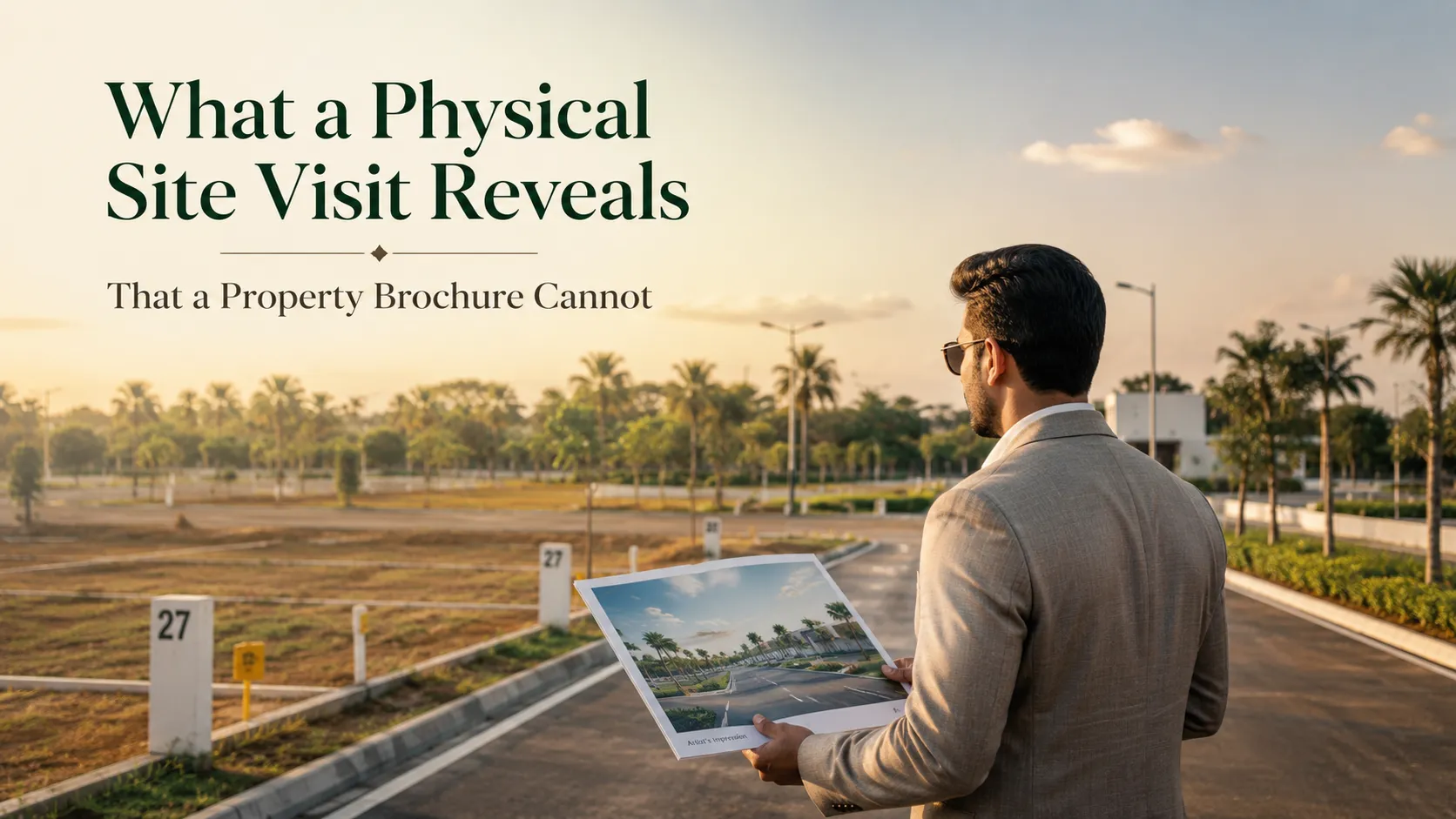

Property brochures are designed to present a project at its best.
They may include attractive entrance gates, landscaped roads, green open spaces, lifestyle amenities and maps highlighting nearby highways, airports or employment centres. These materials are useful for understanding the developer’s vision, but they cannot fully show how the property feels or functions on the ground.
A physical site visit helps buyers move beyond presentation and evaluate the actual location, infrastructure and long-term usability of a plot.
This is especially important when purchasing land because the value of a plot depends on more than its dimensions or quoted price. Road access, drainage, ground level, neighbouring development and construction suitability can directly influence how useful the property becomes in the future.
Here are the most important details that a site visit can reveal.
1. The Real Quality of the Approach Road
A brochure may describe a project as being close to a highway, airport or business district. However, the final stretch of the journey often matters just as much as the main road.
During the site visit, observe:
- Whether the approach road is paved
- Its width and present condition
- Whether two vehicles can pass comfortably
- The presence of sharp turns or narrow stretches
- Traffic conditions at nearby junctions
- Whether access depends on private land
- How the road may perform during heavy rain
A project may be only a few kilometres from an important highway but still take considerable time to reach because of poor internal connectivity.
Buyers evaluating plots for sale in Bangalore should compare actual travel time rather than relying only on the distance shown on a map.
Travel to the site from a point that matters to you, such as your home, workplace, airport or nearest major road. This gives you a more realistic picture of daily accessibility.
2. Whether the Internal Roads Match the Layout Plan
Internal roads have a major influence on the usability and appearance of a plotted development.
A brochure may mention wide roads, landscaped avenues or future street lighting. At the site, check what has already been completed.
Observe:
- The measured or marked road width
- Whether road levels appear even
- The quality of road formation
- Space available for drainage
- Turning space near corner plots
- Accessibility for construction vehicles
- Whether roads shown in the plan exist on the ground
Unfinished roads are not always a negative sign in an early-stage project. However, buyers should know which infrastructure is completed, which is under construction and which is only proposed.
Ask the developer for a clear development schedule rather than assuming every visual in the brochure represents the current condition.
3. Ground Level and Water Movement
Ground level is one of the most important details to inspect before selecting a plot.
A property brochure may not reveal whether a plot is lower than the road, located near a natural water channel or positioned in an area where rainwater collects.
During the visit, check:
- Whether the plot is level with the road
- Signs of soil erosion
- Low-lying sections
- Existing water channels
- Nearby lakes, drains or agricultural land
- The direction in which rainwater is likely to flow
- Whether neighbouring land sits significantly higher
Ask how stormwater will be managed across the layout.
A proper drainage system should guide water away from residential plots and internal roads. Poor drainage can create problems during construction and may increase future maintenance costs.
Where possible, visit the site after rainfall. Conditions that appear normal during dry weather may look very different after a heavy shower.
4. Plot Markings and Actual Dimensions
A brochure or layout plan may show clearly numbered plots, but buyers should confirm that the plot boundaries are identifiable on the ground.
Look for:
- Boundary stones
- Plot-number markers
- Road-facing dimensions
- Rear and side measurements
- Corner points
- Differences between the plan and the physical site
Plot shape also matters.
Rectangular plots are often easier to plan for construction than irregularly shaped plots. Narrow frontage, unusual angles or reduced depth may limit building design options.
Ask whether the dimensions mentioned in the sales documents match the approved layout and the final survey.
Never select a plot only from a digital layout without seeing its actual position.
5. The Character of the Surrounding Area
Project marketing usually focuses on the land inside the development. A physical visit helps buyers understand what exists outside it.
Inspect the surrounding area for:
- Existing homes
- Agricultural activity
- Industrial operations
- Warehouses
- High-tension power lines
- Quarries
- Water bodies
- Waste-disposal areas
- Religious or commercial activity
- Future road or infrastructure work
The surrounding environment can affect noise, air quality, accessibility and residential demand.
Also consider whether the locality appears suitable for future homes. A plot may be legally approved and attractively priced, but long-term residential demand depends partly on whether families would realistically want to live in the area.
6. Distance to Essential Services
Brochures often mention schools, hospitals and shopping areas using approximate distances.
During the site visit, verify how convenient these services actually are.
Check the nearest:
- Hospital or clinic
- School
- Grocery store
- Fuel station
- Public transport point
- Bank or ATM
- Police station
- Restaurant or daily-needs market
A location does not need to have every service immediately nearby, especially when it is part of an emerging corridor. However, buyers should understand the present situation and decide whether it matches their intended holding period.
Someone planning to build soon will have different requirements from an investor prepared to hold the land for several years.
7. Existing Infrastructure Versus Future Promises
Site visits make it easier to separate completed infrastructure from planned features.
Ask the representative to identify:
- Roads already completed
- Drainage work already installed
- Electricity infrastructure
- Water arrangements
- Street-light provisions
- Security facilities
- Landscaping completed
- Amenities under construction
- Features scheduled for later phases
Take photographs and notes during the visit.
Promises regarding infrastructure, amenities or development timelines should be reflected in official documents or the sale agreement wherever appropriate.
A project should not be judged only by its final visualisation. Buyers need clarity about the current stage and the developer’s obligations.
8. How the Sales Team Handles Detailed Questions
A site visit is also an opportunity to evaluate the developer’s communication.
Reliable plot developers in Bangalore should be willing to explain the project clearly, provide relevant documents and allow buyers sufficient time for independent verification.
Pay attention to how the representative responds when you ask about:
- Ownership records
- Layout approvals
- Development timelines
- Water sources
- Maintenance responsibilities
- Additional charges
- Registration procedures
- Construction restrictions
- Cancellation and refund terms
Clear answers do not replace legal due diligence, but vague or changing responses may indicate that further investigation is needed.
Avoid making an immediate payment simply because the salesperson says that a specific plot will not remain available.
9. Noise, Traffic and Environmental Conditions
Some conditions are difficult to understand through maps or photographs.
Stand quietly at the site for a few minutes and observe:
- Highway or aircraft noise
- Industrial sounds
- Dust levels
- Odours
- Heavy-vehicle movement
- Nearby construction
- Wind direction
- General activity around the property
Visit at different times where possible.
A location that feels quiet on a weekend afternoon may be affected by commercial traffic on a weekday morning. Similarly, an approach road that seems open during the day may become congested during peak hours.
These details are especially important for buyers planning to build a home rather than hold the land only as an investment.
10. Whether the Plot Supports Your Intended Use
Every buyer should visit the site with a clear purpose.
Someone purchasing for long-term investment may focus on infrastructure growth, legal clarity and future demand.
A buyer planning to build a home may also need to consider:
- Sunlight and orientation
- Road frontage
- Neighbouring plot levels
- Construction access
- Utility connections
- Building restrictions
- Distance from daily necessities
- Community maintenance
A weekend-home buyer may prioritise landscape, privacy and travel convenience.
The same plot can be suitable for one buyer and unsuitable for another. A site visit helps connect the physical property with your specific objective.
Questions to Ask During the Visit
Carry a written checklist so that important questions are not forgotten.
Ask:
- Can you identify the exact plot on the ground?
- What is the approved road width?
- How will stormwater be managed?
- What is the source of water?
- Which infrastructure is completed?
- Which features are still proposed?
- Are electricity connections available?
- Who maintains the project after possession?
- Are there construction deadlines or restrictions?
- What additional charges apply?
- Can the legal documents be independently reviewed?
- Does the agreement record the development commitments?
Do not rely only on verbal explanations. Request written information wherever possible.
What to Do After the Site Visit
A good site visit should create more clarity, not immediate pressure.
After returning:
- Compare your notes with the brochure
- Review photographs and videos
- Recheck the route and travel time
- Examine the complete cost sheet
- Compare the project with alternatives
- Request copies of legal documents
- Consult an independent property lawyer
- Review the sale agreement carefully
- Revisit the site when necessary
Do not let the appearance of the sales office or project entrance determine the decision.
The final evaluation should combine legal verification, financial planning and physical inspection.
A Brochure Shows the Vision; the Site Shows the Reality
Property brochures are useful starting points. They help buyers understand the intended layout, amenities and positioning of a project.
But land must be evaluated on the ground.
A physical site visit reveals the true approach road, plot level, drainage conditions, surrounding development, existing infrastructure and practical travel time. It also allows buyers to judge whether the location can support their intended use.
The strongest property decisions are made when presentation and reality match.
Visit carefully, ask detailed questions and avoid paying until the important legal, physical and financial details have been independently verified.


























Sign in to leave a comment.