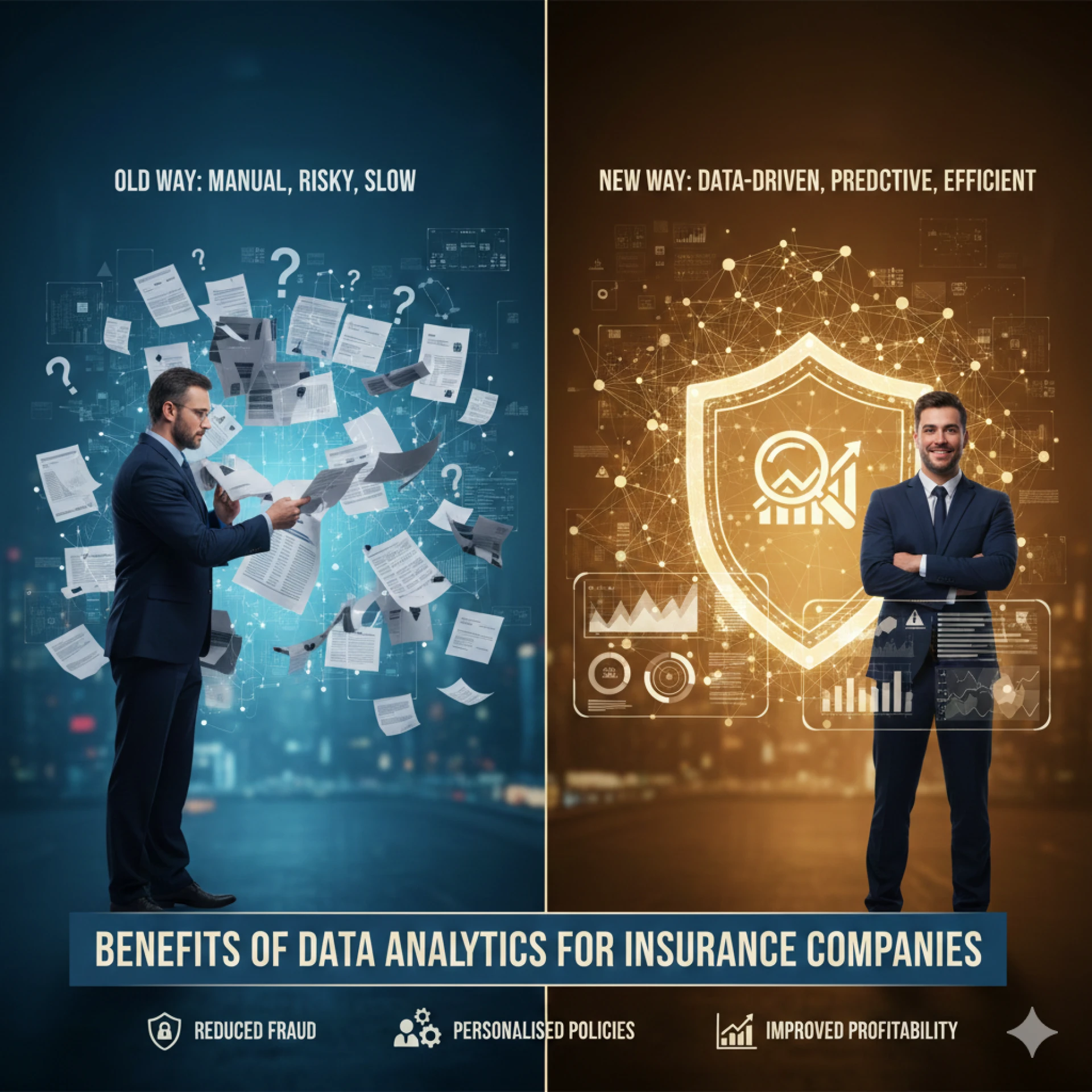

The insurance industry is going through a major digital change. Customers now expect fast service, fair pricing, and quick claim settlements. At the same time, insurance companies face challenges such as fraud, rising operational costs, strict regulations, and strong competition. To manage these challenges effectively, insurers are increasingly adopting data analytics in the insurance industry.
Data analytics helps insurance companies turn large volumes of data into meaningful insights. Instead of depending only on manual processes or past experience, insurers can use data-driven insights to reduce risk, improve efficiency, and deliver better customer experiences.
In this blog, we explain what data analytics means in the insurance sector and highlight the key benefits of data analytics for insurance companies.
What Is Data Analytics in the Insurance Industry?
Data analytics in insurance refers to the process of collecting, processing, and analyzing data to support better decision-making. Insurance companies generate data from many sources, including:
- Customer personal and demographic information
- Policy and coverage details
- Claims history and settlement records
- Billing and payment data
- Health, lifestyle, or driving behavior data
- Customer service interactions
- External data such as weather, location, and market trends
By analyzing this data, insurers can identify patterns, predict future outcomes, and improve business performance across departments.
Why Data Analytics Matters in the Insurance Sector
Traditional insurance models rely heavily on manual processes and historical averages. These methods are often slow and less accurate. Using data-driven approaches allows insurance companies to:
- Make faster and more informed decisions
- Reduce human errors
- Improve pricing accuracy
- Manage risk more effectively
- Enhance customer service quality
As competition increases, analytics-driven insurers are better prepared to adapt and grow.
Key Benefits of Data Analytics for Insurance Companies
1. Better Risk Assessment
Risk assessment is the foundation of insurance operations. With analytics, insurers can evaluate customer risk more accurately by:
- Studying customer behavior and history
- Identifying high-risk and low-risk policyholders
- Predicting the likelihood of future claims
This helps insurers reduce exposure to risky policies and maintain a healthier portfolio.
Benefit: Lower risk and improved financial stability.
2. Accurate and Fair Pricing
Setting the right premium is critical for both insurers and customers. Analytics helps companies:
- Price policies based on real customer data
- Avoid overpricing or underpricing
- Offer competitive and transparent premiums
For example, customers with safe driving records or healthy lifestyles can be rewarded with lower premiums.
Benefit: Fair pricing and higher customer trust.
3. Faster Claims Processing
Claims processing is one of the most important areas in insurance. Analytics supports faster claim handling by:
- Automating claim validation
- Identifying missing or incorrect claim details
- Reducing manual paperwork and delays
This leads to quicker settlements and better customer satisfaction.
Benefit: Faster claim resolution and improved customer experience.
4. Fraud Detection and Prevention
Insurance fraud causes major financial losses every year. Advanced analytics helps insurers:
- Detect unusual claim patterns
- Monitor suspicious behavior
- Flag high-risk claims at an early stage
Some systems can even identify fraudulent activities in real time.
Benefit: Reduced fraud losses and stronger risk control.
5. Improved Underwriting Decisions
Underwriting determines whether a policy should be approved and at what price. Analytics supports underwriters by:
- Providing detailed risk insights
- Reducing dependence on manual judgment
- Ensuring consistency in underwriting decisions
This results in faster approvals and fewer errors.
Benefit: Efficient underwriting and improved accuracy.
6. Personalized Insurance Products
Today’s customers expect insurance products that match their needs. Analytics allows insurers to:
- Understand customer preferences
- Offer customized insurance plans
- Recommend relevant add-ons and coverage options
For example, frequent travelers can be offered tailored travel insurance policies.
Benefit: Higher customer satisfaction and retention.
7. Better Customer Experience
Customer experience plays a key role in long-term success. Using data insights, insurers can:
- Respond faster to customer requests
- Reduce service delays and complaints
- Anticipate customer needs
This builds trust and strengthens customer relationships.
Benefit: Improved loyalty and brand reputation.
8. Reduced Operational Costs
Analytics helps insurance companies improve internal efficiency by:
- Identifying inefficient workflows
- Automating repetitive tasks
- Optimizing resource usage
These improvements lead to cost savings and higher productivity.
Benefit: Lower operational costs and better efficiency.
9. Data-Driven Business Decisions
With access to clear insights, insurance leaders can make decisions based on facts rather than assumptions. Analytics supports:
- Market trend analysis
- Business forecasting
- Strategic planning
This reduces uncertainty and supports sustainable growth.
Benefit: Smarter and more confident decision-making.
10. Regulatory Compliance and Reporting
Insurance companies must follow strict regulatory requirements. Analytics supports compliance by:
- Monitoring regulatory metrics
- Generating accurate reports
- Reducing audit and penalty risks
This ensures transparency and regulatory confidence.
Benefit: Improved compliance and lower legal risk.
11. Improved Customer Retention
Retaining customers is more cost-effective than acquiring new ones. Analytics helps insurers:
- Identify customers at risk of leaving
- Understand reasons for dissatisfaction
- Create targeted retention strategies
This improves long-term customer value.
Benefit: Higher retention and stable revenue growth.
12. Competitive Advantage
Insurance companies that use analytics effectively can:
- Launch new products faster
- Respond quickly to market changes
- Stay ahead of competitors
Data-driven insurers are more agile and innovative.
Benefit: Strong market position and sustainable growth.
Common Use Cases of Data Analytics in Insurance
Some common applications include:
- Claims analytics for faster settlements
- Fraud analytics for detecting false claims
- Predictive analytics for risk assessment and pricing
- Customer analytics for personalization and retention
- Operational analytics for cost and process optimization
Challenges Without Data Analytics
Insurance companies that do not use analytics often face:
- Slow manual processes
- Higher fraud losses
- Poor customer experience
- Inaccurate pricing decisions
- Increased operational costs
These challenges can reduce competitiveness and customer trust.
Why Insurance Companies Should Invest in Data Analytics Now
The insurance sector is becoming more digital and customer-focused. Investing in analytics helps insurers:
- Meet changing customer expectations
- Improve accuracy and efficiency
- Stay competitive and compliant
Early adoption prepares insurance companies for long-term growth.
Conclusion
Data analytics plays a vital role in modern insurance operations. It improves risk assessment, pricing accuracy, claims management, fraud detection, customer experience, and regulatory compliance. It also helps reduce costs and supports data-driven decision-making.
In simple terms, data analytics helps insurance companies work smarter, serve customers better, and grow faster. In today’s competitive insurance market, adopting data analytics is no longer optional—it is essential for long-term success.






























Sign in to leave a comment.