

Servicing a dump truck is not limited to replacing worn parts or troubleshooting hydraulic systems. Repair teams may need to work beneath a raised dump body while inspecting components, repairing hydraulic equipment, servicing air systems, or addressing damage following an accident. In these situations, selecting appropriate truck repair safety equipment is an important part of planning the work.
A BedLock System is designed to provide support for raised dump bodies during maintenance and repair. However, there is no single configuration that fits every truck. Frame width, chassis design, mounted components, and available clearance can all affect which system is appropriate.
For repair shops and fleet maintenance teams, the right approach is to evaluate the truck’s actual frame and application before selecting a support system.
Why Does Truck Frame Size Matter?
The truck frame provides the structural area where the BedLock System is positioned. Because frame dimensions vary between vehicles, support equipment must be compatible with the frame at the intended installation point.
A system that is designed for a narrower frame should not automatically be assumed to work on a wider chassis. Likewise, measuring the frame in one location does not necessarily tell a repair team what it needs to know about another area where access may be required.
Before selecting equipment, technicians should consider:
· Frame width at the intended support location
· Frame profile and structural configuration
· Available clearance around the frame
· Location of brackets and mounted equipment
· Dump body configuration
· Intended maintenance or repair application
This makes measurement one of the most useful steps in the selection process.
What BedLock Systems Are Available for Different Frame Sizes?
BedLock Safety Products offers several configurations intended for different truck and trailer applications.
BedLock System
Frame/Application
Configuration
BL-450A/B
Frames up to 4.5 inches wide
Available with A channel-style or B flat-plate top
BL-600A/B
Frames up to 6 inches wide
Available with A or B top configurations
BL-700B
Frames up to 7 inches wide
B top configuration
BLN-450A/B
Made-to-order, limited-access applications
Notched configuration with shortened base-plate side
When Is a Standard BedLock the Better Choice?
A standard configuration may be suitable when the frame is accessible and there is adequate room to position the dump body safety prop as specified.
For example, a repair shop may have a dump truck with a clear frame area and no significant equipment interfering with the intended support location. In that case, there may be no reason to introduce a modified configuration.
The key is not to choose a system simply because it is commonly used on a particular type of truck. The physical conditions around the frame should determine the selection.

What Happens When Frame Access Is Restricted?
Not every truck has an open frame area suitable for a conventional support arrangement. Equipment may be bolted or welded to the chassis as part of the truck’s original or customized configuration.
Battery boxes and air tanks are common examples of components that can occupy space around the frame. Brackets, hydraulic components, and other installed equipment can create similar restrictions.
This is where a dump body safety support like a Notched BedLock may be considered.
The BLN-450A/B uses a shortened base-plate side and reinforced supports to accommodate certain limited-access applications. Because this is a made-to-order configuration, the truck’s dimensions and obstruction details should be provided when discussing the application.

How Can Accidents Affect Dump Truck Repair Requirements?
Repair conditions can change significantly after an accident.
A collision or rollover may bend frame components, damage brackets, shift mounted equipment, or affect the alignment of the dump body. Even if the truck previously accommodated a standard dump truck safety lock or support system, the damaged vehicle may require a new assessment before repair work begins.
Other scenarios can also change the support requirements, including:
· Replacement of a damaged dump body
· Chassis modifications
· Installation of additional equipment
· Hydraulic system repairs
· Structural frame repairs
· Extensive body refurbishment
· Fleet vehicles with different body or chassis configurations
After an accident, technicians should not assume that previously recorded dimensions remain accurate. The frame and surrounding components should be inspected before selecting truck repair safety equipment.

Why Should Repair Shops Avoid Improvised Support Solutions?
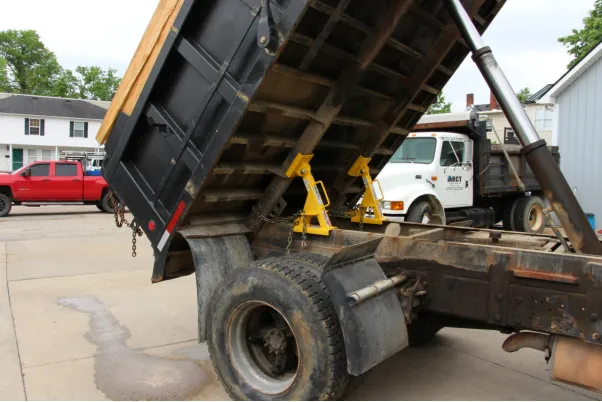
A raised dump body creates a serious maintenance hazard if it moves unexpectedly. OSHA requires dump bodies to have a positive means of support that is permanently attached and capable of being locked in position when workers are underneath the body for maintenance or inspection.
This is why makeshift solutions should not be treated as equivalent to purpose-designed support equipment. Improvised blocking or props may not provide the appropriate positioning, strength, or retention required for the application.
Repair teams should also follow the truck manufacturer’s maintenance procedures and use equipment according to its specifications.
The objective is to establish a controlled support arrangement before technicians begin work beneath the raised body.
Does the Largest BedLock Always Make the Best Choice?
Not necessarily.
Choosing a larger system simply because it appears more substantial can overlook important application factors. The support must correspond to the truck’s frame dimensions and the available installation space.
Similarly, choosing equipment based only on axle count or overall truck size can be misleading. Two trucks performing similar work may have different chassis layouts, frame widths, or mounted components.
The selection process should therefore be application-based rather than based on appearance or general vehicle category.
What Should Fleet Managers Consider for Mixed Fleets?
Mixed fleets create an additional challenge because maintenance teams may work on multiple truck configurations.
A fleet may include single-axle dump trucks, tandem-axle units, larger dump trailers, and vehicles with customized equipment. Keeping several support configurations available may be more practical than attempting to use one system across every application.
A simple equipment record can help maintenance teams document:
· Vehicle type and model
· Frame width
· Existing BedLock configuration
· Support location
· Clearance restrictions
· Mounted equipment
· Any special application requirements
This information can reduce guesswork when a truck enters the shop for scheduled maintenance or unexpected repairs.
How Should a Repair Shop Choose the Right BedLock System?
The most reliable approach is to start with measurements and application details.
BedLock Safety Products, LLC provides support systems for dump truck maintenance and repair applications, including configurations for different frame widths and specialized limited-access applications. The company can review vehicle and frame information to help identify an appropriate BedLock System.
Repair professionals can provide the frame dimensions, truck or trailer type, support location, and details about any components restricting access. This information allows the appropriate configuration to be evaluated before equipment is supplied.
It is also important to distinguish maintenance support from normal truck operation. BedLock Systems are intended for use in repair shops during dump body maintenance and repair, not for supporting dump bodies during cargo hauling or on-road operation.
For more details, get in touch with them today.
About the Author
The author specializes in occupational risk prevention and human factors engineering, writing for industrial, fleet, and heavy-duty equipment publications. Their work focuses on how equipment selection, maintenance procedures, workplace conditions, and human decision-making influence safety outcomes in demanding repair environments.

























Sign in to leave a comment.