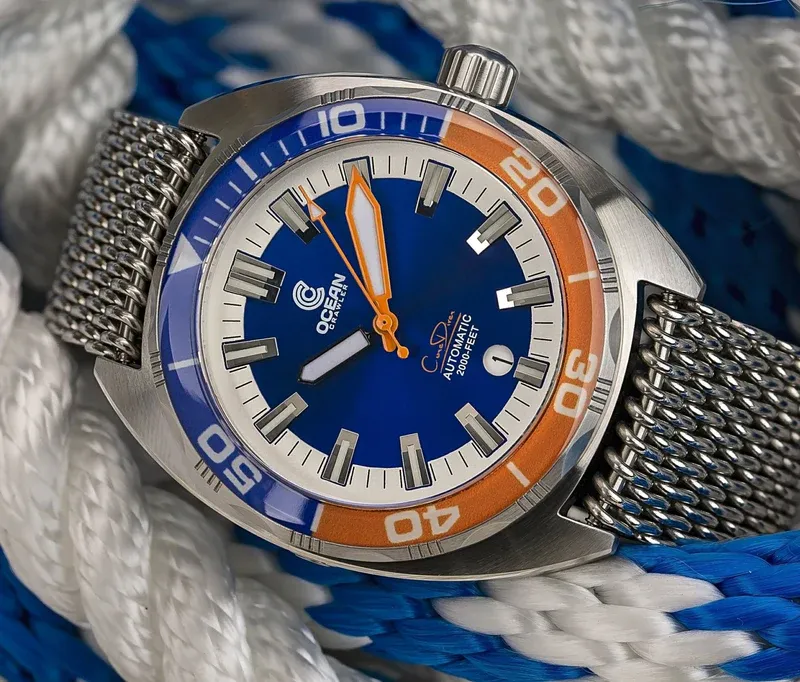

Have you ever worn a dive watch, seen the "200m" figure on the dial, and questioned whether it could withstand a real underwater dive? Marketing tends to focus on big numbers, but the durability of a watch depends on its construction rather than the printed numbers.
This article looks at what makes a real diving watch different from a stylish desk watch. It focuses on case design, sealing systems, crystals, and testing. There are reasons why the stainless steel dive watch is still the standard, how modern coatings have an impact on wear, and what you need to check before relying on any watch underwater.
The Foundation Starts With ISO 6425, Not Marketing
To be called a true diver, the watch has to fulfill the criteria of ISO 6425, which, among others, requires at least 100 meters of water resistance and passing all the tests in the laboratory. It is a mere number of depth on the dial. The standard requires a diver's watch to have a pre-selectable 60-minute device. This is usually a unidirectional bezel with 5-minute divisions. These divisions must be clearly visible at 25 cm, even in total darkness.
It also requires:
- Saltwater immersion for 24 hours in a 30 g/L solution, then functional checks
- Reliability under water for 50 hours, followed by a condensation test
- Magnetic resistance to 4,800 A/m and shock resistance equivalent to a 1-meter drop onto hardwood, about 5,000 g's
Each ISO diver must complete an overpressure test at 125% of its depth rating for two hours. They also need to undergo a thermal shock cycle from hot to cold water. This is the reason why a certified watch is designed with safe limits rather than relying on hope.
The Case and Crystal of a Stainless Steel Dive Watch
Steel is durable for several reasons. First, 316L resists corrosion well. Second, it machines easily for thick walls. Lastly, it performs well under compression. Typically, 13 to 16 mm thick metal is used with a lug-to-lug under 50 mm so as to keep gasket surfaces flat when a load is applied.
The crystal is actually more important than what a lot of buyers think. Sapphire, which is a 9 on the Mohs hardness scale, will resist scratches from gear much better than mineral glass; however, thickness is the main factor for depth.
Professional models often use domed sapphire crystals. These crystals are 3.0 to 3.5 mm thick and have an anti-reflective coating. This design helps them resist pressure deflection. A flat crystal may give the impression of being strong, but a well-designed dome is able to distribute the load more effectively.
Thickness, Lugs, and Compression Rings Matter
Look for:
- Screw-down case back with at least 6 to 8 threads
- Drilled lugs or solid end links that do not flex the spring bar seats
- A crystal retaining ring, not just adhesive
Independent lab tests show that watches rated for 1,000 meters have withstood pressures of 4,200 meters. This is because manufacturers often test their products 25% beyond the rating. Fluid leaks occur from the ring-lock structure, not by chance.
Coatings That Matter: The Black DLC Dive Watch Advantage
Hard coatings can't increase the depth rating of a watch, but they can help protect the sealing surfaces that do. Diamond-Like Carbon (DLC) adds a thin ceramic layer. This layer boosts surface hardness and saltwater resistance. It keeps the steel core tough, too.
A black DLC dive watch is a great choice if you are messing around with the boats, tanks, and tools because the scratches on the case walls can later become points of corrosion. For the Ocean Crawler's bolt DLC type, the collection focuses on the DLC coating. This not only covers the watch but also includes sapphire bezels and 600-meter cases. These elements help keep the seals fresh.
Internal Bezel Engineering in a Super Compressor Dive Watch
Tough divers do not always require an external bezel. Moreover, a super compressor dive watch features a unique dual-crown system that operates an internal rotating ring. When external pressure occurs, the spring-loaded case back compresses slightly. This creates tight seals without stressing them.
The watch design keeps the timing ring safe from impact, sand, and accidental rotation. It also reduces water entry around the bezel gasket. For glove-wearers in cold-water diving, the second crown allows accurate control without reducing the level of water resistance.
Helium Valves and Extreme Depth Engineering
When saturation diving deeper than 300 meters, helium atoms may eventually penetrate the seals during long habitat stays. The helium escape valve allows the helium gas to escape during decompression without damaging the crystal. Recreational diving at 40 meters doesn’t need that valve. However, if a watch has one, it shows extra overpressure pathways and a thicker crystal seat. These features are in watches tested beyond 2,000 feet.
What Makes a Black DLC Dive Watch Truly Tough
Depth toughness involves a system. It starts with ISO 6425 safety margins. Then, it adds thick sapphire crystals, multi-gasket screw-down crowns, and cases designed for compression. Finally, it undergoes a test at 125 percent overpressure. Coatings are used to maintain the integrity of seals, internal bezels provide protection to the timing features, and correct luminous materials are a vital aid when visibility is lost.
If you want a single timepiece that can take on real water activities, focus more on the build quality than the dial color. A strong super compressor dive watch or a steel diver from Ocean Crawler is built to last. It passes tough tests and handles impacts well. This watch won’t follow fleeting trends and will keep time accurately at deep depths where it matters.






























Sign in to leave a comment.