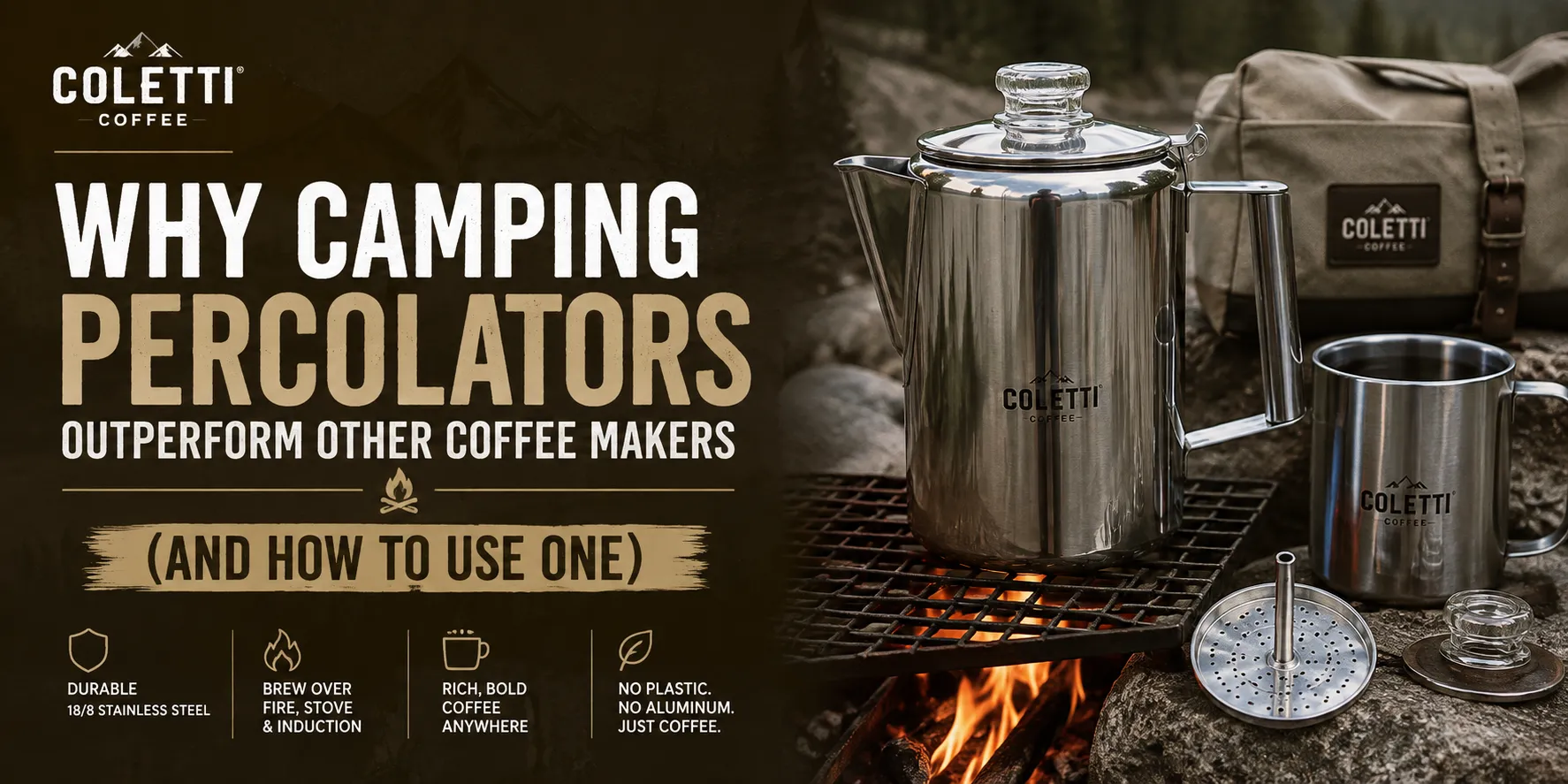

Quick answer: Camping percolators outperform other coffee makers because they need no paper filters, no electricity, and no fragile parts - just heat and grounds. Built from stainless steel instead of plastic or glass, they survive campfires, cooler drops, and years of trail abuse while brewing bold, full-bodied coffee for a crowd in about 10–15 minutes.
If you've ever burned a paper filter over a campfire, watched a plastic drip cone warp on a camp stove, or run out of battery for a "portable" electric maker three days into a trip, you already know most coffee makers aren't built for camping - they're built for kitchen counters.
A camping percolator is different. It's a closed metal pot with a stem and basket that cycles boiling water through coffee grounds again and again until it reaches the strength you want. No filters, no cords, no glass carafes to crack in a cooler - just water, grounds, and heat. That's exactly why generations of hunters, backpackers, and campers have chosen percolators over every other camping coffee maker on the market.
Below, we break down why percolators beat pour overs, French presses, and drip machines outdoors, and exactly how to use one so your coffee comes out bold, not bitter.
What Makes a Camping Percolator Different
A percolator recirculates boiling water through grounds via a metal stem and perforated basket, pulling flavor and oils out with each pass. A pour over coffee maker depends on one slow, controlled pour through a paper or metal filter - great on a kitchen counter, fussy in wind and cold. A French press needs a steady water source and a glass or plastic carafe most people won't trust to a truck bed. Drip machines need power you won't find at a campsite.
Percolators solve the real outdoor brewing problem: they work with whatever heat source you already have — campfire, propane stove, or an induction-ready base on an induction cooktop - and they don't depend on a single consumable part that can run out, tear, or blow away in the wind.
Why Camping Percolators Outperform Other Coffee Makers
1. They Survive Conditions Other Coffee Makers Can't
A quality camping percolator is stainless steel from top to bottom - no plastic housing to warp near a flame, no glass carafe to shatter in a pack. COLETTI percolators use 1mm-thick 18/8 (304) stainless steel with a rosewood handle and annealed glass top, built specifically to handle direct campfire heat, drops, and years of seasonal use, and backed by a 1-year warranty.
2. No Filters, No Power, No Failure Points
A pour over needs paper filters. A drip machine needs an outlet. A pod machine needs both. A percolator needs neither - just the pot, grounds, and a heat source. That's one less thing to forget, run out of, or troubleshoot 20 miles from the nearest outlet.
3. Bolder Coffee, Brewed at Scale
Because grounds steep through repeated boiling cycles instead of one quick pour, percolator coffee comes out stronger and heavier-bodied than most pour-over coffee — a real advantage on cold mornings. Percolators also scale for groups: a 9-cup percolator brews roughly 45oz, while a 24-cup model can serve a full campsite, something a single-serve pour over simply can't touch.
4. Works Over Any Heat Source
Percolators aren't picky. Campfire, propane burner, wood stove, or induction cooktop (with a compatible base) — a percolator adapts to whatever heat you have, while most other camping coffee makers are limited to one setup.
5. Simpler Mechanics, Fewer Ways to Fail
Fewer moving parts means fewer failure points. A percolator is a pot, a stem, and a basket — nothing to charge, calibrate, or replace mid-trip.
Percolator vs. Other Coffee Makers: Quick Comparison
| Feature | Camping Percolator | Pour Over | French Press | Electric Drip |
|---|---|---|---|---|
| Power needed | No | No | No | Yes |
| Filters required | No | Usually | No | Usually |
| Works over open flame | Yes | Limited | No | No |
| Best for | Groups, durability | Solo, control | Solo, home | Home/RV with power |
| Coffee strength | Bold, full-bodied | Light–medium | Medium–bold | Medium |
How to Use a Camping Percolator (Step-by-Step)
Learning how to use a percolator is simpler than most people expect:
- Fill with water to the base of the stem, using the fill line as your guide.
- Add coffee to the basket using a 1:1 ratio — one tablespoon of medium-coarse grounds per cup of water (9 tablespoons for a 9-cup percolator).
- Assemble the stem and basket, then set the pot over your heat source.
- Bring it to a boil. Once you see the first perks through the glass top, ease off the heat slightly.
- Let it percolate 4–7 minutes. Longer brews stronger, more bitter coffee; shorter brews milder.
- Remove from heat and let it settle for a minute so grounds sink before pouring.
That's the whole process — no paper filters to fumble with cold hands, no carafe to hold steady.
Camping Percolator FAQs
Is percolator coffee good?
Yes. Percolator coffee is bolder and more full-bodied than drip coffee because the grounds are extracted through repeated boiling cycles instead of a single pass. Dialing in grind size and perk time keeps it from turning bitter.
How long does it take to brew coffee in a camping percolator?
Most percolators take 10–15 minutes total: a few minutes to reach a boil, then 4–7 minutes of active percolating, depending on batch size and strength preference.
Can you use a camping percolator directly over a campfire?
Yes. Stainless steel percolators are built for direct flame. Wooden handles should stay clear of prolonged direct heat, or be wrapped in foil as a simple precaution.
Are stainless steel percolators better than aluminum ones?
Yes. Stainless steel resists rust, won't leach a metallic taste into your coffee, and holds up to campfire heat and dishwasher cleaning far longer than aluminum.
What's the easiest way to make coffee while camping?
Most experienced campers agree it's a percolator: no filters, no power, no calibration - just water, grounds, and heat.
Why do campers prefer percolators over a French press or drip machine?
Percolators don't depend on electricity or fragile glass, they brew for a group in one pot, and they can be set directly on a campfire grate - three things most other coffee makers can't do.
Brew Better Coffee on Your Next Trip
If you're comparing coffee makers for camping, it comes down to this: percolators are built for the outdoors, and everything else is adapted to it. COLETTI builds its percolators - including the flagship Bozeman - from 18/8 stainless steel with no aluminum or plastic, designed and warrantied for real trail use by a veteran-owned team that tests gear the way you'll actually use it.
Shop COLETTI Camping Percolators
Free shipping. 1-year warranty. Veteran owned.



















Sign in to leave a comment.