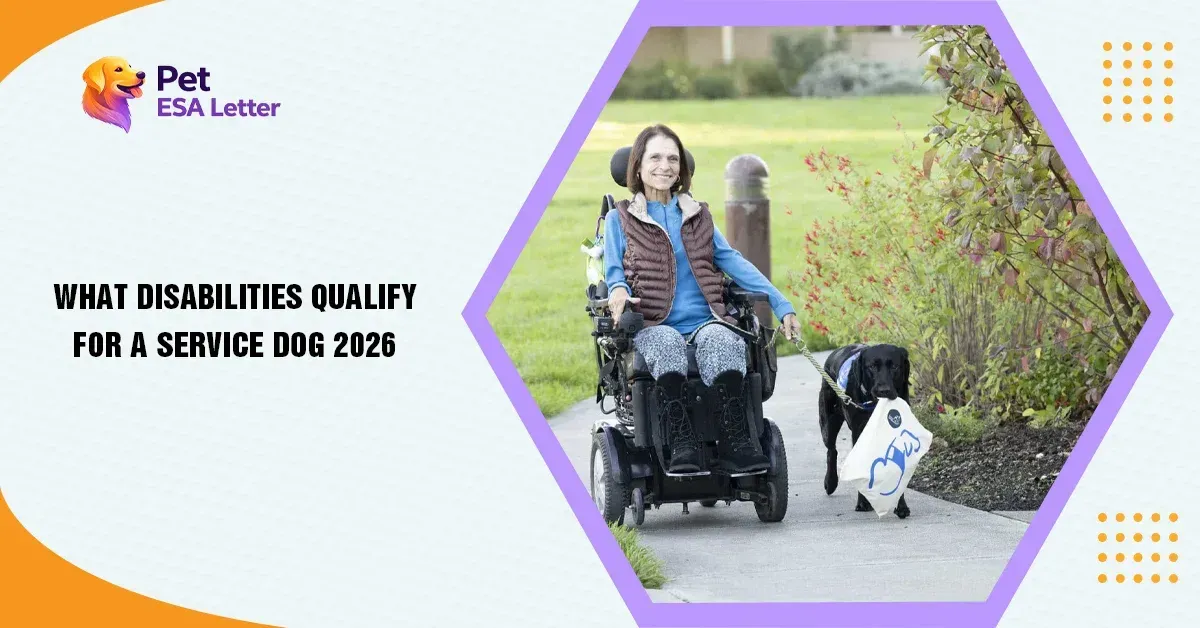

Service dogs play an essential role in helping individuals navigate daily physical, sensory, and psychological challenges. However, many people are unclear about the legal standards that determine eligibility. Under the Americans with Disabilities Act (ADA), qualification is based on functional impact rather than a rigid list of medical diagnoses.
If you are wondering what disabilities qualify for a service dog in 2026, this guide outlines the legal criteria, qualifying health conditions, and assistance animal rights.
The Legal Standard: What Counts as a Disability?
Under federal law, a person qualifies for a service dog if they have a physical or mental impairment that substantially limits one or more major life activities (such as walking, seeing, hearing, breathing, sleeping, working, or concentrating).
The key legal test is twofold:
- Functional Limitation: The medical condition significantly interferes with daily living.
- Individually Trained Tasks: The dog is trained to perform specific actions directly mitigating that condition.
4 Major Categories of Qualifying Disabilities
1. Psychiatric and Psychological Disabilities
Mental health conditions that substantially limit daily functioning qualify for task-trained assistance. A psychological service dog (or Psychiatric Service Dog) can perform Deep Pressure Therapy (DPT), interrupt self-harm or panic attacks, and alert to rising anxiety levels.
- Post-Traumatic Stress Disorder (PTSD)
- Severe Panic Disorder & Generalized Anxiety
- Major Depressive Disorder
- Bipolar Disorder & Schizophrenia
- Autism Spectrum Disorder (ASD)
2. Physical and Mobility Impairments
Service dogs help individuals with physical limitations maintain independence by pulling wheelchairs, retrieving items, or offering balance support.
- Multiple Sclerosis (MS) & ALS
- Paralysis & Spinal Cord Injuries
- Cerebral Palsy & Muscular Dystrophy
- Severe Chronic Pain & Arthritis
3. Sensory Disabilities
Sensory assistance dogs assist handlers with vision or hearing impairments.
- Guide Dogs: Assist blind or low-vision handlers with navigation and traffic safety.
- Hearing Dogs: Alert deaf or hard-of-hearing handlers to specific sounds (doorbells, smoke alarms, names being called).
4. Medical Alert & Chronic Health Conditions
Medical alert dogs detect physiological or chemical changes in the body before emergency episodes occur.
- Type 1 and severe Type 2 Diabetes (blood sugar alert)
- Epilepsy and Seizure Disorders
- Postural Orthostatic Tachycardia Syndrome (POTS)
- Cardiac Arrhythmias & Severe Allergies
Housing Rights and Assistance Animals
Under federal regulations, service animals and Emotional Support Animals (ESAs) receive housing protections under the Fair Housing Act for emotional support animals. Landlords must grant reasonable accommodations, exempting qualifying animals from pet fees, weight limits, and "no-pets" policies.
To request housing accommodations for an ESA or service dog, tenants must provide valid documentation from a licensed healthcare provider. Utilizing a reputable provider network like Pete's ESA Letter helps ensure your letter complies fully with state and federal guidelines.
Common Misconceptions to Avoid
Understanding legal requirements helps handlers avoid scams and invalid claims. One of the most prevalent issues is falling for ESA registration myths, such as believing that paying for an online registry entry, ID badge, or official certification vest grants legal service animal or ESA status. Federal law does not recognize any official registry—only task training (for service dogs) or a legitimate clinician's letter (for ESAs) establishes legal standing.
Frequently Asked Questions (FAQs)
Is there an official government list of qualifying service dog disabilities?
No. The ADA uses a functional standard rather than a diagnostic list. If a physical or mental health condition substantially limits a major life activity and a dog is trained to perform tasks to assist with that limitation, it qualifies.
Do I need to show medical records to bring a service dog into public places?
No. Under Title II and Title III of the ADA, businesses cannot demand medical records, diagnostic proof, or demonstration of trained tasks. Staff may only ask two questions if the disability is not obvious:
- Is the dog a service animal required because of a disability?
- What work or task has the dog been trained to perform?
Can an Emotional Support Animal (ESA) qualify as a service dog?
Not automatically. An ESA provides comfort through presence alone. To become a service dog, the animal must undergo specific task training to assist with a diagnosed disability.































Sign in to leave a comment.