
As more Indians travel abroad for higher education, employment, business expansion, or permanent residency, document authentication has become an essential part of international applications. One of the most common terms you'll encounter is Apostille. Although many people have heard the word, they are often unsure about its purpose and importance.
An apostille is an internationally accepted certificate that verifies the authenticity of a public document. It is issued under the Hague Convention of 1961 and allows documents issued in one member country to be legally recognized in another member country without requiring embassy legalization.
For Indian citizens, the Ministry of External Affairs (MEA) issues apostille certificates after the required state-level verification. Once apostilled, documents become valid in more than 120 Hague Convention countries, making the process faster and simpler than traditional legalization.
Why is Apostille Required?
Apostille certification is necessary whenever official Indian documents are used in Hague Convention member countries. Common purposes include:
- Studying at foreign universities
- International employment
- Work permits and visas
- Permanent residency applications
- Business registration overseas
- Marriage registration abroad
- Property and legal documentation
Without proper authentication, foreign authorities may reject your documents during the verification process.
Documents That Can Be Apostilled
Different categories of documents require apostille services:
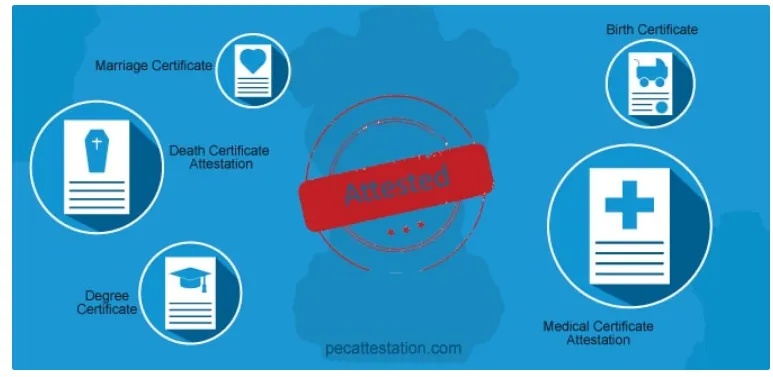
Educational Documents
- Degree Certificates
- Diploma Certificates
- Mark Sheets
- School Leaving Certificates
- Transcripts
Personal Documents
- Birth Certificate
- Marriage Certificate
- Divorce Certificate
- Police Clearance Certificate (PCC)
- Death Certificate
- Affidavits
Commercial Documents
- Certificate of Incorporation
- Power of Attorney
- Export Documents
- Commercial Invoices
- Business Agreements
Apostille vs. Attestation
Many applicants confuse apostille with document attestation. The difference is straightforward:
- Apostille is accepted by countries that are members of the Hague Convention.
- Attestation with Embassy Legalization is required for countries that are not Hague Convention members, such as the UAE, Qatar, Kuwait, and several others.
Choosing the correct authentication method saves both time and money.
Apostille Process in India
The document authentication process generally includes:
- Initial verification or notarization (where applicable)
- State-level authentication (HRD, Home Department, SDM, or Chamber of Commerce depending on document type)
- Apostille by the Ministry of External Affairs (MEA)
- Final delivery of authenticated documents
The exact procedure varies according to the type of document and the destination country.
Benefits of Apostille Certification
An apostille certificate offers several advantages:
- International legal acceptance
- Faster visa processing
- Simplified document verification
- Eliminates embassy legalization for Hague countries
- Builds trust with foreign authorities
- Saves processing time and costs
Common Mistakes to Avoid
Applicants often face delays because of simple errors such as:
- Using damaged or laminated documents
- Name mismatches across certificates
- Missing state-level verification
- Submitting photocopies instead of originals
- Choosing the wrong authentication process
Preparing documents carefully can help avoid unnecessary delays.
Get Professional Apostille Assistance
Although the apostille process is standardized, every document follows different verification requirements. Professional guidance can simplify documentation, reduce processing errors, and help applicants receive their authenticated documents within the expected timeframe.
If you're planning to study, work, migrate, or conduct business overseas, understanding the apostille process is the first step toward successful document legalization.
Learn more about the complete apostille procedure, document requirements, processing time, and fees by visiting:
Proper document authentication today can prevent unnecessary complications during your international journey tomorrow. Read More…
























Sign in to leave a comment.