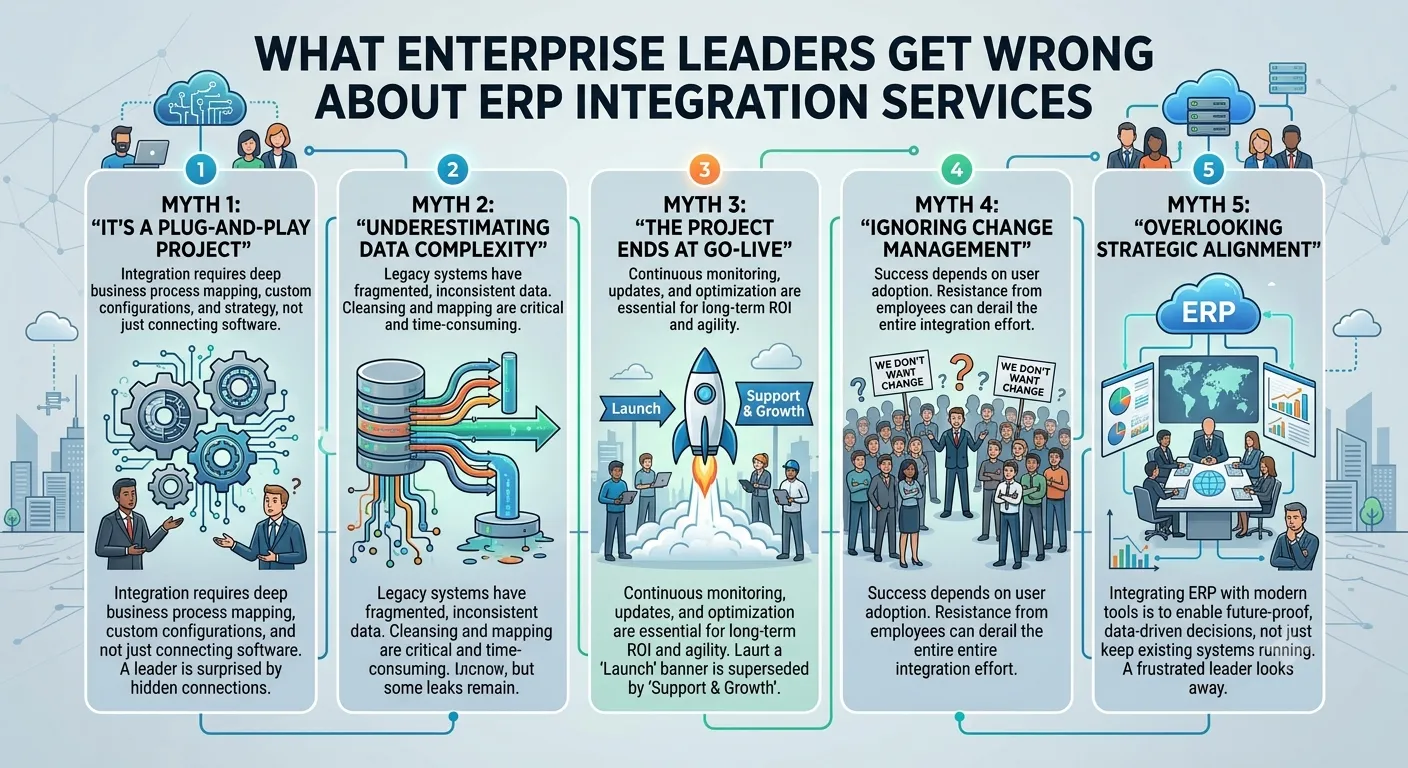

Every executive I speak with has a similar ambition. They want their organization to move faster, make better decisions, and reduce operational friction. Yet many discover that adding another application or upgrading an ERP platform does not solve the real problem. The challenge lies in how business systems communicate. ERP Integration Services have become a strategic priority because disconnected applications continue to create reporting delays, duplicate data, and inconsistent decision-making across finance, operations, procurement, and customer-facing teams.
Organizations investing in digital transformation often realize that technology alone cannot fix fragmented business processes. Success depends on aligning enterprise systems with business objectives, governance, and operational workflows. As organizations evaluate modernization initiatives, many begin with specialized ERP integration solutions to establish a reliable foundation for enterprise-wide collaboration.
According to McKinsey, companies that successfully execute digital transformation initiatives are significantly more likely to achieve sustained improvements in operational performance and customer satisfaction. The message is clear. Integration has shifted from an IT responsibility to a business strategy.
Why This Challenge Exists
The average enterprise now depends on dozens of business applications. Finance teams use accounting platforms. Sales departments rely on CRM systems. Manufacturing, HR, procurement, logistics, and analytics often operate on separate technologies purchased over many years.
This fragmented technology landscape creates hidden operational costs. Employees spend valuable time reconciling reports instead of analyzing business performance. Executives question data accuracy because every department produces different numbers. Automation initiatives fail because underlying information is inconsistent.
Gartner has consistently emphasized that poor data quality and fragmented enterprise architecture remain major barriers to digital business success. Even organizations adopting AI struggle to produce reliable insights when enterprise data remains isolated across multiple systems.
The problem is rarely the ERP platform itself. It is the absence of an integration strategy that connects people, processes, governance, and information into a unified operating model.
A Better Approach to ERP Integration Services
Understanding the Business Context
Effective ERP Integration Services begin long before selecting APIs or middleware. Every organization has unique operational priorities, regulatory obligations, approval structures, and reporting requirements.
An integration roadmap should answer business questions before technical ones.
- Which decisions require real-time visibility?
- Where do manual approvals create delays?
- Which departments maintain duplicate customer or inventory records?
- Which processes directly influence profitability?
Technology decisions become significantly easier when integration priorities are driven by measurable business outcomes rather than software capabilities.
Organizations that spend time understanding operational dependencies typically avoid expensive redesign efforts later in the implementation journey.
Building a Sustainable Strategy
Enterprise integration should be treated as an evolving business capability rather than a one-time implementation project.
That means establishing governance for data ownership, integration standards, security policies, and lifecycle management from the beginning. Enterprise architecture also deserves executive attention. Point-to-point integrations may solve today's requirements but often create unnecessary complexity as the business expands.
AI adoption introduces another dimension. Predictive planning, intelligent automation, and conversational business assistants depend on trusted enterprise data. Without standardized integration practices, AI initiatives inherit inconsistent information, limiting their business value.
This is why organizations increasingly partner with Oodles Technologies to evaluate integration architecture alongside ERP modernization, ensuring current investments remain valuable as future business requirements evolve.
Measuring Business Outcomes
Technology projects often celebrate successful deployments while executives evaluate completely different outcomes.
Business leaders care about shorter financial closing cycles, improved forecasting accuracy, lower operational costs, faster order fulfillment, stronger compliance, and better customer experiences.
Successful ERP Integration Services should therefore include measurable business indicators from the planning stage.
Common executive KPIs include:
- Reduction in manual data entry
- Faster month-end financial reporting
- Improved inventory accuracy
- Higher order processing speed
- Lower integration maintenance costs
- Increased planning accuracy
- Reduced operational risk
These metrics provide a clearer picture of business value than technical measures such as API response times or system uptime alone.
Lessons from Enterprise Consulting
During one enterprise transformation engagement, our consulting team worked with a manufacturing organization experiencing persistent operational delays across procurement, finance, and warehouse operations. Different departments relied on disconnected applications, resulting in duplicate inventory records, delayed purchase approvals, and inconsistent financial reporting.
Instead of beginning with software integration, the engagement started with business process discovery. Stakeholders from every department mapped operational dependencies, identified data ownership, and established governance policies before technical implementation began.
The integration strategy connected ERP, CRM, procurement, warehouse management, and financial systems using standardized data models and event-driven workflows. Priority was given to critical operational processes rather than integrating every application simultaneously.
Within six months, manual workflows decreased by 55%, financial reporting became 40% faster, inventory discrepancies declined by 32%, and executive planning meetings shifted from debating data accuracy to discussing business strategy.
Perhaps the most valuable outcome appeared months after project completion. The organization introduced AI-assisted demand forecasting without requiring significant architectural changes because enterprise data had already been standardized across business functions.
The engagement reinforced an important lesson. Integration delivers lasting value when organizations focus on business operating models before technology implementation.
Looking Beyond System Connectivity
Many organizations still evaluate integration as a technical necessity rather than a strategic investment. That perspective overlooks its broader influence on governance, operational resilience, AI readiness, and enterprise decision-making.
Well-planned ERP Integration Services create a consistent flow of trusted information across the organization, enabling leaders to respond confidently to market changes, customer expectations, and future growth opportunities.
As enterprise ecosystems continue expanding, organizations that prioritize integration as a long-term business capability will be better positioned to modernize operations, adopt emerging technologies, and make faster, evidence-based decisions. Businesses planning their next phase of modernization should evaluate ERP Integration Services as a strategic foundation rather than simply another technology initiative.
Frequently Asked Questions
1. Why are ERP integrations becoming more important for enterprise organizations?
Modern enterprises operate multiple business applications across finance, HR, CRM, procurement, and operations. Integrating these systems improves data consistency, accelerates decision-making, reduces manual work, and supports future digital transformation initiatives.
2. How do ERP Integration Services support AI adoption?
ERP Integration Services establish reliable and standardized enterprise data, allowing AI models to produce more accurate insights, automate workflows, improve forecasting, and support executive decision-making without relying on fragmented information.
3. What should executives evaluate before starting an ERP integration initiative?
Leadership teams should assess business objectives, current process bottlenecks, data quality, governance policies, security requirements, and long-term scalability before selecting integration technologies or implementation partners.
4. What KPIs indicate a successful ERP integration project?
Organizations commonly measure success through faster financial reporting, improved inventory accuracy, reduced manual processing, better forecasting, increased operational efficiency, lower maintenance costs, and stronger compliance across business functions.
5. How can organizations reduce risks during ERP modernization?
A phased implementation strategy, clear governance, standardized data models, stakeholder participation, and continuous performance measurement help organizations minimize disruption while creating a technology foundation that supports long-term business growth.


























Sign in to leave a comment.