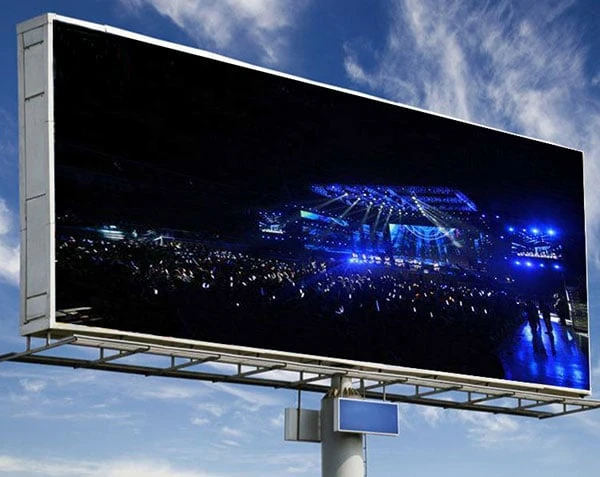

This type of screen operates based on the LED, as the name implies. These coloured lights will function as pixels or sub-pixels. When these luminous points are added together, an image is formed. A giant LED screen is thus a collection of LEDs organised into modules linked together to create an SMD screen. The light emitted by the LEDs is then controlled by these elements, which diffuse the desired content.
Unlike other types of displays, LED screens use direct emission (unlike backlit solutions such as LCD or OLED). As a result, they are more visible in direct sunlight and have a high contrast and saturation level. Furthermore, they are more durable screens, with some lasting up to twenty years. This is why they are commonly used outside. Finally, one of the most significant advantages of LED screens is that they are not limited in size or shape. They are completely modular.
How big can a massive LED screen get?
With giant LED screen technology, there is no size limit. There are, in fact, regular.
Several hundred square metre installations in Asia and the United States.
The screen size will thus be determined by other constraints such as location, budget, administration, etc.
SMD screens, unlike micro-LEDs, are primarily intended for large installations and visibility from a distance. Indeed, more minor format supports imply closer visibility, and thus a finer resolution, and thus much higher prices.
What is an LED screen's PITCH? What exactly is a PIXEL?
The pitch represents the distance between each LED. It is also known as physical pitch or absolute pitch. It is usually measured in millimetres. A P followed by a number represents this information. It is quickly discovered in the technical specifications of a digital LED screen. This information is critical because it is directly related to visibility distance.
In contrast, a pixel is each point of light that makes up an image on a screen. In general, an LED represents a pixel on a giant LED screen.
How far can a massive LED screen be seen? PITCH and visibility distance relationship
An LED screen can be seen from a long distance. Two factors will determine this. First and foremost, consider the screen size. Indeed, the larger the screen, the more visible it must be from a distance, and vice versa. For example, standing 2 m from an 8 m2 screen ultimately makes it difficult to see it. On the other hand, viewing a 75-inch television from 50 metres away is difficult.
As mentioned in the previous question, the pitch will be another critical factor. The rise will determine the screen's resolution. The closer we are to the screen, the more detail we will see; thus, a higher resolution will be required. The image will be blurry, and the distance between the LEDs will be visible to the naked eye if the pitch is too large. Furthermore, there is a relationship between pitch size and visibility distance. This is because pitch size in millimetres equals sight distance in metres.
For example, a screen with a pitch of 6mm (P6) will require a viewing distance of 6m to be seen clearly.
0











Sign in to leave a comment.