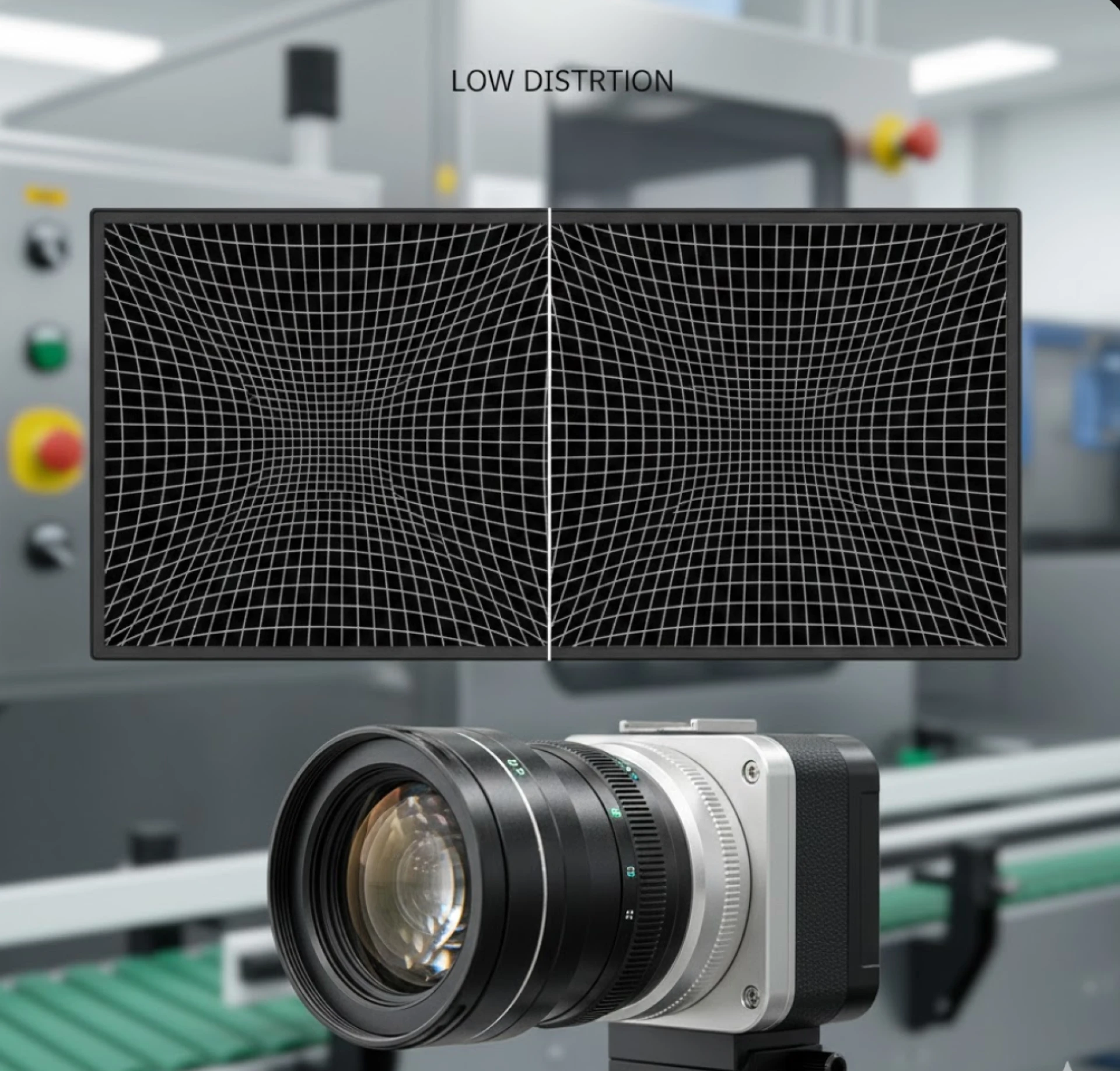

Precision imaging plays a vital role in industries such as machine vision, factory automation, automotive systems, robotics, and surveillance. In these fields, image accuracy is not optional. Even small visual errors can lead to incorrect measurements, system failures, or flawed data analysis. One optical component that directly impacts imaging accuracy is the Low Distortion Lens.
Understanding what distortion means, how it affects image quality, and why distortion control is essential helps engineers and system designers build reliable vision systems.
Understanding Optical Distortion in Imaging Systems
Optical distortion occurs when straight lines in a real-world scene appear curved or warped in an image. This effect is usually caused by lens design limitations. There are two common types of distortion known as barrel distortion and pincushion distortion.
Barrel distortion makes straight lines appear to bulge outward from the center. Pincushion distortion pulls lines inward toward the center. In consumer photography, minor distortion may be acceptable. However, in industrial imaging and measurement systems, distortion can reduce accuracy and compromise results.
When vision systems are used for dimensional inspection, object positioning, or robotic guidance, geometric accuracy is critical. If the lens alters the true shape or size of objects, the entire analysis process becomes unreliable.
What Defines a Low Distortion Lens?
A Low Distortion Lens is specifically engineered to minimize geometric image errors. Advanced optical design techniques reduce the curvature effect across the frame. The goal is to maintain straight lines and accurate proportions from the center to the edges of the image.
These lenses use carefully designed glass elements and precise alignment to correct optical aberrations. In high-performance industrial lenses, distortion levels are often kept below one percent, and sometimes much lower depending on application requirements.
The result is a more faithful representation of the real-world scene. This accuracy is essential for systems that rely on digital image processing and computer vision algorithms.
Why Precision Imaging Demands Minimal Distortion
Precision imaging systems are widely used in factory automation, quality control, and machine vision. Cameras inspect products on assembly lines to detect defects, measure dimensions, and verify assembly accuracy. Even slight image warping can lead to incorrect measurements.
For example, when inspecting printed circuit boards, the camera must detect small variations in component placement. A distorted image may cause measurement errors that lead to rejected products or missed defects.
Robotic guidance systems also depend on accurate spatial information. Robots use visual input to determine object location and orientation. If the optical system introduces distortion, robotic movements may become inaccurate, reducing efficiency and safety.
In intelligent transportation systems, accurate imaging is critical for license plate recognition and traffic monitoring. Clear and distortion-free images improve identification reliability and data processing accuracy.
Role in Machine Vision and Industrial Automation
Machine vision systems combine cameras, lighting, and software to automate inspection tasks. The optical lens serves as the first step in this process. It determines how accurately the scene is projected onto the image sensor.
A Low Distortion Lens ensures that measurement tools within the software can analyze objects without complex correction algorithms. While digital correction is possible, it may reduce image resolution and processing efficiency. Optical correction at the lens level provides cleaner and more reliable results.
In industrial automation, production lines operate continuously. Reliable optical performance reduces recalibration needs and system downtime. Stable geometric accuracy improves long-term consistency.
Importance in Automotive and ADAS Systems
Automotive vision systems rely heavily on precise imaging. Advanced Driver Assistance Systems use cameras to detect lanes, pedestrians, vehicles, and road signs. Geometric distortion can affect object recognition and distance estimation.
Accurate lane detection, for example, requires straight road markings to appear straight in the captured image. Distorted imagery may confuse onboard processing algorithms, leading to incorrect decisions.
Dashcams and surround view systems also benefit from reduced distortion. Although wide-angle optics are often used in these applications, distortion control remains important for realistic representation of the driving environment.
By minimizing image warping, automotive camera systems can deliver more dependable visual data for safety applications.
Impact on Surveillance and Security Systems
Surveillance systems often monitor large areas such as parking lots, commercial buildings, and public spaces. Wide-angle lenses are common in these installations. However, wide fields of view can increase distortion if not properly corrected.
A Low Distortion Lens improves clarity and maintains natural proportions. This enhances facial recognition accuracy and object identification. In security applications, reliable visual evidence is essential.
Video analytics software also performs better with distortion-free images. Motion detection, people counting, and behavior analysis depend on accurate spatial representation.
Technical Features That Reduce Distortion
Several design factors contribute to distortion control. Precision-ground glass elements help guide light accurately onto the image sensor. Multi-element lens construction balances optical paths and reduces aberrations.
Advanced coating technology improves light transmission and reduces internal reflections. This enhances contrast and sharpness, supporting detailed image capture.
Matching the lens to the correct sensor size is also important. Proper coverage prevents edge darkening and maintains uniform image quality. In high-resolution imaging systems, distortion control becomes even more critical because pixel-level accuracy matters.
Working with an experienced optical lens manufacturer allows system designers to select lenses optimized for specific imaging requirements.
Choosing the Right Lens for Precision Applications
Selecting a lens for precision imaging involves careful evaluation of distortion specifications, focal length, sensor compatibility, and environmental conditions. Applications that involve measurement or calibration demand very low distortion levels.
Field of view requirements must balance coverage and geometric accuracy. Wider lenses may require advanced correction design to maintain low distortion performance.
Resolution compatibility should match the camera sensor. High megapixel sensors require optics capable of maintaining clarity across the entire frame.
Environmental durability is another factor in industrial settings. Temperature variations and vibration can affect performance. Stable mechanical construction ensures consistent optical alignment.
Conclusion
Precision imaging systems require accurate, reliable, and distortion-free visual data. Optical distortion can compromise measurements, reduce system accuracy, and interfere with automated analysis. A Low Distortion Lens plays a critical role in maintaining geometric integrity across the image frame.
From machine vision and factory automation to automotive safety and surveillance monitoring, distortion control supports dependable performance. By minimizing image warping and preserving true object proportions, these specialized lenses enhance the reliability of modern vision systems.
As industries continue to adopt intelligent imaging solutions, high-quality optical design will remain essential for achieving precise and consistent results.
About Us
TOWIN is a professional optical lens supplier founded in 2012 in Xiamen, China, offering a complete range of M12, CS-mount, C-mount, and customized lens solutions for security, automotive, machine vision, and industrial applications. Guided by our PAEF philosophy — Professional, All-inclusive, Easy, Fast - we help customers worldwide quickly match the right lens to their needs.
Website - https://www.towinlens.com/





























Sign in to leave a comment.