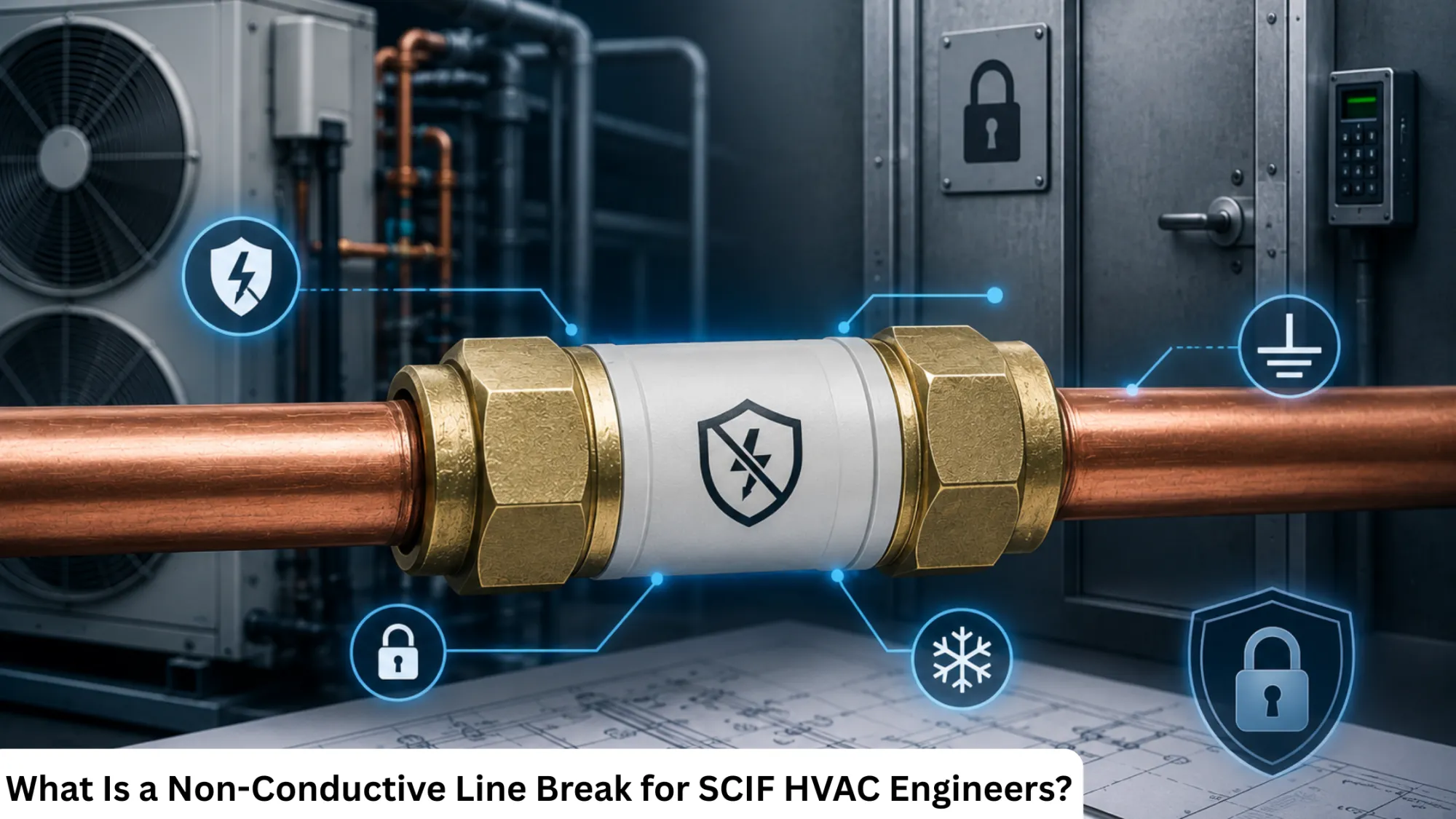

Designing mechanical systems for high-security environments requires a major shift in priority. For standard mechanical, electrical, and plumbing (MEP) projects, success is judged by efficiency, thermal comfort, and life-cycle costs. However, when working in a Sensitive Compartmented Information Facility (SCIF), new challenges arise. In this environment, every piece of metal leaving or entering the space represents a potential vulnerability.
Copper piping provides an unintended conductive path for electrical currents. To prevent these piping networks from serving as conduits for compromised data or as entry points for electrical surges, engineers rely on specialized hardware.
While metallic air ducts may require electrically isolating duct connectors or other approved isolation methods, depending on the facility design, the non-conductive refrigerant line break serves as the vital component for isolating high-pressure fluid piping loops. It closes the gap between how mechanical fittings function and how our national security demands they function.
What Is a Non-Conductive Line Break?
A security-grade, non-conductive line break is an advanced, high-pressure mechanical fitting designed to interrupt electrical continuity in metallic piping systems while maintaining pressure integrity. Conventional dielectric unions are generally designed for galvanic corrosion protection rather than validated isolation in secure facilities. A security-grade non-conductive line break helps interrupt conductive electrical paths and reduce the effects of stray currents in secure piping systems.
These systems are composed of a dielectric polymer, advanced high-performance ceramic, or composite materials sealed between metallic plumbing (copper, stainless steel, etc.). This design ensures the creation of an electrically insulating barrier between metallic sections while maintaining a sealed fluid pathway.
How Does a Non-Conductive Line Break Work?
The fundamental engineering challenge of a non-conductive break is balancing two opposing physical properties: complete electrical insulation and high-pressure containment.
The component works by forcing the refrigerant or chilled water to pass through an isolated zone. Because the internal dielectric sleeve has high dielectric strength, it interrupts electrical continuity across the metallic piping while maintaining a sealed fluid path.
These line breaks are also required to function in the harsh conditions of modern-day HVAC systems. An example of this is HVAC systems that use R-410A or modern low Global Warming Potential (GWP) refrigerants, which can operate at greater than 400 PSI and undergo large thermal cycling.
High-quality line breaks can bond the polymer or ceramic core to the metal ends without the need for fasteners. Over the years, they have been engineered to maintain long-term pressure integrity when properly installed.
Why Electrical Isolation Matters in Secure HVAC Systems
In a SCIF or Special Access Program Facility (SAPF), physical security is only half the battle. Technical security, specifically the mitigation of compromising emanations, known under the military umbrella term TEMPEST, is equally critical.
Unprotected metallic piping paths introduce three major risks to a facility:
1. Technical Security Considerations: Servers, workstations, and cryptographic equipment can generate unintended electromagnetic emanations during operation. Where metallic refrigerant piping crosses the secure perimeter, electrical isolation may help reduce conductive pathways that are considered during the facility's overall technical security design.
2. Ground Loop Prevention: A controlled ground plane is necessary to protect sensitive equipment in secure facilities. A field-installed condensing unit that directly connects to an evaporator using a continuous metal tube can unintentionally introduce electrical noise and ground loops to the facility.
3. Lightning and Surge Protection: Thunderstorms are dangerous to outdoor chillers as they are prone to lightning strikes and power surges. To combat this threat, a non-conductive break gives electrical isolation that reduces the possibility of surges through a conductive line.
Where Are Non-Conductive Line Breaks Used?
Certain facilities handling classified information, national security assets, or other mission-critical operations may require electrical isolation at perimeter piping penetrations.
1. SCIFs
SCIFs are designed and accredited per ICD 705 and the accompanying technical security guidance. For metal HVAC piping that crosses the secure perimeter, the Certified TEMPEST Technical Authority (CTTA) may call for electrically isolating measures to reduce conductive paths of emanations. A non-conductive line break may be considered in an approved method of mitigation per the security design and accreditation needs of the facility.
2. Government Facilities
These breaks may be used to secure automated building systems from sophisticated electronic eavesdropping by embassies, federal law enforcement operation centers, and intelligence facilities.
3. Defense and Aerospace Facilities
Radar and communication test facilities use isolation breaks for their protection of tactical communication loops from external electromagnetic interference.
4. Data Centers
Within some government, defense, or high-security data centers, isolation line breaks may be employed where isolation needs call for them.
5. Other Mission-Critical Infrastructure
Nuclear control rooms and advanced research labs use isolation line breaks for the same reasons.
Benefits of Non-Conductive Line Breaks
Using these unique systems in your mechanical design offers some distinct benefits:
1. Regulatory Compliance: Non-conductive line breaks may meet specific project ICD 705 and UFC 4-010-05 security requirements. However, use is case-specific.
2. Galvanic Corrosion Prevention: These line breaks also prevent direct contact of metals, which in turn prevents galvanic corrosion. It is beneficial for long-term use of the connection.
3. Maintained Flow Efficiency: An isolation line break with a smooth internal bore helps maintain the velocity of cooling fluids in HVAC systems and data centers.
Key Factors to Consider When Specifying a Non-Conductive Line Break
Using basic industrial components can lead to failures of pressure and security perimeters. Use the following when specifying a unit:
1. Pressure & Temperature
- Must match or exceed the system's design pressure (up to 600 PSI, depending on the application).
- Must safely withstand the system's full operating thermal limits.
2. Refrigerant Compatibility
- Internal composite materials must resist chemical breakdown from specific refrigerants.
- Seals must be fully compatible with synthetic polyolester (POE) oils to prevent leaks.
3. Dielectric Strength
- Requires a verified minimum voltage breakdown threshold.
- Ensures the component provides reliable electrical isolation across the piping connection.
To meet the above criteria, parts must be purchased only from a vetted, approved non-conductive refrigerant line break manufacturer. Manufacturers of good repute will provide the required pressure-testing certifications and, where available, applicable electrical isolation or validation documentation.
Balancing Efficiency and SCIF Security
Securing the physical perimeter of a facility is no longer enough; engineers must also secure the mechanical pathways. Copper piping can create unintended conductive pathways that should be considered during the design of secure mechanical systems. Implementing a robust non conductive line break HVAC solution allows design teams to deliver high-performance cooling while maintaining an airtight electronic perimeter.
The earliest possible engagement with your mechanical team and the security professionals will help you maintain compliance and safeguard classified data and sensitive equipment.
Frequently Asked Questions
Question 1. What is the difference between a standard dielectric union and an SCIF-grade non-conductive line break?
Answer. Standard unions only prevent galvanic corrosion between dissimilar metals at low voltages. On the other hand, a SCIF-grade non-conductive line break is a high-pressure union that can provide electrical isolation that helps interrupt conductive paths for stray electrical currents while maintaining pressure integrity.
Question 2. Does ICD 705 explicitly require line breaks on all HVAC piping?
Answer. No. ICD 705 does not specifically require non-conductive line breaks on every HVAC pipe. The need for them depends on the facility's security design and the guidance of the Certified TEMPEST Technical Authority (CTTA), who determines the appropriate mitigation measures for the project.
Question 3. How do you test a non-conductive line break after installation?
Answer. After installation, the line break is typically verified through pressure and leak testing, as well as electrical insulation testing with a megohmmeter (megger). The project engineer or manufacturer may also require additional acceptance procedures, such as CTTA, to confirm that the component meets both mechanical and electrical isolation requirements.
























Sign in to leave a comment.